InjectEave: Eavesdropping on Headphones by Injecting a Carrier and Listening to the Modulated Retransmission
Researchers from the Hong Kong University of Science and Technology (Guangzhou) and the Hong Kong Polytechnic University recently published a paper titled "Injected and Leaked: Actively Inducing Side-Channel Leakage Using Electromagnetic Injection and Hardware Nonlinearity".
The paper describes how an attacker can use a directional antenna to transmit a carrier signal toward an electronic device, where nonlinearities in its components modulate the signal, which connected cables then re-radiate as unintentional antennas. The attacker can then receive the modulated carrier at the same frequency as it is transmitted and demodulate the modulated sidebands.
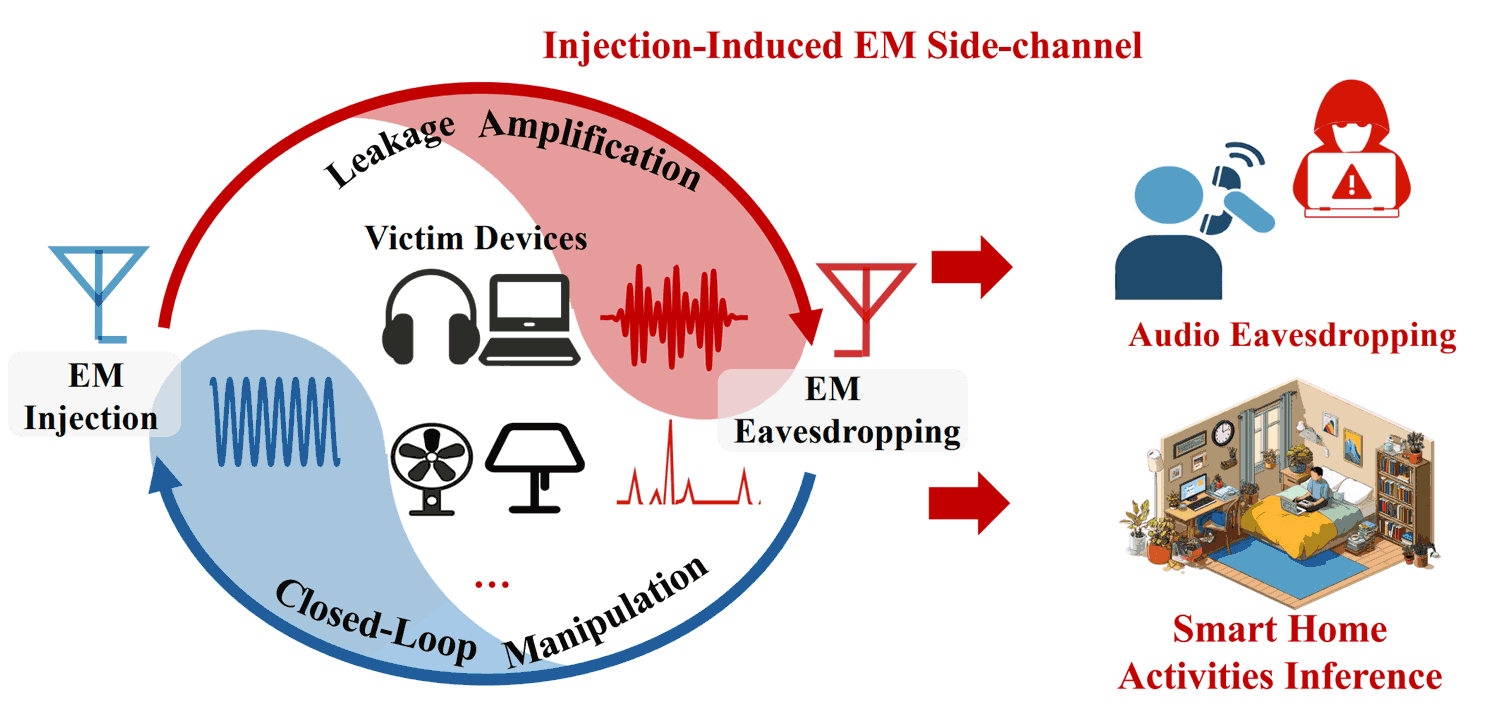
In their experiments, they used a USRP B210 software-defined radio to transmit the CW injection signal at anywhere from 0 to 8 MHz (the exact frequency for a device is not specified in the paper for ethical considerations), and a spectrum analyzer to receive the injection-induced EM leakage. The spectrum analyzer demodulates the received mixed signal, then routes the baseband to a PC for further processing. They show how various wired and wireless headphones exhibited injection-induced leakage via the amplifier, and how landline desk phones, smart fans, and lamps were also susceptible.
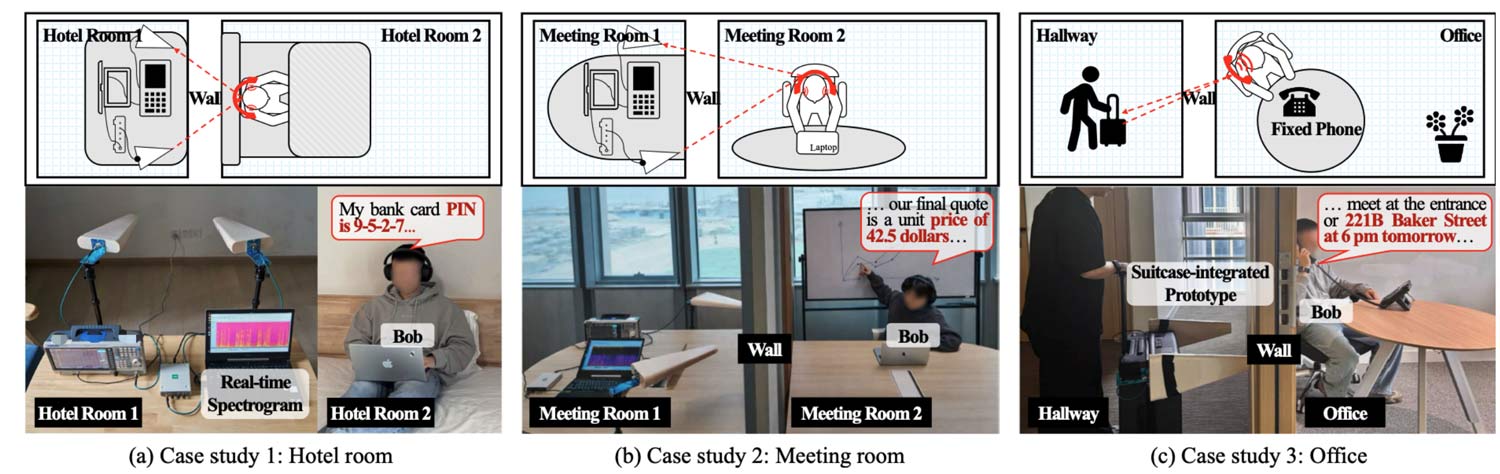
They also show a real-world application where they eavesdropped on audio from headphones and desk phones through walls in a hotel, meeting room, and office.