Tagged: DMR

RTL-SDR Tutorial: Following Trunked Radio with Unitrunker

The popular trunking decoding software Unitrunker now supports the RTL2832U R820T RTL-SDR directly in its new version. This means that extra SDR receiver software like SDR# is no longer required to use Unitrunker.

You can download the latest version of Unitrunker here. (NOTE: Unitrunker has recently been updated to V2.1 and so the tutorial below may look a little different now)

In a normal radio system, one company (or talkgroup) might use a single frequency for radio communications. However, this is very inefficient as the frequency may not be in use for the majority of the time. In a trunked radio system, a small set number of frequencies are shared between a large number of talkgroups. Each radio receives a special computer controlled control channel. The control channel determines a vacant frequency that a particular talkgroup should use. This helps to make radio frequency allocations more efficient.

Because a talkgroup might switch between various frequencies often, it can make listening to a conversation difficult for radio scanners. Unitrunker can be used to decode the control channel and follow a voice conversation as it hops across various frequencies. With two RTL-SDR dongles you can set up a trunking receiver station with just Unitrunker. What follows below is a tutorial on how to set this up.

Continue reading

Improved Digital Voice P25 Decoding with DSD+

Update: This post is now very old. The latest version of DSD+ can now to found at www.dsdplus.com.

Over on Reddit we've seen mention of an upgraded Digital Speech Decoder (DSD) program, named DSD+. The original DSD is a program that can be used in conjuction with a SDR receiving program such as SDR#, and an audio piping program like VBCable to decode digital speech, such as P25 and DMR/MOTOTRBO.

DSD+ claims to have improved decoding and audio quality capabilities. An audio sample from a weak P25 sample can be found here for DSD+, and for comparison here for the old DSD.

DSD+ can be downloaded from this megaupload link.

To run DSD+. you will need to place an MP3 encoder file lame_enc.dll into the same folder as the dsd.exe executable. This file is not included with DSD+ due to licencing. For Windows, lame_enc.dll can be downloaded from http://lame1.buanzo.com.ar/#lamewindl (Mega Mirror). Download the ZIP option, and then copy the dll file into the same folder as DSD+.

If you don't know how to use DSD, see our tutorial on using DSD here, and if desired simply use DSD+ instead of the original DSD. (Note cygwin is not required for DSD+)

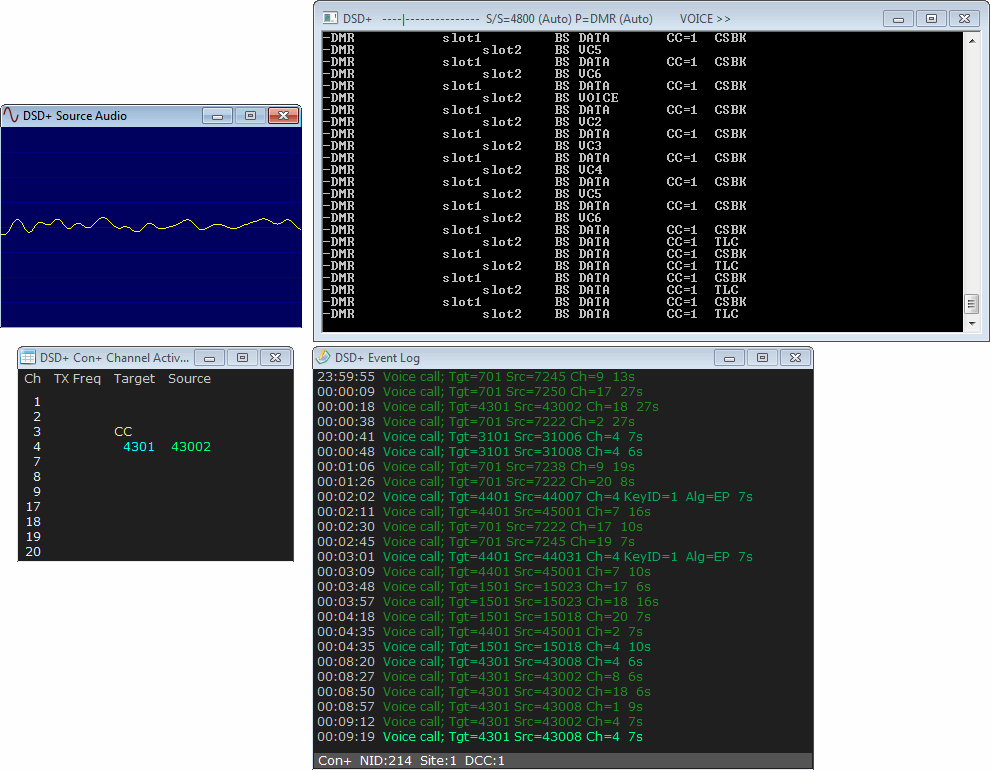
DSD+ Output
DSD+ Output

New DSD Block Available for GNU Radio

The popular digital speech decoder (DSD) software has now been wrapped into a GNU Radio Companion block. Previously, DSD required use of virtual audio cables to get decoding to work with GNU Radio, but now the signal audio can be passed directly into this block.

Luke Berndt from the HackRF-dev forums has posted his work to make the functionality of DSD available to GNU Radio users in the form of a GRC block. “I have been playing around a bit and found an easy way to receive and playback digital LMR. More and more of the radio systems are going from narrow band FM to Digital. This makes it tough to listen to them on GQRX. DSD is a great program which can decoded the audio you get when you tune in a system in GQRX, but you either have to run it on another machine with a audio cable in between or figure out how to do a virtual audio cable on your machine.

Luckily, someone wrapped the DSD libraries so they can be accessed as GRC blocks. I have put together a GRC file and a Python program that make it a little easier to use the block.

If you have a chance, give them a try and let me know if they work. There is a good chance I have messed up the values in the filters or else where, but I have gotten clean audio out of it.”

Download the files from GitHub.

DSD is a Linux and Windows software program capable of decoding popular digital speech codecs such as APCO P25 and MOTOTRBO/DMR.

Via DangerousPrototypes