Dragon Labs CR-8: An 8-Channel Coherent SDR Crowdfunding Soon
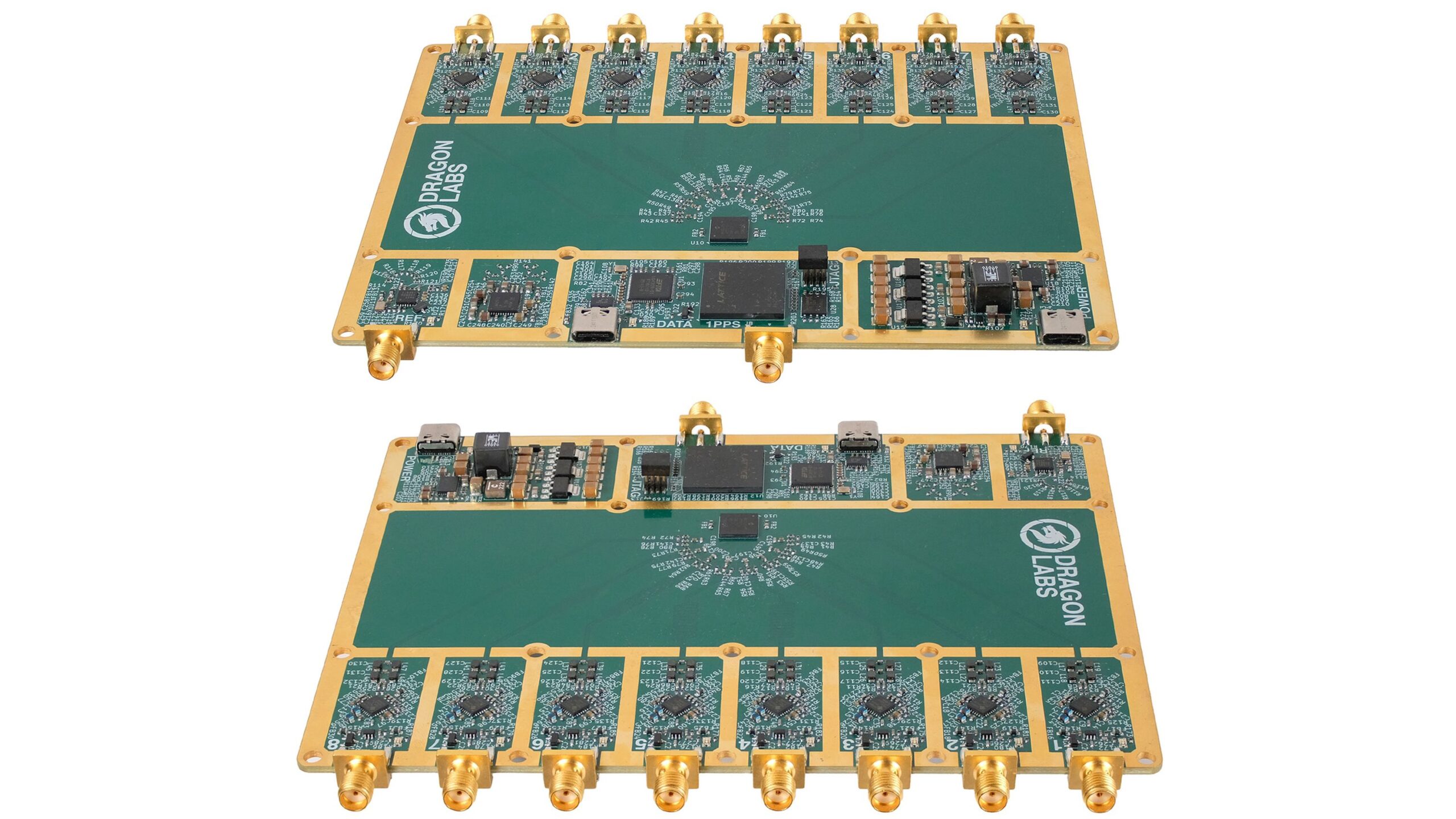
Dragon Labs have recently announced that the CR-8 model is getting ready for crowdfunding on CrowdSupply. The CR-8 is an 8-channel coherent software-defined radio with a 12-bit ADC, a tuning range of 25 MHz to 1750 MHz, and 8 MHz of bandwidth per channel. A coherent SDR unlocks various applications such as radio direction finding, beamforming, and antenna diversity.
The CR-8 was originally designed for a Master's thesis by Alexandre Rouma, who is also the creator of the popular SDR++ software, which is commonly used by RTL-SDR enthusiasts.
The core of the build appears to consist of R860 tuners for each channel and an MCP3721-200 analog-to-digital converter (ADC). The MCP3721-200 is a chip commonly used for radar, imaging, and cellular base station applications, as it naturally provides aligned samples with built-in fractional delay recovery, making it ideal for coherent applications. A seperate signal source on the PCB provides the needed signal for the phase calibration of the tuners.
SDR++ and SatDump will natively support the CR-8, and there is also a GNU Radio source block. While the C API is open source, they note that the firmware will be closed source.
Pricing has yet to be announced, but we found a recent comment from the team indicating a target price of US$500 - $600 for the bare PCB, with a CNC-milled enclosure available as an optional add-on.





























Thanks for posting this. I appreciate it. Perhaps because of the PWM audio you mentioned, I couldn’t listen to this RX. It’s too “artifacty” and the digital noise modulated into the audio is disturbing. 🙂 It is still appreciated nonetheless.
i hope the spacing of the sma connectors is 12,7mm since thats exactly the same spacing as all mini-circuits 8 port power splitters
looking for active 25MHz-1100MHz RF-Splitters (4-port,8-port) to use the CR-8 with only one/two antennas.
Very interesting!
I have kerberos sdr (the first version of kraken sdr). I am very satisfied with it.
I am currently working in my own version of DF software with kerberos/kraken. I am trying to use FFT to autodetect targets in all 2.4 MHz available bandwidth, and DF to automatically get the bearing to all of them at once.
Moreover, I try to follow UNIX philosophy. I have one tool to dump raw samples from kerberos/kraken, another one to add/multiplex some metadata (GPS location and more), another one to autodetect targets and estimate DoA, and another one to split output in several .csv files, one for each target. You can run all of them in a UNIX shell pipeline or dump samples to a file and process them later. Then you can open csv files with kraken sdr mobile app.
It would be very interesting for me to use my homebrew software with this new radio. It would be super amazing to have two 4 element antenna arrays and 8 MHz bandwidth for each array.
However, the process could not be real time I suppose. It would be needed to store raw samples in an SSD and process them later. The size of the SSD would be huge, but it could be possible to get one.
Would it be possible to run the SDR in a USB 3.0 port, attach a SSD to another USB 3.0 port and dump raw data from one to the other, with little or no sample loss?
The idea behind these radios is excellent, but data is generated so fast that you need to keep this issue into account.
Any suggestion or remark would be welcome!
It would also be great to be able to retune the central frequency with no by hand manual antenna disconnection and reconnection. This is a good improvement in kraken sdr, in my view.
Thank you,
German EA4GJA