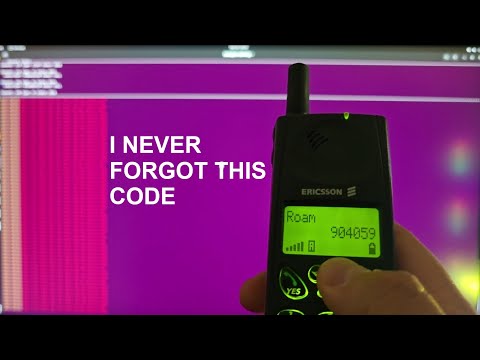
Over on the YouTube channel "Nostalgia For Simplicity," the creator has uploaded a video where he revisits the original 1G analog cellular system, AMPS, to finally understand a mysterious phenomenon he experienced over 20 years ago as a kid, where he was able to unintentionally intercept other people's calls with his 1G phone. Using vintage hardware like the Ericsson DH668, he recreates a small AMPS network and confirms that the system is fully analog, instant, and surprisingly good-sounding.
AMPS worked by dividing the spectrum into numbered voice channels, with each call occupying one channel at a time. In busy cities, simply tuning to an active channel could let you hear someone else’s call. In this revival setup, there is only one active call, making the effect easy to demonstrate. This is essentially wideband analog FM voice on fixed channels, something easily observable and demodulated with modern SDR hardware.
Investigating this ancient 1G tech has highlighted why 1G systems were fundamentally insecure and why the world moved on to digital standards. If you're interested, the other videos on his channel continue to explore early cell phones and their quirks.
[Also seen on Hackaday]






























Those were wonderful times.
An ancient rotatable VHF antenna on the roof, a satellite inline amplifier, and an even older analog satellite receiver from Technisat (Drake).
Back then, I could receive up to five different ATV amateur radio operators. Eventually, I discovered telephone signals via the receiver’s 70 MHz intermediate frequency and the cheap scanners. Constantly correcting the frequency, both on the receiver and the scanner, was tedious, but it worked.
One evening, I had a Stabo-XR scanner with a voice inverter for testing. It was fantastic. Unfortunately, only that one evening.
These days, things have become very quiet in the analog telephone range. What remains are the very rare analog calls from Russia via military satellites. On 266.850/266.950 MHz.
Damals eine wunderbare Zeit.
Eine uralte drehbare VHF Antenne auf dem Dach, ein Sat-Inline Verstärker und ein noch älterer analoger Sat-Receiver von Technisat (Drake).
Empfangbar waren damals bis zu 5 verschiedene ATV- Amateurfunker.
Irgendwann habe ich über die 70MHz ZF des Receivers und den billigen Scannern Telefonsignale entdeckt. Mühselig war das ständige korrigieren der Frequenz, sowohl am Receiver, als auch am Scanner, aber es hat geklappt.
Zum testen hatte ich an einem Abend einen Stabo-XR Scanner mit Voice Inverter. Der war super. Leider nur diesen einen Abend.
Mittlerweile ist es sehr ruhig geworden, im analogen Telefonbereich. Was bleibt, sind die sehr seltenen analogen Telefonate aus Russland über die Militärsatelliten.
Auf 266.850/ 266.950MHz.