Tagged: Elektro-L

Elektro-L3 Now Drifting West to 14.5°W: L-Band xRIT Could Return to Western Europe in October

Back in May, we posted about how Russia's Elektro-L3 geostationary weather satellite was expected to move from 76°E to 14.5°W, which would finally bring an unencrypted L-band LRIT/HRIT downlink over Western Europe. Thank you to RTL-SDR reader tec_msat for writing in and letting us know that the move now appears to be underway.

tec_msat writes that Elektro-L3 went quiet around September 10. Updated TLEs on September 13 then showed the satellite drifting west at roughly 1.7 degrees per day. Around September 20, its orbit was circularized, making it drift faster at around 3.1 degrees per day. At its current speed, it should reach 14.5°W around October 12. Based on Elektro-L5's commissioning timeline, test transmissions could begin within days of arrival.

Elektro-L5, launched in February 2026, has now been successfully commissioned at L3's old 76°E slot, which covers Asia, the Middle East, and parts of Russia and Australia. It has been transmitting GGAK, LRIT and HRIT, as well as X-band RDAS. With L5 taking over the eastern slot, L3 will replace the aging Elektro-L2 at 14.5°W. L2 never provided LRIT/HRIT from that position due to power supply issues, although the original Elektro-L1 did when it was stationed there.

Roscosmos noted in August, when announcing L5's commissioning, that L3 may be moved to 14.5°W. However, there has been no official announcement from Roscosmos that the relocation has started, so the drift observations currently come from amateur TLE tracking.

Once commissioned, L3 should once again make geostationary L-band weather imagery at 1691 MHz available to users in the UK, Ireland, Iceland, Portugal, Spain and western France. tec_msat also speculates that the signal may be stronger over Europe than it was from 76°E (potentially due to better elevation angles), making xRIT reception even easier.

If you're in the coverage area, now might be a good time to get your dish, feed and LNA ready. SatDump is the best software tool to use for reception and decode and our Discovery Dish with L-Band feed and RTL-SDR Blog V3 is a great starting point for hardware.
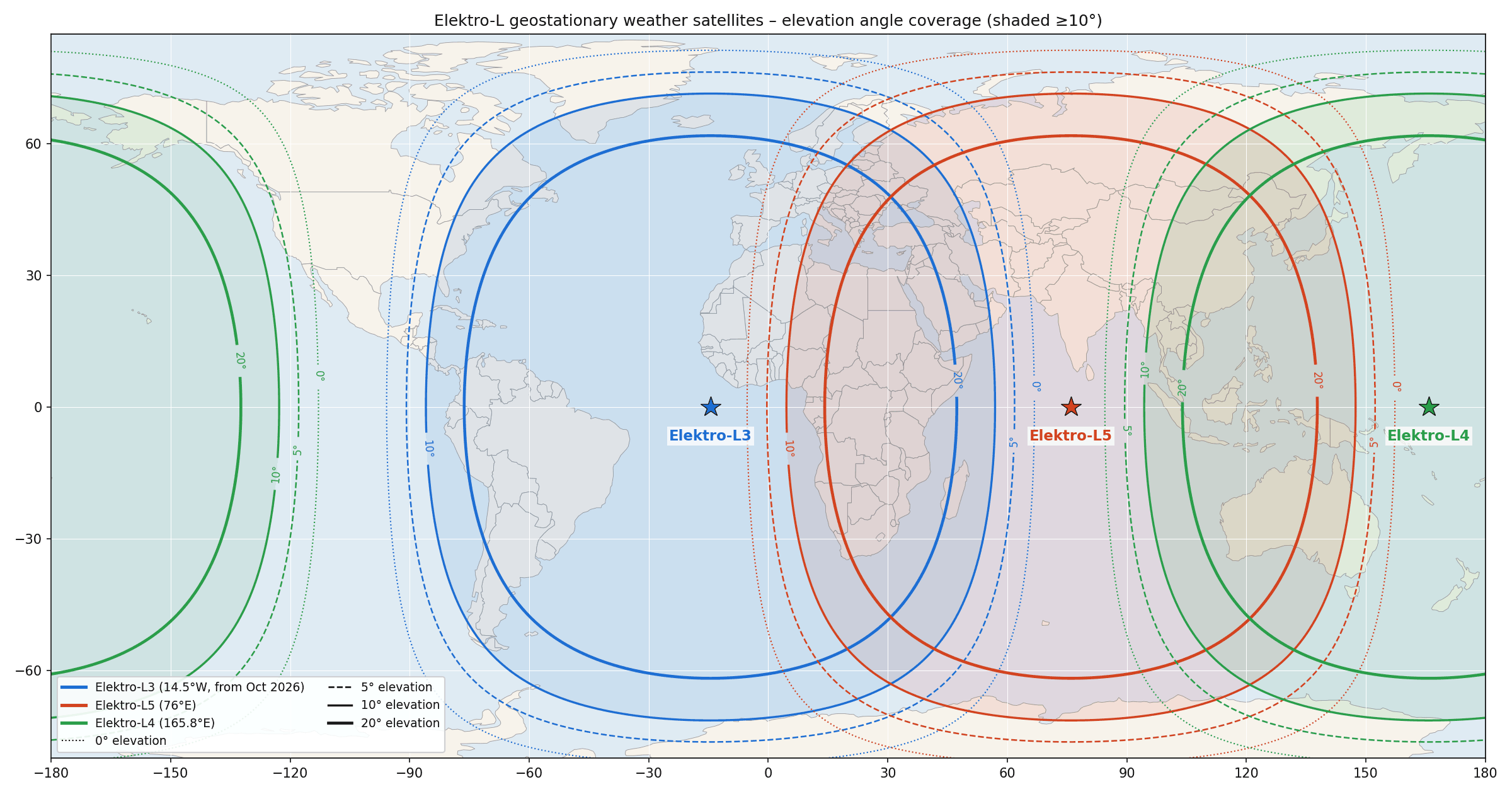
Expected Elektro L3/L4/L5 global coverage from mid-October 2026.

Receiving Unintentional Voice Transmissions from GPS Satellites

Over on dereksgc's YouTube channel we've discovered a few more recent interesting videos from his satellite decoding series that people may be interested in. One from two weeks ago shows how it's possible to receive voice transmissions on navigation satellites such as GPS.

Many navigational and meteorological satellites carry a search and rescue (SAR) repeater which is intended to receive UHF emergency locator beacons and rebroadcast them in the L-band or higher. However the repeaters appear to be picking up all sorts of other signals from the ground, including voice transmissions. Dereksgc notes that the theory is that there are some land based communications systems in some countries that are sharing frequencies that emergency locator beacons use, or that malicious pirates may be actively using these SAR repeaters for their own communications.

Dereksgc shows examples of retransmitted signals on the Beidou, GLONASS and Elektro-L satellite downlinks at 1.5442 GHz and at 2.226 MHz for the GPS satellites. He also shows what sort of satellite dish and feed setup you need. In the video he uses a HackRF as the SDR, but you could also use an RTL-SDR for the satellites that transmit at 1.5442 GHz.

Receiving voice transmissions from GPS satellites || Satellite reception pt.10

Decoder for Geostationary Elektro-L Weather Satellites Released

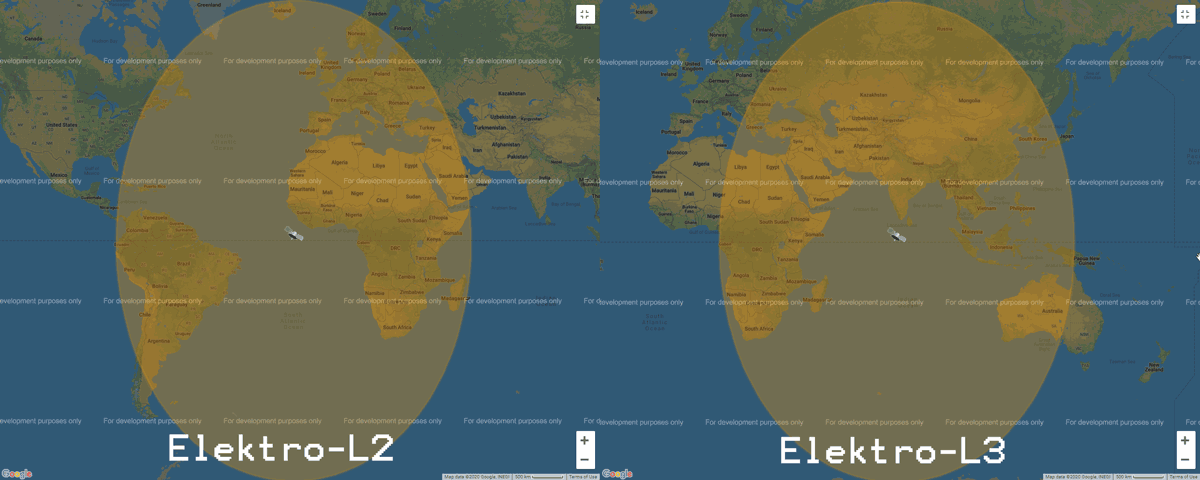
Elektro-L is a range of Russian geostationary weather satellites. Elektro-L1 and L2 were launched in 2011 and 2015 respectively, and Elektro-L3 was launched more recently in December 2019. Currently only Elektro-L2 and L3 are in operation. Like it's NOAA GOES, Himawari and GK-2A cousins, Elektro-L satellites beam back full disk images of the entire earth.  Elektro-L2 is positioned to cover South America, Africa and Europe, whilst Elektro-L3 covers the East of Africa, Eastern Europe, Russia, Middle East, Asia and the West of Australia.

Elektro L2 and L3 Coverage from https://www.wmo-sat.info/

Recently @aang254 has been Tweeting that he has managed to get an Elektro-L decoder working. The decoder is open source and available on GitHub and Windows builds are already available. He notes that he's still working on the demodulator, but that should be released tomorrow. This decoder is great news as now Europeans now have an opportunity to receive full disk images. There is no full guide yet on how to use the decoder, but we expect that one will be released soon.

We note that according to wmo-sat.info the Elektro-L satellites transmit at ~1693 MHz, and have a 2 MHz wide HRIT and 200 kHz wide LRIT mode. So the signals should be able to be received with an RTL-SDR and appropriate LNA. EDIT: Unfortunately it seems that wmo-sat.info may have incorrect information, and that Elektro-L requires X-Band hardware to receive these images. While not totally impossible, an X-Band satellite SDR setup is a bit more difficult to put together compared to the L-band SDR setup used by GOES and GK-2A.