Tagged: NOAA-15

A Browsable Archive of Historical Weather Satellite Data

Thank you to Meti for writing in and sharing his browsable archive of historical weather satellite data (further information here). The archive is designed to store weather satellite data, whether in baseband IQ format, frames, or images, for scientific, educational, or preservation purposes.

With NOAA POES now fully shut down, the archive could be useful for individuals who didn't have the opportunity to decode a NOAA satellite for real, or perhaps for those who will want to relive their old hobby one day. Meti writes:

I've been working on setting a weather satellite data archive up; a lot of these incredible satellites are lost to time because people didn't save the data or had it deteriorate over the years, as has been proven with the ongoing POES decommissioning!

My goal is to create a browsable archive of historical satellite data that is downloadable and re-decodable by others who didn't and/or don't have the opportunity to catch the satellites in question themselves for scientific, educational, or just preservative purposes.

I've been working hard asking around various people and groups for the possibility of them keeping some data from as many different satellites as possible, but still have large gaps in several satellites. I was wondering if it were possible to try to publish this archival effort on the blog to try to get more outreach than word of mouth?

The archive currently stands at 430 gigabytes of data with about 100 more awaiting processing due to missing pipelines, already spanning more than 4 decades!

The archive currently stores a variety of different satellites and their data products, and some in the archive even have the raw IQ data, which occupies a significant amount of hard drive space.

However, Meti notes that many satellites are still missing from the archive, and he would like to reach out to the community for submissions. If you have any data from the following, please reach out to Meti.

GEO:
- Meteosat wefax
- Meteosat xRIT (Only have very limited data)
- GOES-N LRIT/MDL/GVAR/Sounder SD (Before it became EWS-G! So over the US)
- Elektro-L1 xRIT/RDAS

LEO:
- NOAA APT older than NOAA 12
- NOAA HRPT from any sat besides 15/18/19
- Seastar (OrbView-2) HRPT
- MetOp LRPT !!! (Metop-A transmitted for a few days) - Meteor M1 HRPT
- Meteor 3M APT/HRPT
- Meteor 1/Priroda/2 APT (other than Meteor 2-21. NOT M2!)
- FengYun 2A/B/C/D/E/F (S-)VISSR (Or LRIT)
- Fengyun 1 CHRPT

Catch-all
- Any L-band prior to ~2000
- Any VHF prior to ~1990
- Any anomalies - instrument failures leading to strange receptions (i.e. NOAA 17 failing APT broadcasts). THIS IS EXCLUDING NOAA-15 post 2020 and any user-side issues (weak reception, sample drops etc.)

You can find more information about the project and how to contribute on this linked page.
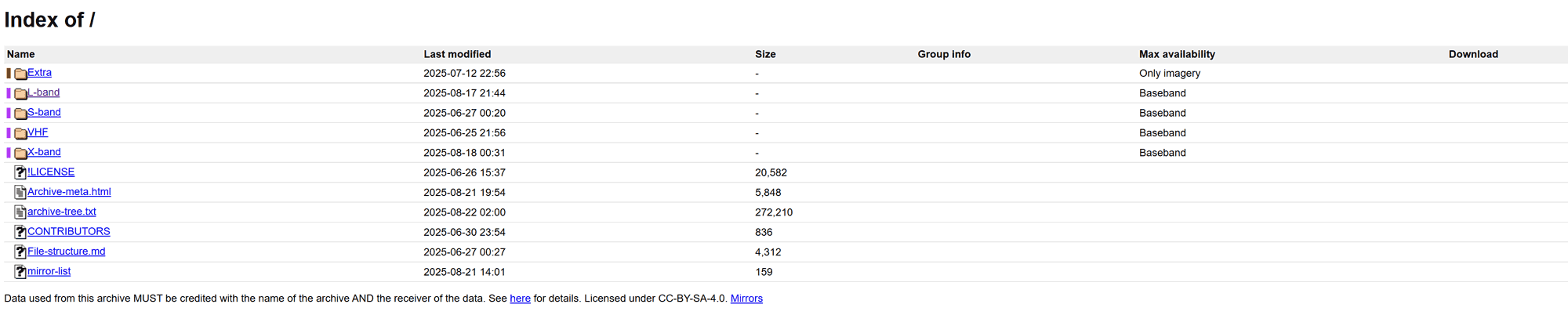
Satellite Archive. Currently over 430 GB Archived.

NOAA 15 and 19 To Be Decommissioned Within the Next Two Weeks

The National Oceanic and Atmospheric Administration (NOAA) have recently announced that they are planning to decommission NOAA 15 and NOAA 19 on August 12, 2025 and August 19, 2025 respectively.

Update #7: NOAA has completed End of Life (EOL) testing activities for NOAA-15 and NOAA-19 and will commence the decommission process shortly. These two remaining satellites in the NOAA Polar Operational Environmental Satellites (POES) Constellation are far beyond their primary mission design life. All have incurred subsystem and instrument degradation or failures and have entered a "twilight phase" where failure modes are increasingly likely. As a reminder, NOAA-18 was decommissioned on June 6, 2025 at 1740 UTC due to an unrecoverable failure to the S-Band transmitter. The remaining satellites in the legacy POES constellation will be decommissioned as follows: NOAA-15 on August 12, 2025 and NOAA-19 on August 19, 2025.

NOAA-15, NOAA-18, and NOAA-19 have long been core satellites for RTL-SDR users. For many of us, one of these would have been the first satellite from which we received weather data via the 137 MHz APT signal.

These NOAA satellites were marked end-of-life (EOL) back on June 16, 2025. However, EOL status still meant that transmissions would continue as normal. The EOL status simply marked that the satellites should no longer be used for mission-critical services, and that no attempts at repair or recovery would be made if needed.

On June 06, 2025, just before the EOL status officially went into effect, NOAA-18 was decommissioned and shut down due to a prior transmitter failure that left ground control in danger of being unable to control the satellite in the future. 

While nothing critical appears to have happened to the remaining NOAA-15 and NOAA-19 satellites as of yet, these are ageing satellites with various ongoing issues. NOAA-15 was launched in 1998, and NOAA-19 in 2009. They have long exceeded their design life.

As with NOAA-18's decommissioning, it does not appear that NOAA will deorbit the satellites. Instead, they will be left in orbit and put into a safe electrical state, with the transmitters shut down.

You can find more information about the decommissioning over on Carl Reinmann's usradioguy blog.

A Drawing of NOAA-19

More Information about the NOAA-15 AVHRR Failure

Thank you to Carl Reinmann (aka usradioguy) for submitting his blog post which goes into deeper detail about the NOAA-15 weather satellite imaging failure that we posted about last week. 

In his post Carl discusses in detail the technical aspects of the AVHRR Scan Motor failure, shows plots of the AVHRR motor current increasing, provides multiple examples of corrupt images being recently received and notes the history of previous failures which were eventually resolved.

He also notes that even with the AVHRR failure the other sensors on the satellite will remain functional, however a failure of this instrument would mean the end of the easy to receive APT images at 137 MHz from NOAA-15. We note that there is still the opportunity to receive NOAA-18 and NOAA-19 which are the remaining operational satellites that transmit APT at 137 MHz.

NOAA have now also released an official notice about the failure which reads:

Product Outage/Anomaly: NOAA-15 AVHRR degraded image data issued by NESDIS NSOF
Date/Time Issued: Oct 22, 2022 1947Z

The NOAA-15 AVHRR Scan Motor current began showing signs of instability on Oct 18 at approximately 1800Z, when the current began to gradually rise from about 205 mA to about 250 mA, where it remained until Oct 24. At about 0000Z on Oct 24, the current began rising again throughout the day, peaking at about 302mA on Oct 25. Scan motor temperature began rising about the same time and is currently steady at ~29°C. The instrument is still producing data, but it is highly degraded. This behavior may be a sign of an impending scan motor stall but requires further investigation. Options for recovery are limited.

NOAA-15 Scan Motor Failure

The NOAA-15 Weather Satellite may be Failing (Again)

The NOAA APT weather satellites are popular because they fly over most places on earth frequently, and they are easy to receive images directly from with modest hardware such as an RTL-SDR and v-dipole antenna.

Three NOAA APT satellites currently operational include NOAA-15, NOAA-18 and NOAA-19. The satellites are however long past their rated mission age, with NOAA-15 being almost 25 years old now.

Unfortunately NOAA-15 appears to be having trouble with it's image scanning motor at the moment, and it is producing corrupted images. This problem has occurred in the past in 2018 and 2019, before fixing itself, so the hope is that it will fix itself again this time.

NOAA does not appear to have released any information about the outage yet on their General Satellite Messages page.

We also wanted to note the recent news that NOAA will be transitioning NOAA-15, 18 and 19 to a private company for on-orbit operations.

Hackaday Article about the Slow Death of NOAA-15

If you've been following our blog, or have your own RTL-SDR based weather satellite station, then you'll know that the NOAA-15 APT satellite has been experiencing issues lately. There appear to be problems with it's camera scan motor resulting from it running low on lubrication. This is fully understandable as the satellite is 21 years old and well past it's expected life span. The satellite appears to be working some days, and producing garbage image other days.

Over on Hackaday, Dan Maloney has uploaded an interesting article that explores the history and technology behind NOAA-15's camera, and why it is now failing.

When NOAA-15 fails for good, don't feel too bad as we still have NOAA-18 and NOAA-19, the Russian Meteor M2, and Meteor M2-2 satellites, and the GOES satellites, all of which can be received by an RTL-SDR. Several new weather satellites are also planned for 2020 and onwards.

Weather Satellite NOAA 15 Appears to have Failed (Again)

Back in April 2018 we posted how the NOAA-15 APT weather satellite that many RTL-SDR users enjoy receiving images from was having problems with it's scan motor resulting in image errors. The satellite recovered from that problem, but today the problem appears to be back and in a much worse way now.

Users on Reddit and Twitter have reported bad images coming in from NOAA 15. Over on Reddit u/rtlsdr_is_fun has provided a post showing an example of a corrupted image, and also provided an IQ and Audio file. On his blog [Karsey] has also posted some interesting looking corrupted images that he's received.

Corrupted NOAA-15 Image Received by [Karsey]
Corrupted NOAA-15 Image Received by [Karsey] (See his post for the full sized images)

NASA have put out a statement indicating that yet again it is a problem with the scan motor, and the problem could be permanent.

The NOAA-15 AVHRR Scan Motor current began showing signs of instability at approximately 0400Z on July 23, 2019. At about 0435Z the current rose sharply to about 302mA where it has remained. Scan motor temperature began rising about the same time and is currently steady at ~26M-0C. Black body temperatures dropped sharply at about the same time. The instrument appears to no longer be producing data.
This behavior is consistent with a scan motor stall, but requires further investigation. Options for recovery are limited.

Having been launched in 1998 with a minimum spec of 2 years operation, NOAA-15 has already well outlived it's time and may finally be failing for real. We hope it will recover, but if not we should be thankful that Russian weather satellite Meteor M2-2 is now fully operational and transmitting beautiful high resolution images.

The NOAA-15 Weather Satellite May be Failing

Over the last few days the NOAA-15 APT weather satellite has begun to show signs of failure with people receiving corrupted images. NOAA 15, 18 and 19 are weather satellites that can be easily received with an RTL-SDR and a satellite antenna such as a V-Dipole, QFH or Turnstile (tutorial here). NOAA 15 was launched on 13 May 1998, making it one month away from being 20 years old. To put it into perspective, NOAA-15 was only built to the spec of being designed to last 2 years minimum. 

The problem currently appears to be intermittent and is due to a loss of lubricant on the scan motor. NOAA released a message:

The N15 AVHRR global imaging became corrupted on April 12 at ~0000 UTC due to sync issues. This may be caused by erratic scan motor current due to loss of lubricant. The problem appears to have corrected itself, as the global image is no longer corrupted. The issue is still under investigation.

In the Tweet below UHF Satcom displays an example of a corrupted image that was received.

The issue is intermittent, and hopefully it can be fixed, but if not we still have NOAA 18 and 19 which were launched in 2005 and 2009 respectively, as well as the Russian Meteor M2 satellite which was launched in 2014. 

If you're interested discussion of this topic can be found on various Reddit threads [1], [2], [3].