Tagged: stingray

The Thought Emporium Explores IMSI Cell Phone Tracking and Other Advanced Cell Phone Attacks with Software Defined Radios

Over on YouTube, The Thought Emporium channel has uploaded a video outlining how mobile phones constantly leak unique IMSI identifiers over the air, making passive location tracking much easier than most people expect. While LTE and 5G improve security, older 2G and 3G protocols still expose permanent subscriber IDs that can be collected and linked to movement over time.

The video highlights how accessible this surveillance is. A cheap RTL-SDR USB dongle, basic antenna, and free software pre-installed on DragonOS are enough to passively collect IMSI numbers from nearby phones running on 3G. Once you know a person's unique IMSI number, you can easily track their movements if you have cheap radios monitoring the areas they frequent.

They also show how it's possible to use a more advanced TX-capable SDR like a USRP B210 to create a Stingray device, which is a fake cell-tower base station that you can force nearby cell phones to connect to. Once connected to the Stingray, all communications from your phone can be tapped. Finally, they discuss SS7 attacks, which, while difficult and/or expensive to gain access to the SS7 walled garden, can allow malicious actors to easily reroute security-related messages, such as 2-factor authentication.

The video finishes with potential defenses, including turning phones off when needed, forcing more secure LTE/5G-only connections, and using tools that detect fake cell towers. Privacy-focused mobile services that rotate identifiers are also discussed.

Recreating NSA Spy Tech Was WAY Too Easy


USRP SDRs used to Break 3G to 5G Mobile Phone Security

According to researchers at the International Association for Cryptologic Research it is possible to snoop on 3G to 5G mobile users using a fake base station created by an SDR. It has been well known for several years now that 2G mobile phone security has been broken, but 3G to 5G remained secure. However, the researchers have now determined that lack of randomness and the use of XOR operations used in the Authentication and Key Agreement (AKA) cryptographic algorithm's sequence numbering (SQN) allows them to beat the encryption.

In their research they used a USRP B210 SDR which costs about US$1300, but it's likely that cheaper TX/RX capable SDRs such as the US$299 LimeSDR could also be used. In their testing they used a laptop, but note that a cheap Raspberry Pi could replace it too.

Theregister.co.uk writes:

"We show that partly learning SQN leads to a new class of privacy attacks," the researchers wrote, and although the attacker needs to start with a fake base station, the attack can continue "even when subscribers move away from the attack area."

Though the attack is limited to subscriber activity monitoring – number of calls, SMSs, location, and so on – rather than snooping on the contents of calls, the researchers believe it's worse than previous AKA issues like StingRay, because those are only effective only when the user is within reach of a fake base station.

The full paper is available here in pdf form.

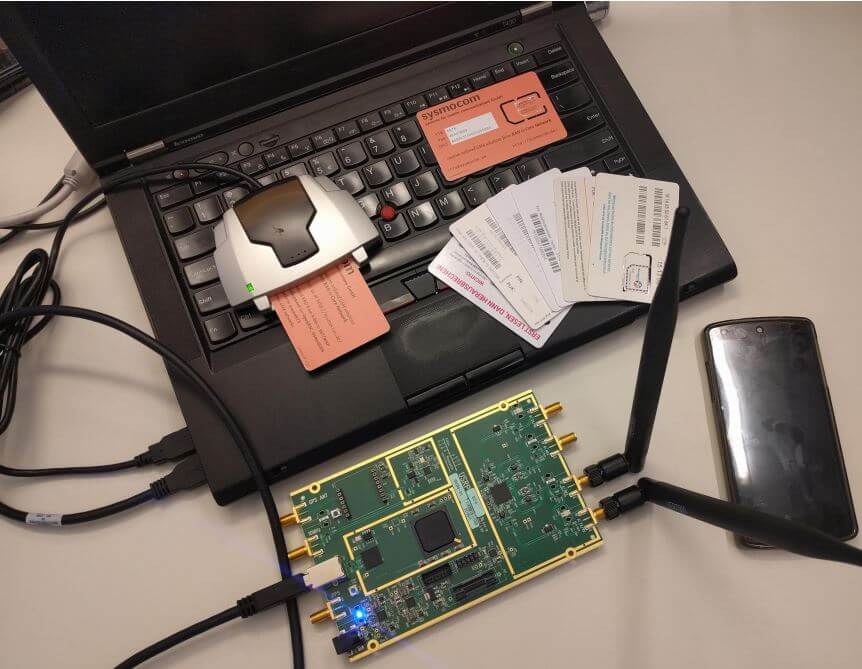
Tools used including a laptop, USRP B210 and a sim card reader.