Using a Fruit Fly Brain to Tune an RTL-SDR FM Radio
You may have seen in the news that researchers have recently mapped the brain and nervous system of a fruit fly and digitally simulated it in what they call a 'connectome'. Without additional training, the connectome exhibited fruit fly-like behavior when connected to a virtual body, suggesting that the fruit fly's behavior is encoded in its brain structure.
The fly brain neural network can also be hacked into performing other tasks. Various researchers have already repurposed it for tasks like controlling robots, driving a simulated car, playing virtual games like Beat Saber and Doom, trading crypto, and more. One novel fly brain application related to RTL-SDRs was submitted to us by Nik K (SV1EEX). Nik used the fruit fly connectome to tune an RTL-SDR-based FM radio. Nik writes:
Can the reconstructed nervous system of a fruit fly navigate the FM broadcast band and find a radio station?
I built an open-source experiment to test that question using an RTL-SDR Blog V4 and the published adult male Drosophila melanogaster CNS connectome: 165,122 traced neurons connected by more than 10 million signed neural edges.
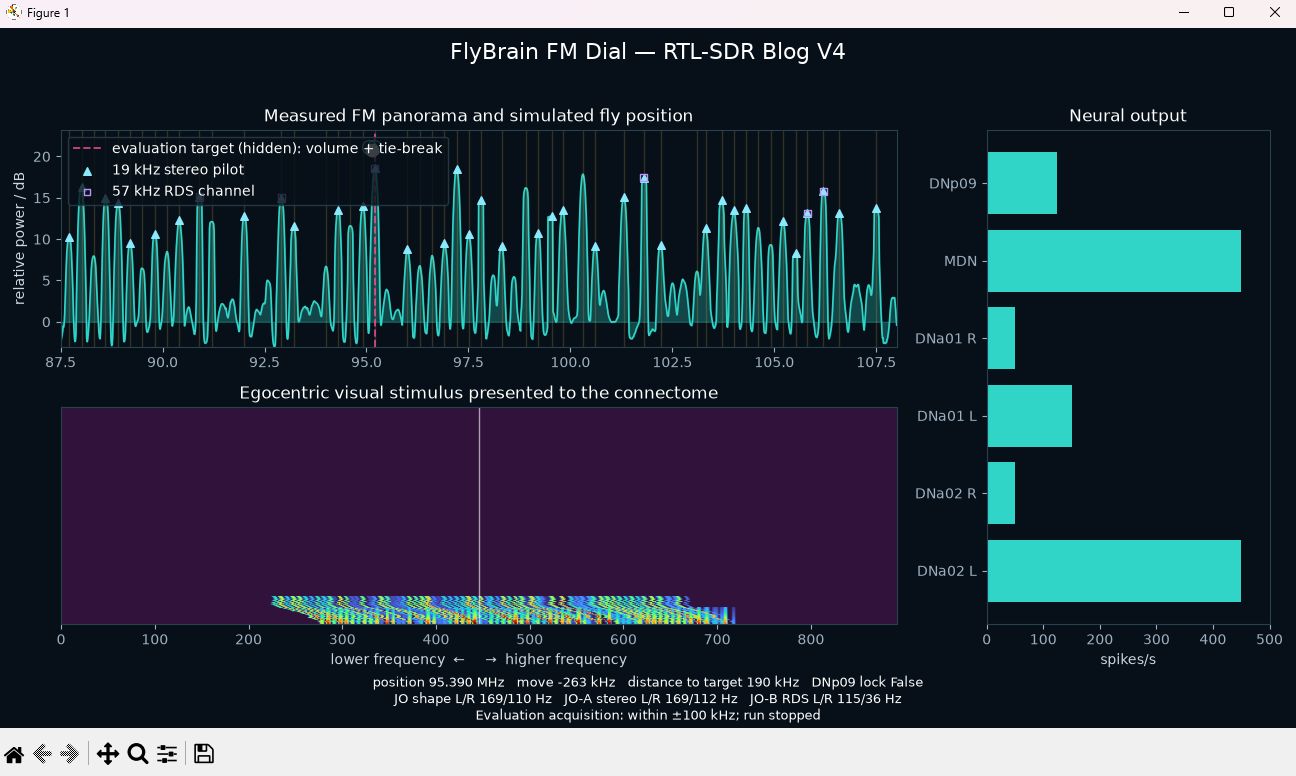
The RTL-SDR V4 scans the real 87.5–108 MHz broadcast band and creates a panoramic RF environment. Instead of giving the software a list of stations, I convert that measured spectrum into an egocentric visual scene and present it through the 892 retinotopic optic columns used by the connectome simulation. Activity produced by anatomically identified DNa02 descending neurons moves a virtual receiver left or right along the dial.
The experiment also gives the simulated biomimetic fly a substituted RF “mechanosensory” channel. Spectral shape is mapped to bilateral Johnston’s-organ input, while the 19 kHz stereo pilot and 57 kHz RDS subcarrier stimulate JO-A and JO-B populations. This helps distinguish stations that appear similar in power and occupied bandwidth. These mappings are engineered sensory substitutions; they are not a claim that biological flies can detect radio waves.
In one preliminary run on a panorama recorded with the RTL-SDR Blog V4, the connectome-driven controller started at 97.750 MHz. Without receiving the target frequency directly, it entered the predefined ±100 kHz acquisition region around the hidden 95.200 MHz target after 33 actions and stopped at 95.126973 MHz.
The result is deliberately reported as a single preliminary observation. The repository separates external acquisition from neural DNp09 lock events and includes random, visual-only and direct-peak controllers for controlled comparisons.
I describe the resulting system as a connectome-driven virtual embodied agent operating in an RF-derived sensory environment—effectively, a digital fruit-fly nervous system whose world is the FM spectrum and whose movement consists of tuning a radio.
The complete source code, Windows setup, RTL-SDR V4 compatibility fixes, connectome setup procedure, technical manual, experimental protocol, limitations and acquisition dashboard are available here:
https://github.com/z1000biker/
DrosophilarRFsensory The project builds on the open-source
flycoinrhimplementation and the published adult male Drosophila CNS connectome.