Discovery Dish 1420 MHz Hydrogen Line Feed Tested with a WiFi Grid Dish
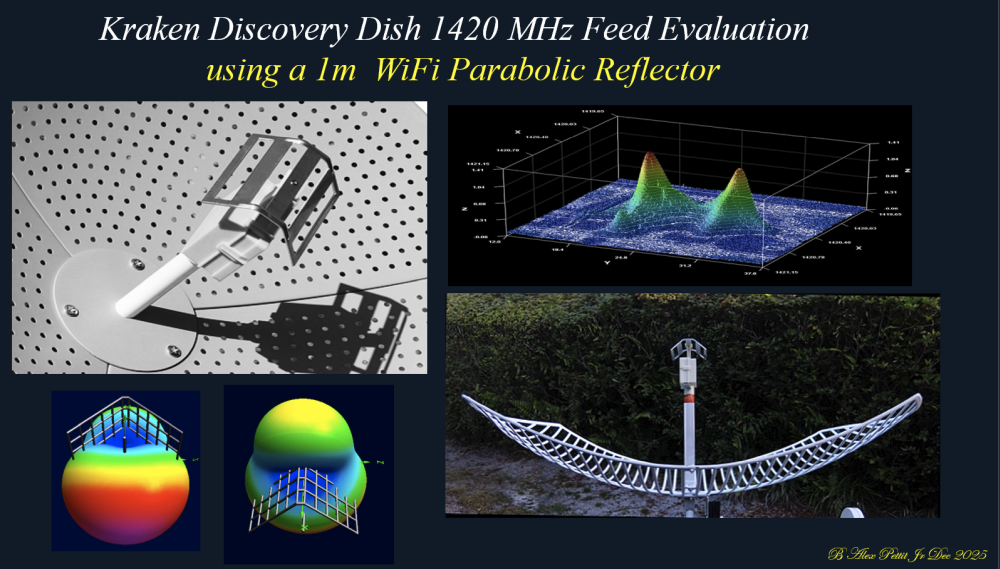
Thank you to Alex P for writing in and sharing with us his detailed evaluation of the Discovery Dish 1420 MHz hydrogen line feed when paired with a low-cost 1m WiFi grid dish. The goal was to see how well this near off-the-shelf setup performs as a hydrogen line radio telescope. The Discovery Dish feed integrates the dipole very close to the internal LNA and filters to minimize losses, uses a weather-sealed enclosure, and is built around a low-noise Qorvo QPL9547 amplifier, which has a very low noise figure at 1420 MHz.
Alex used 4NEC2 with a simple geometry approximation to analyze the beam pattern and also experimentally determined the optimal feed-to-dish spacing for the WiFi grid. The results show that the Discovery Dish feed significantly outperformed a more standard feed + external LNA setup.
Alex also shows how he uses aluminum foil, or conductive foam, to shield the feed from all signals during a background correction scan. Generally, for background correction scans, we recommend pointing towards a cold area of the sky (any area far away from the Milky Way with little to no hydrogen), but Alex prefers this method.
Related posts:
- Discovery Dish Pre-Launch: A Lightweight Dish and Feed for L-Band Weather Satellites and Hydrogen Line Reception
- Tech Minds: Testing out Discovery Dish for Inmarsat and Hydrogen Line Radio Astronomy
- Discovery Dish Now Available for Crowd Funding! A Lightweight Dish and Feed for L-Band Weather Satellites, Hydrogen Line and Inmarsat
- Video Demonstrating Hydrogen Line Detection with an RTL-SDR and WiFi Dish
- Cheap and Easy Hydrogen Line Radio Astronomy with an RTL-SDR, WiFi Parabolic Grid Dish, LNA and SDRSharp