L-Band Weather Imagery Soon Coming Back to Western Europe via Elektro-L3
Thanks to weather satellite enthusiast 'Heja Ali' who wrote in to share some welcome news. On February 12, 2026, Roscosmos successfully launched Elektro-L No.5 aboard a Proton-M rocket from Baikonur Cosmodrome, the fifth in the Elektro-L series of Russian geostationary weather satellites (following No.1 in 2011, No.2 in 2015, No.3 in 2019 and No.4 in 2023). Like its predecessors, it carries an unencrypted 1691 MHz L-band downlink with both LRIT and HRIT imagery.
The interesting consequence for amateur satellite enthusiasts is what happens next. Per SatDump's satellite list, L5 is now commissioning at 76°E (L3's old slot), L4 is operational at 165.75°E, and the European slot at 14.5°W is currently held by L2, which has lost its L-band transmitter to a power supply failure. Once L5 is fully operational, L3 is expected to drift west to 14.5°W to replace L2, finally restoring an unencrypted geostationary L-band downlink to the UK, Ireland, Iceland, Portugal, western France, and Spain for the first time since EUMETSAT switched off Meteosat HRIT in 2018.
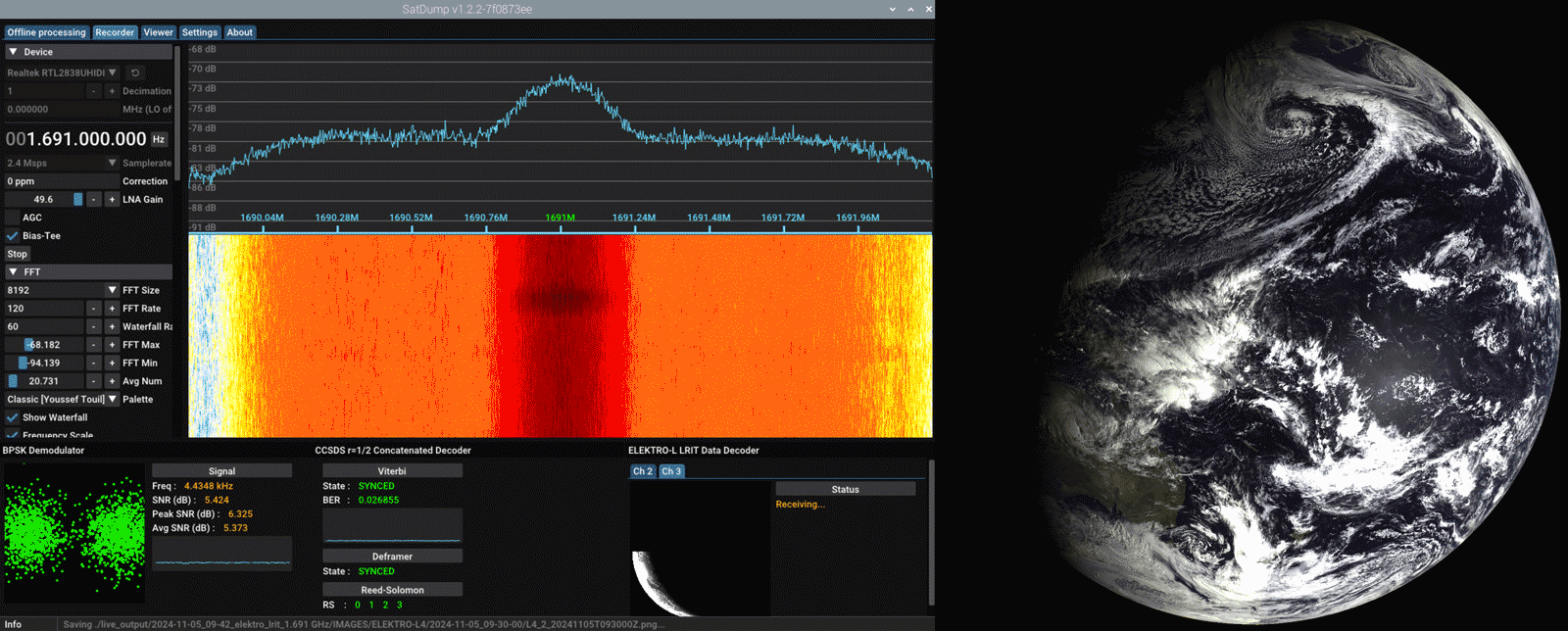
The Electro-L 1691 MHz signal is easily received by an RTL-SDR Blog V3 or V4, LNA, and a modest 65 cm dish. Our Discovery Dish with the L-band weather satellite feed is a good choice, with existing users in southern Europe routinely pulling Elektro-L3 at 5 to 6 dB SNR using SatDump (which only needs around +1 dB to decode).
There is no firm public timeline yet for L3's drift west, but if you are in far-western Europe and have been waiting on a geostationary L-band satellite to become available, now is a good time to start planning for the receive hardware.





























We’ve been saying this since December 2025, it’s certainly not news. Another thing is that Eumetsat hasn’t turned off HRIT in L-band. Geo MSGs still transmit in L-band but with weak signal strength and you need dishes of at least 3 meters and a good feed.
It’s better late than never and many people don’t have access to such dishes.