Testing Hubble Network’s Bluetooth-to-Satellite Link from Budapest
Thank you to Zoltán Dóczi for writing in and sharing his blog post about trying out Hubble Network’s direct-to-satellite Bluetooth service. Hubble is a growing LEO satellite constellation service (currently about seven satellites are up, with a planned 60) that claims that off-the-shelf BLE chips can send small telemetry packets straight to its satellites without any extra hardware. To test this, Zoltán ran Hubble’s Zephyr-based satellite sample on a +20 dBm Silicon Labs EFR32MG24 board with a PCB antenna, and later added an ESP32-C6. The devices were powered by an 18650 cell and left on a flat roof in Budapest from August until late September.
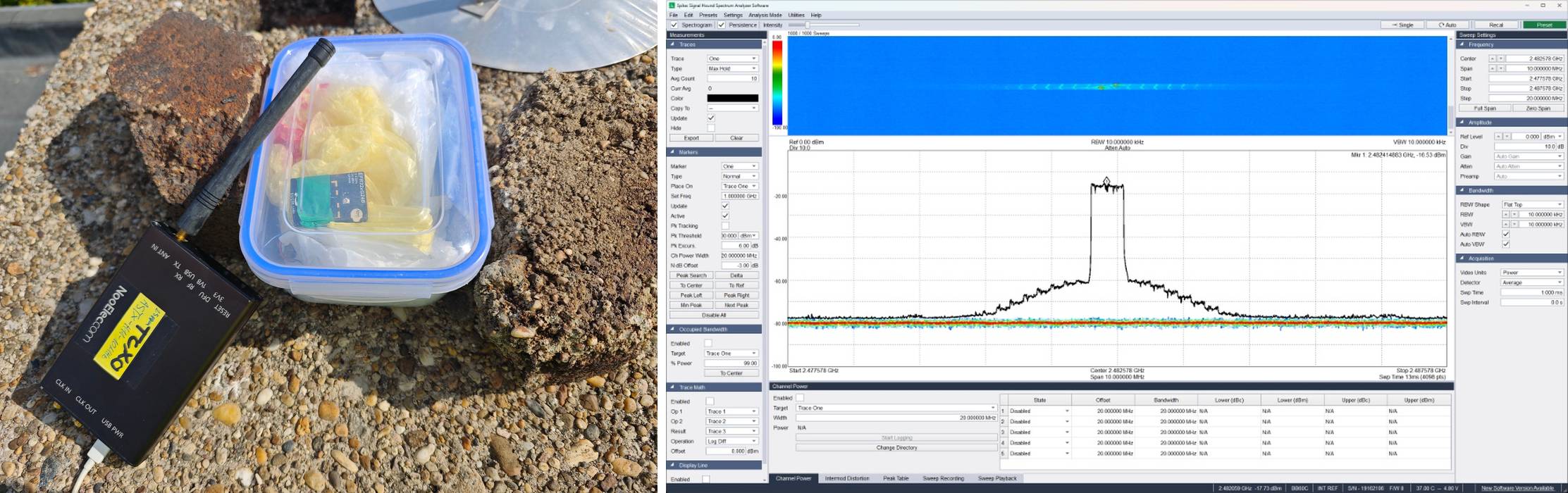
Locally, the transmitter was clearly working. He picked up bursts every 10 seconds near 2.482 GHz with a Signal Hound BB60C, a HackRF One running an Android RF analyzer app, and his ESP32-based ESPARGOS receiver array. The signal turns out to be narrowband and frequency hopping across 19 channels at the top of the 2.4 GHz band, rather than standard BLE advertising.
Unfortunately, over about eight weeks, the Hubble dashboard recorded zero satellite packets. The cause appears to be that Hubble’s satellite service currently only covers the USA, which was not clear in the onboarding documentation at the time. Satellite access also requires a paid “Live” organization, not the free Sandbox account he used. SatNOGS observations of HUBBLE-6 telemetry on 401.1 MHz confirmed that the satellites themselves were healthy. While this was a negative result so far, mostly due to his EU location, Zoltán's post is a useful write-up for anyone thinking of experimenting with the service. He notes that his next step is to try decoding the uplink frames locally with a PlutoSDR.