CyberEther V2 Released: GPU-Accelerated SDR Flowgraphs with Python Blocks, Tiling Displays and an Optional AI Assistant
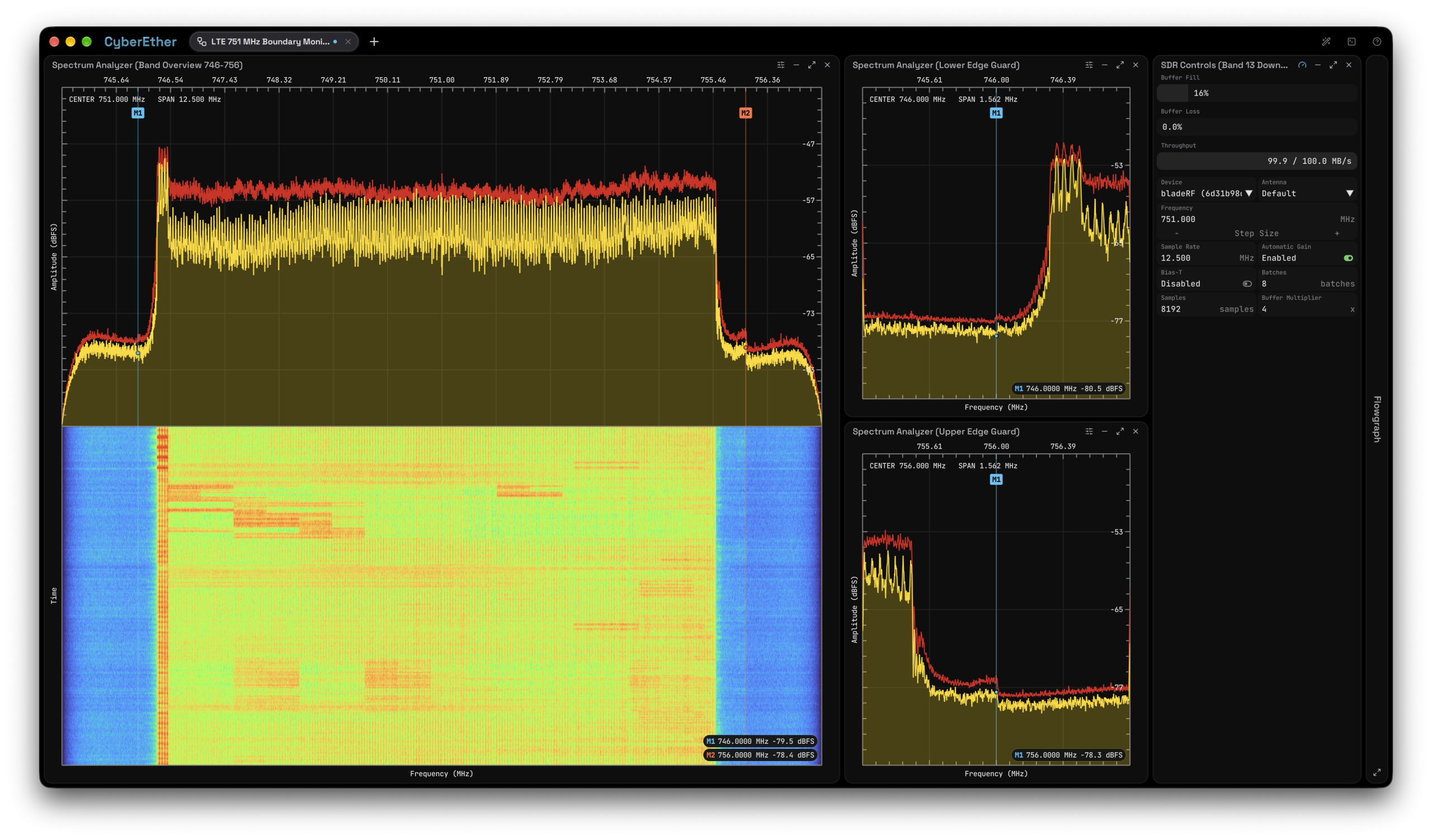
Luigi Cruz, the developer behind CyberEther and BirriaSDR, which we posted about back in October, has announced the release of CyberEther v2.0.0. CyberEther is an open-source, GPU-accelerated signal processing and visualization framework that Luigi has been developing since 2021. Luigi programs GPUs for SETI research at the Allen Telescope Array, and CyberEther is a tool he built for the job, written from scratch on Vulkan, Metal, and WebGPU. It runs on Windows, macOS, Linux, and the Raspberry Pi, and directly in a web browser via WebAssembly.
CyberEther has built-in drivers for the RTL-SDR (including bias tee control), Airspy, Airspy HF+, HackRF, LimeSDR, bladeRF, PlutoSDR and BirriaSDR, and other radios can be used via SoapySDR. Most of these also work in the browser version over WebUSB, so you can plug in an RTL-SDR and start processing signals without installing anything. A headless instance can also run on a server or Raspberry Pi and stream its interface to a browser over WebRTC.
Luigi describes the new version on X:
This CyberEther v2 is more opinionated in a good way. 1. It’s a general-purpose code editor for signal processing pipelines. 2. The flowgraph is how the data gets processed. It has standard building blocks to make almost everything from scratch. The Python block is also there to implement custom logic on the fly. 3. The stackable tiling compositor is how you display the processed data. The interface changes for the project. Not the other way around. 4. The interface is designed for humans while being fully integrated with the optional built-in agentic assistant. It’s also fully aware of the environment. It can answer questions, modify the pipeline, or even customize the tiling interface. I had fun developing it and hope you guys like it! Please share your feedback! https://t.co/DNHGYfg71k
— Luigi Cruz (@luigifcruz) November 25, 2026
The flowgraph interface includes over sixty built-in blocks, including FFTs, filters, AM, FM, and PSK demodulators; an ADS-B decoder; waterfall, spectrogram, and constellation displays; network streaming; and ONNX machine learning inference. Flowgraphs run live, so there is no generate-and-run step, and you can change parameters live while signals are flowing.
The Python block lets you write custom processing code with NumPy, or CuPy on NVIDIA GPUs, in an inline editor that reloads the block in place when you change the code. On the display side, plots and configuration panes sit in dockable tiles you can split, resize, and rearrange, and v2 now saves these layouts with each flowgraph. v2.0.0 also includes a gallery of example flowgraphs, built-in offline documentation, undo/redo, copy and paste of connected blocks, integrated terminal tiles, and LimeSDR XTRX support.
The optional AI assistant is only available in the desktop and server builds. It supports OpenAI, ChatGPT plan sign-in, Anthropic Claude, OpenRouter and Fireworks AI, as well as local models via any compatible server such as Ollama or vLLM. The AI can create entire flowgraphs, answer questions, diagnose errors, edit the flowgraph, inspect live signal data, and arrange plots into dashboards. It also offers an opt-in MCP server for connecting external AI agents. Luigi shows an example in the X post below.
The new CyberEther v2 has a built-in terminal that you can use with agents to create flowgraphs for you. I used Claude Code to create a simulated phase delays and polyphase filterbank of the Allen Telescope Array. It was smart enough to found the exact antenna positions and analyzed the FPGA code to learn the exact specifications and re-implemented it in Python inside the flowgraph. Pretty cool stuff!
— Luigi Cruz (@luigifcruz) November 26, 2026
Binaries for Windows, Apple Silicon macOS and x64 / ARM64 Linux (including CUDA builds) are available on GitHub, and the code is open source under the MIT license.
CyberEther vs GNU Radio
At first glance, many assume that CyberEther and GNU Radio overlap completely, but while they share the same DSP block design philosophy, the two projects diverge in many ways. GNU Radio has been a community project since 2001, with a team of core maintainers, many contributors over the years, dozens of actively maintained out-of-tree (OOT) modules, and a large body of academic work built on it. GNU Radio has always had a relatively high learning curve, and figuring out versioning and installing the version a project requires has been difficult. GNU Radio World, which we posted about in September, is a new addition that brings GNU Radio into the browser, reducing the installation requirements.
CyberEther, on the other hand, is still largely a one-person project. Luigi has authored the majority of the project, and while it has a plugin system, there is no real third-party ecosystem around it yet. However, CyberEther stands out for its GPU acceleration, fast and polished interface, and a canvas that doubles as the real-time GUI, so there is no separate GUI sink to add or code to generate. Combined with zero setup in the browser and an assistant that understands the whole environment, it is one of the quickest ways to get a capable signal processing workbench running. In addition, CyberEther has a permissive MIT license, meaning that it could be used in commercial closed-source work without the GPL baggage that comes with GNU Radio (apart from drivers like librtlsdr).





























Impressive release from Luigi Cruz! Combining real-time GPU signal processing, inline Python blocks, and a browser-ready WebGPU mode in one clean MIT-licensed package is fantastic news for the SDR community.
Visit Us<a href=”https://unissula.ac.id/”>Unissula</a>