Tagged: soapysdr

HaxaWave: Turning the Modem in an Old Qualcomm MSM8916 Phone into a 14.8 MS/s SoapySDR Receiver

Back in October, we posted about D325f-SDR, which turns the Qualcomm modem in an old LG phone into an SDR, and we posted an update last week. Now Piotr Krysik has written in to share HaxaWave, a similar project but for the MSM8916 modem in a Wileyfox Swift phone. Piotr notes that it has been in the works since before these phone SDRs started appearing this year.

HaxaWave is receive-only and needs no hardware modification. It tunes 735-995 MHz and 1195-2700 MHz at up to 14.8 MS/s, limited by the phone's USB 2.0 port.
Piotr notes that sensitivity varies strongly across the range because of the filters in the phone's receive path. The phone runs Nura (formerly postmarketOS) and shows up as a SoapySDR device, so programs like SDR++ work on a PC over USB networking, or on the phone itself.

Rather than patching the stock modem image, the firmware is built from Qualcomm's public modem_proc source with a few small patches. The SDR itself is a Hexagon DSP program loaded at run time, and the stock firmware can be selected again at any time. The project is experimental and tested on one phone only. The code is open source under the GPL-3.0 licence and available on GitHub, along with a build and install guide and a description of how the receive path works.
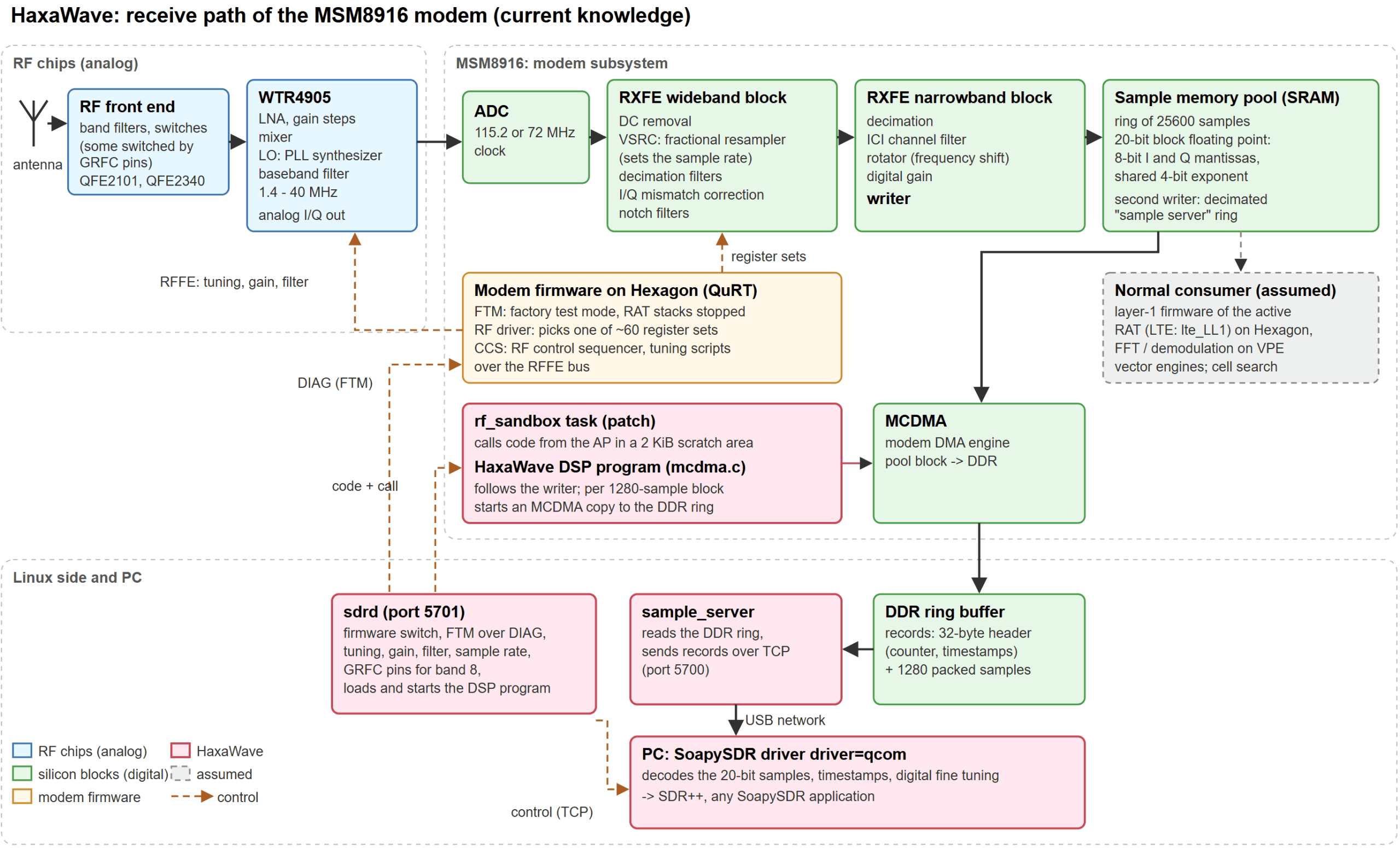
Block Diagram of the MSM8916 Modem
HaxaWave: Comparing a USRP B210 with the modem of a phone used as an SDR

AI Disclaimer: Piotr notes that the project was developed with the help of LLM tools, and the README states that language models did a large part of the work.

RTLSDR-Airband V3 Released

Thanks to RTL-SDR.com reader Lee Donaghy for writing in and little us know that RTLSDR-Airband was recently updated to include SoapySDR support. This allows the software to now work with almost any SDR including the RTL-SDR, Airspy, SDRplay, HackRF, LimeSDR and more. They have also removed the 8-channels per device limitation and applied various bug fixes too. The full changelog is posted at the end of this post.

RTLSDR-Airband is a Linux based command line tool that allows you to simultaneously monitor multiple AM or FM channels per SDR within the same chunk of bandwidth. It is great for monitoring narrowband communications such as aircraft control and can be used to feed websites like liveatc.net, or for use with a Icecast server, or simply for continuously recording multiple channels to an MP3 file locally. It is also very useful for those running on low powered computing hardware who want software that uses less CPU power than a full GUI program like GQRX or CubicSDR.

Version 3.0.0 (Feb 10, 2018):

  • Major overhaul of the SDR input code - now it's modular and hardware-agnostic (no longer tightly coupled with librtlsdr).
  • Support for SoapySDR vendor-neutral SDR library - any SDR which has a plugin for SoapySDR shall now work in RTLSDR-Airband.
  • Support for Mirics DVB-T dongles via libmirisdr-4 library.
  • Support for RTLSDR is now optional and can be disabled at compilation stage.
  • Removed the 8-channels-per-device limit in multichannel mode.
  • Configurable per-device sampling rate.
  • Configurable FFT size.
  • Support for multibyte input samples.
  • Support for rawfile outputs (ie. writing raw I/Q data from a narrowband channel to a file for processing with other programs, line GNUradio or csdr).
  • INCOMPATIBLE CHANGE: removed rtlsdr_buffers global configuration option; buffer count can now be adjusted with a per-device "buffers" option.
  • INCOMPATIBLE CHANGE: removed syslog global configuration option; syslog logging is now enabled by default, both in foreground and background mode. To force logging to standard error, use -e command line option.
  • Added -F command line option for better cooperation with systemd. Runs the program in foreground, but without textual waterfalls. Together with -e it allows running rtl_airband as a service of type "simple" under systemd. Example rtl_airband.service file has been adjusted to reflect this change.
  • Added type device configuration option. It sets the device type (ie. the input driver which shall be used to talk to the device). "rtlsdr" is assumed as a default type for backward compatibility. If RTLSDR support has been disabled at compilation stage, then there is no default type - it must be set manually, or the program will throw an error on startup.
  • Frequencies in the config can now be expressed in Hz, kHz, MHz or GHz for improved readability.
  • Lots of bugfixes.
  • Rewritten documentation on Github Wiki.