Tagged: USRP B210

VMA Radio Lab: DecSAT Extended into a Multi-SDR Receiver with DVB-T/T2, DAB+ and Analog PAL TV

Last week we posted about DecSAT, an open-source program by CasualArclamp that turns a HackRF One into a DVB-S/S2/S2X satellite receiver and analyzer. Now Vitor Martins Augusto has written to share his fork, 'VMA Radio Lab' (initially called DecSAT-VMA), which extends DecSAT into a general-purpose broadcast receiver and measurement tool.

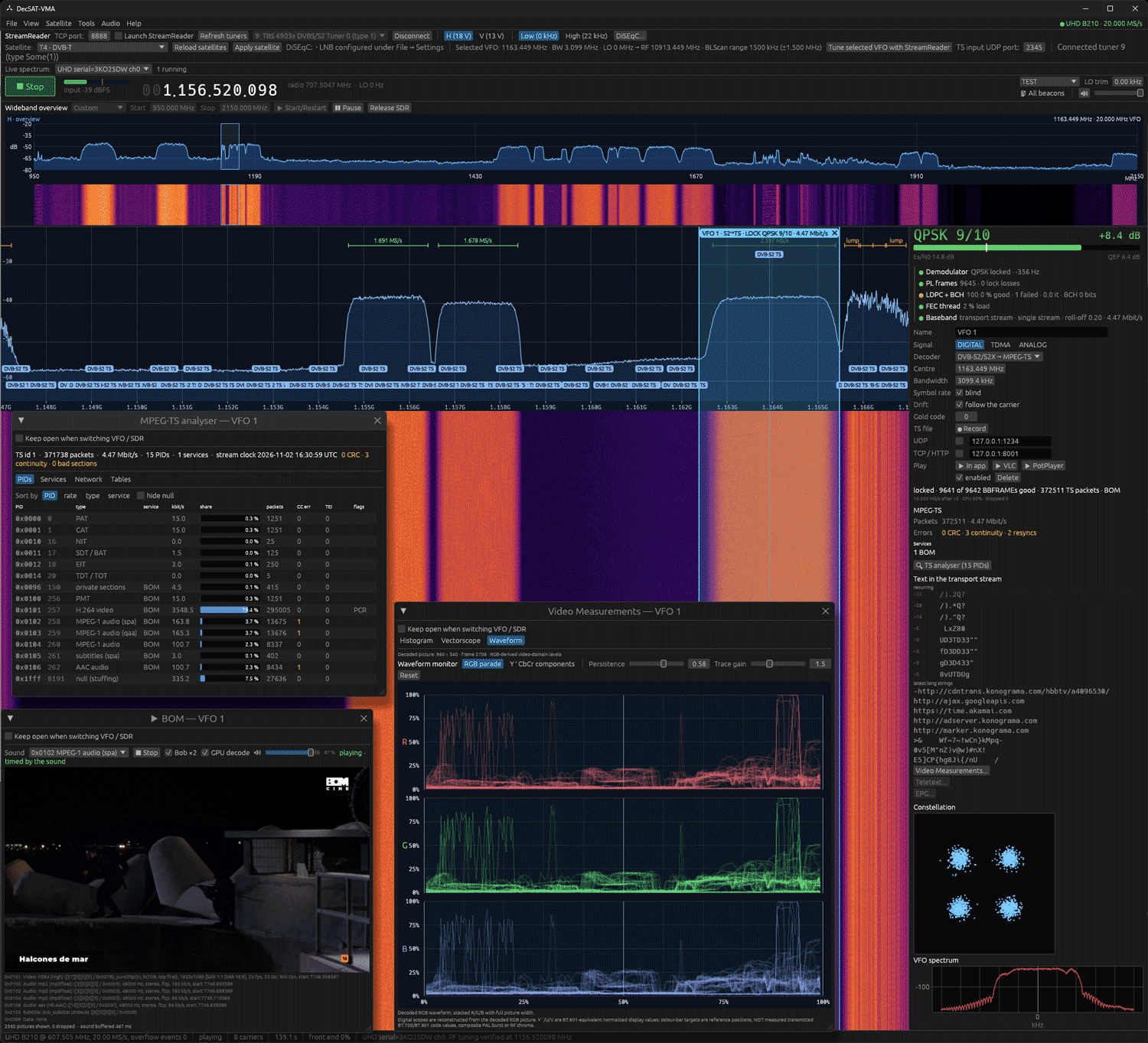
The biggest difference between DecSAT and VMA Radio Lab is multi-SDR operation. VMA Radio Lab can run several SDRs at once, each with its own VFOs, including the HackRF, PlutoSDR, USRP B210, RTL-SDR, SDRplay RSP1 and Airspy. One SDR can be dedicated to a sweeping wideband overview, such as the full 950 - 2150 MHz satellite IF. It also pulls in DVB-T/T2, DAB/DAB+ and TETRA decoding from CasualArclamp's sibling projects DecDVB-T, DecDAB and DecLAB, and adds analog radio, PAL color TV with teletext, measurement tools such as a vectorscope and transport stream analyzer, and control of CrazyScan-compatible TBS tuner cards for LNB power and hardware DVB reception.

Meanwhile, the original DecSAT remains satellite-focused. Since our last post it has added support for Fobos SDR, Airspy and network IQ input (including rtl_tcp), and has merged some of VMA's early RTL-SDR, PlutoSDR, B210 and analog TV code.

VMA Radio Lab is GPLv3 and available as a Windows 64-bit build and source zip on the website. We note that TETRA audio needs a separate ACELP codec DLL that isn't included for legal licensing reasons, and the bundled development notes describe several of the newer decoders, such as AIS and ACARS, as experimental. 

Decscat-VMA Screenshot

AI Disclaimer: The original DecSAT lists Claude as a contributor. While VMA does not disclose it, the development notes included with the VMA Radio Lab source suggest that its extensions were also written with the help of AI.
NNJ-SDR++: Improved Firmware and Software for Kintex-7 AD9361 B210 Clones

USRP B210 Chinese clones can now be commonly found on marketplace sites for less than USD$300. This is a bargain, considering that an original USRP B210 (board only) costs US$2,387. The disadvantage is, of course, janky ported firmware that doesn't support all the available features and doesn't maximize the available performance.

Recently, Fabrizio Francione wrote in and wanted to share his new firmware and software project, called "NNJ-SDR++ UHD Edition V1.0". This project consists of improved firmware that unlocks the full sample rate, fixes various problems, and enables the onboard GNSS receiver. It also includes a modified SDR++ frontend that exposes more controls. Fabrizio writes:

The work involved substantial FPGA and software development rather than simply customizing the SDR++ interface. Starting from the original B210-compatible architecture, I progressively redesigned and extended several areas of the firmware, including improved CIC numerical handling, RX/TX fixed-point processing, BRAM-based asynchronous transport FIFOs, CIC passband compensation, a wideband FIR receive path, ADC clipping/overload telemetry, runtime FPGA control and diagnostics, and a dedicated wideband profile for operation at up to 56 MS/s.

I also finally integrated the board's onboard u-blox MAX-M10S GNSS receiver directly with the FPGA, including GPS UART data, internal PPS capture and timing telemetry, while preserving external 10 MHz reference and PPS support.

On the host side, I developed a customized UHD 4.10 environment and SDR++ frontend for both Windows and Linux. The application exposes RF filter bandwidth, LO offset, reference lock, PPS status, GNSS information, firmware telemetry and other board-specific controls directly from the SDR++ source panel.

One particularly interesting part of the project was making sustained 56 MS/s operation practical across both operating systems while retaining B210/UHD compatibility.

The Firmware is not open source or free, and Fabrizio is selling it for US$19.90.

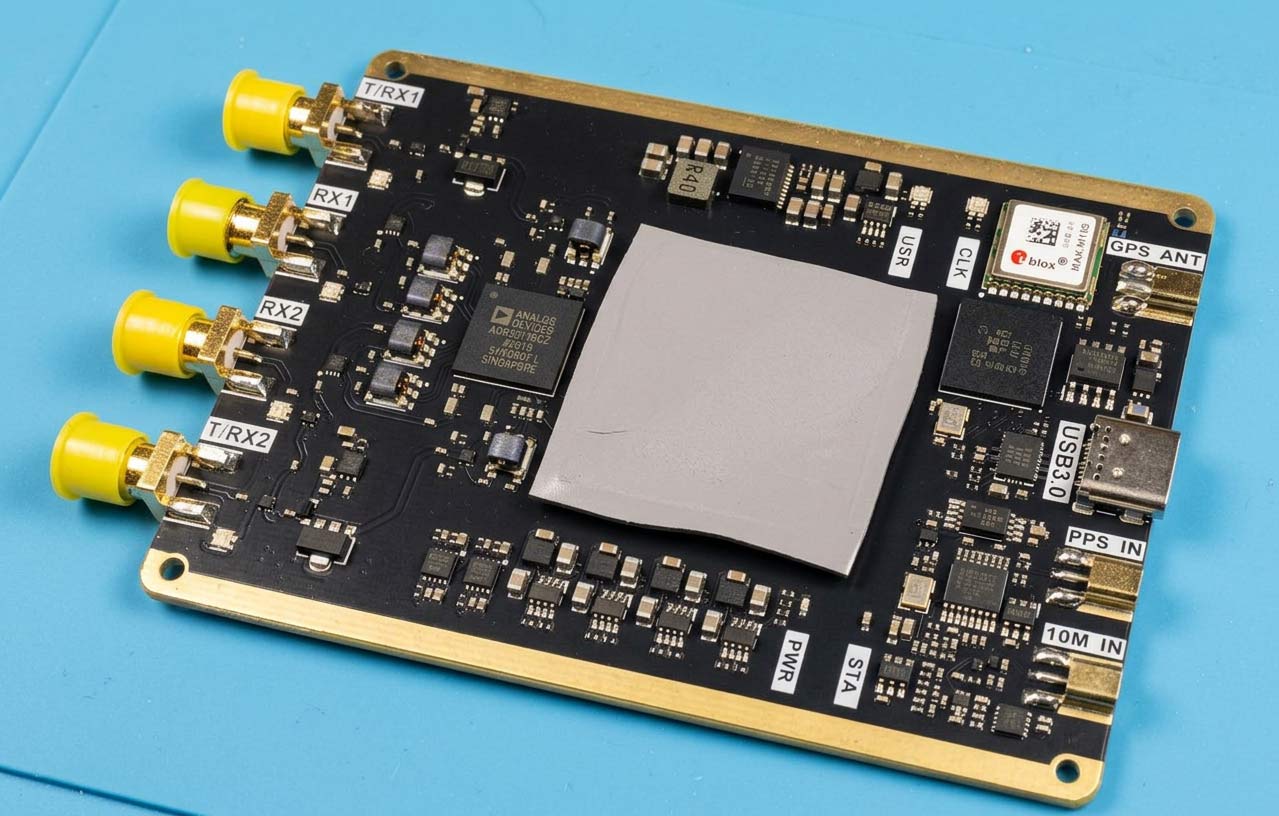
The inside of a B210 Clone
Kintex-7 FPGA & custom SDR++ : 56 MHz Wideband Waterfall