Tagged: DVB-T2

VMA Radio Lab: DecSAT Extended into a Multi-SDR Receiver with DVB-T/T2, DAB+ and Analog PAL TV

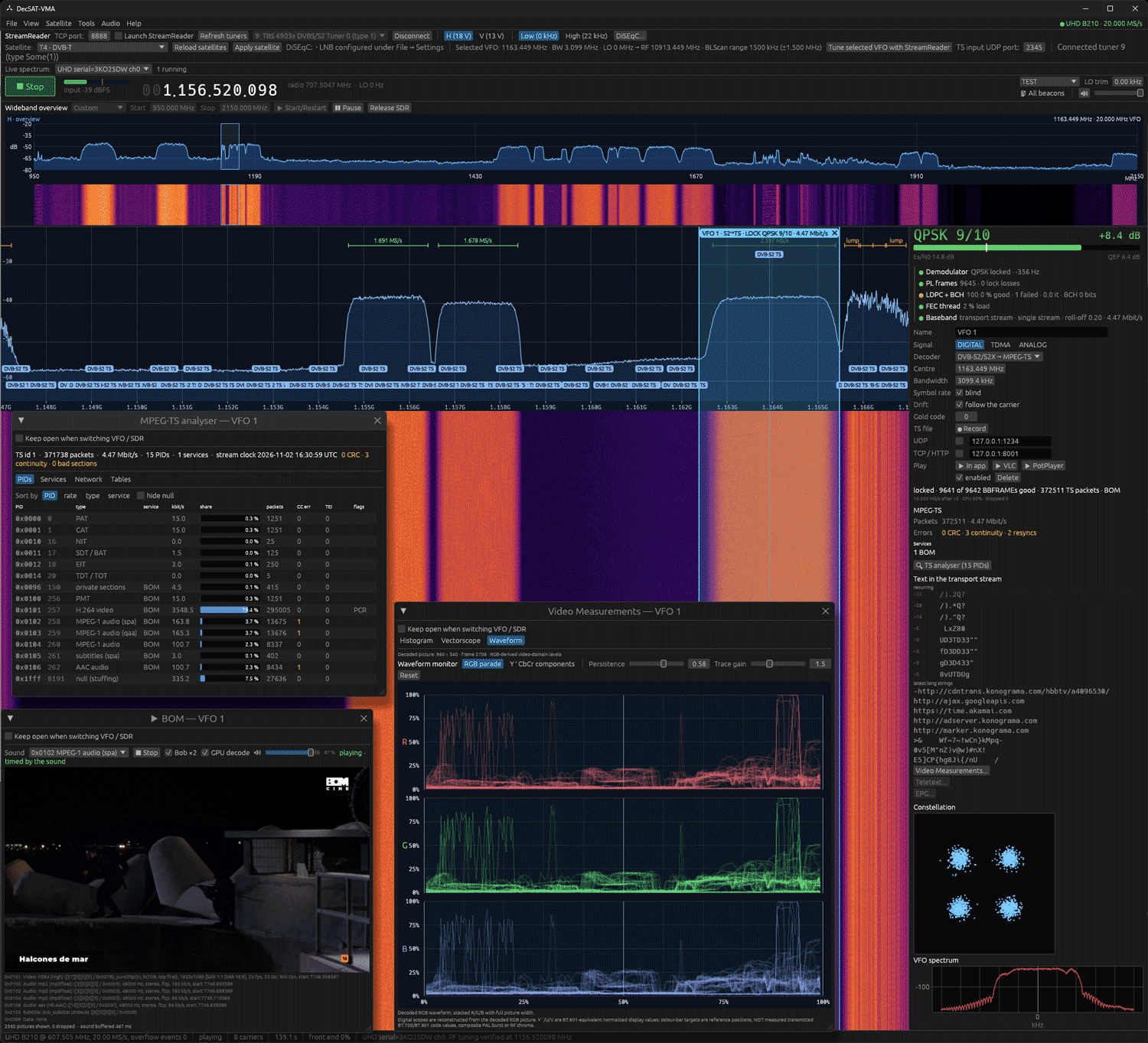
Last week we posted about DecSAT, an open-source program by CasualArclamp that turns a HackRF One into a DVB-S/S2/S2X satellite receiver and analyzer. Now Vitor Martins Augusto has written to share his fork, 'VMA Radio Lab' (initially called DecSAT-VMA), which extends DecSAT into a general-purpose broadcast receiver and measurement tool.

The biggest difference between DecSAT and VMA Radio Lab is multi-SDR operation. VMA Radio Lab can run several SDRs at once, each with its own VFOs, including the HackRF, PlutoSDR, USRP B210, RTL-SDR, SDRplay RSP1 and Airspy. One SDR can be dedicated to a sweeping wideband overview, such as the full 950 - 2150 MHz satellite IF. It also pulls in DVB-T/T2, DAB/DAB+ and TETRA decoding from CasualArclamp's sibling projects DecDVB-T, DecDAB and DecLAB, and adds analog radio, PAL color TV with teletext, measurement tools such as a vectorscope and transport stream analyzer, and control of CrazyScan-compatible TBS tuner cards for LNB power and hardware DVB reception.

Meanwhile, the original DecSAT remains satellite-focused. Since our last post it has added support for Fobos SDR, Airspy and network IQ input (including rtl_tcp), and has merged some of VMA's early RTL-SDR, PlutoSDR, B210 and analog TV code.

VMA Radio Lab is GPLv3 and available as a Windows 64-bit build and source zip on the website. We note that TETRA audio needs a separate ACELP codec DLL that isn't included for legal licensing reasons, and the bundled development notes describe several of the newer decoders, such as AIS and ACARS, as experimental. 

Decscat-VMA Screenshot

AI Disclaimer: The original DecSAT lists Claude as a contributor. While VMA does not disclose it, the development notes included with the VMA Radio Lab source suggest that its extensions were also written with the help of AI.
Muxwright: A Multi-Standard Radio and TV Test Transmitter for the PlutoSDR

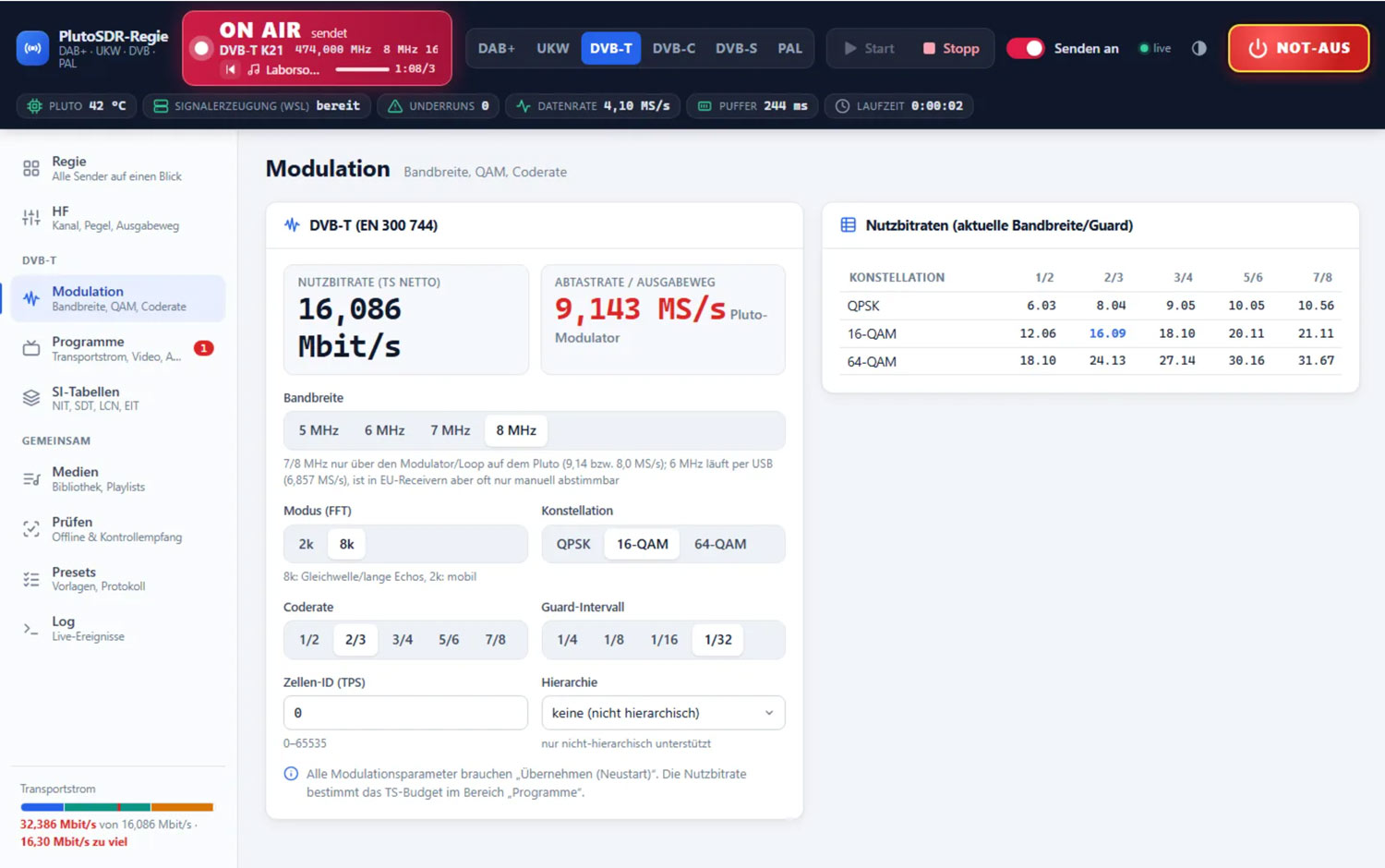
Thank you to Peter Holzhauser for writing in and sharing Muxwright, a multi-standard radio and TV test transmitter for the ADALM-Pluto (PlutoSDR). Peter has in the past submitted his ESPSoup, and Etherbulb projects. Muxwright is intended for home lab testing only, with the Pluto connected to the receiver under test via cable and attenuator or inside a shielded box, as radiating broadcast standards over the air requires a frequency assignment.

Muxwright can generate FM stereo with RDS/RBDS, DAB+, DVB-T, DVB-T2, DVB-C, DVB-S/S2, ATSC 1.0, ISDB-T, DTMB and analog PAL/NTSC TV, plus DVB-S2 DATV for QO-100 and other amateur bands (which of course requires an amateur radio license). The digital TV modulators run directly on the Pluto and everything is controlled from a browser dashboard. The Pluto's RX input can also be used as a monitoring receiver for expected vs. actual test reports.

The software runs on Windows 10/11 via WSL2 and is currently at Beta 0.4. The README notes that it has only been verified on the original Pluto Rev. B, and that DVB-T2, ATSC, ISDB-T and DTMB are still untested with real TV sets. The code is MIT licensed (with the FM/RDS module under GPL-3.0) and available on GitHub, however, the Windows installer is only available by request via email from the website.

Muxwright Transmitting DVB-T with a PlutoSDR

AI Disclaimer: The project's GitHub commit history lists Claude as a co-author.

OnAir: A Digital TV and DAB Decoder for SDRs

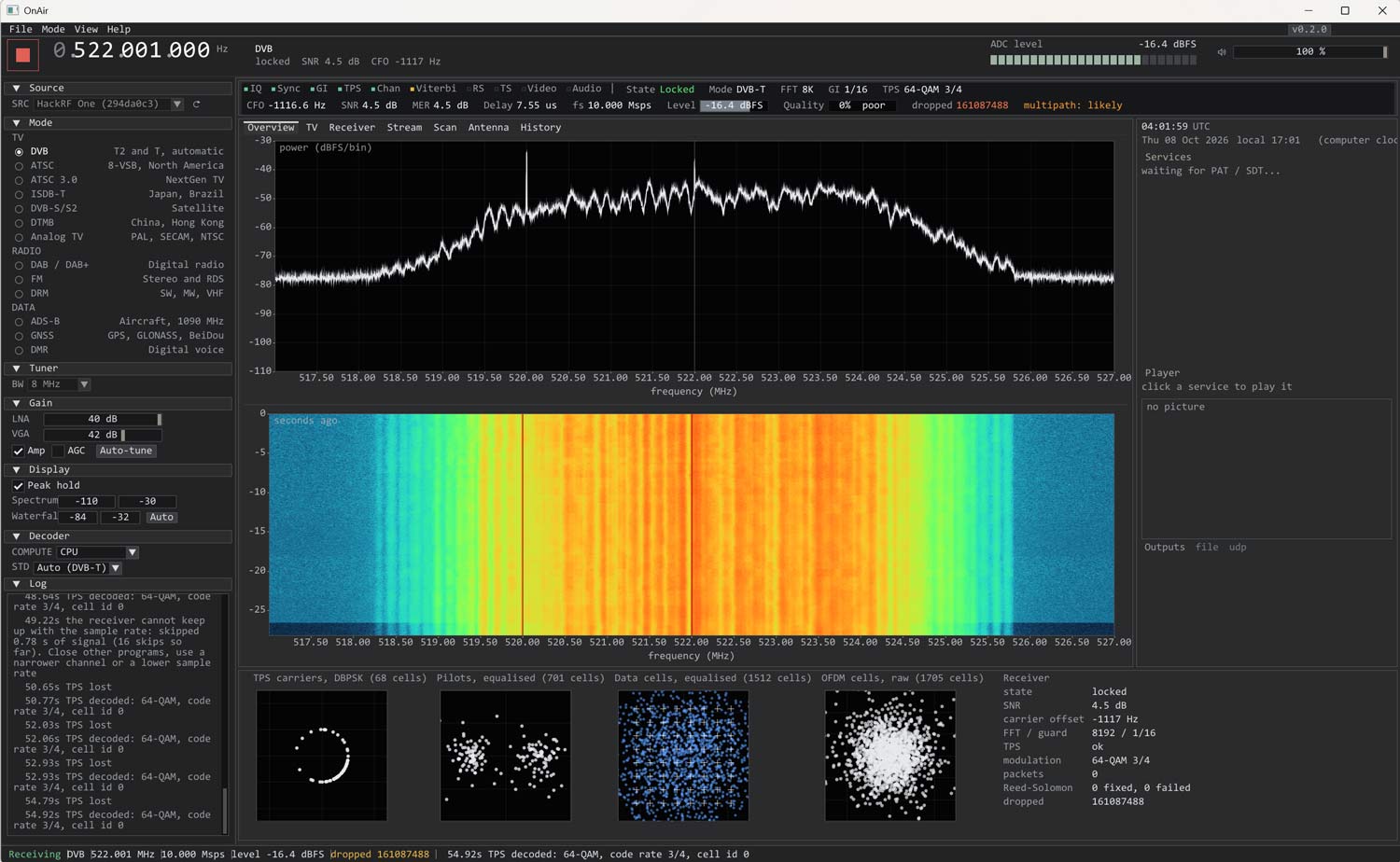
Thank you to Kristijonas for writing in and sharing with us his project, OnAir. OnAir is an easy-to-use digital TV decoder for DVB-T2, DVB-T, ATSC 1.0, ATSC 3.0, ISDB-T, and a digital audio decoder for DAB / DAB+ and FM Radio. It also supports Analog TV modes such as PAL, SECAM, and NTSC, and data modes like ADS-B, GNSS (GPS, GLONASS, BeiDou), and DMR.

It supports various wideband SDRs, including HackRF, PlutoSDR, BladeRF, LimeSDR, USRP, Airspy R2, and SDRplay. RTL-SDRs unfortunately do not have enough bandwidth to decode digital TV channels in SDR mode, but the software still supports RTL-SDRs for narrowband signals.

The software is easy to install, with an installer .exe being available for Windows, a .deb file for Debian Linux, and a .dmg file for macOS. 

OnAir Screenshot
OnAir Screenshot

AI Disclaimer: This software lists Claude as a contributor.