Tagged: l-band

RTL-SDR Heat Dissipation as seen by a Thermal Camera

The RTL-SDR is known to get quite hot during operation and when it gets too hot reception of frequencies over 1.2 GHz can be degraded. Marko Cebokli wrote into us at RTL-SDR.com to show us some thermal imaging pictures that he has made of the RTL-SDR PCB. The images clearly show that the hottest part of the PCB is the R820T chip. The RTL2832U chip stays cool and the only other hot component on the PCB is the voltage regulator. In the post Marko also explains his conclusions on why the reception fails at frequencies over 1.2 GHz when it gets too hot.

The images show that the top of the R820T chip reaches a temperature of 85 degrees Celsius after just 10 minutes of operation. The underside of the chip reaches 68.9 degrees Celsius. Marko writes that these temperatures may be even higher when the RTL-SDR is placed inside the plastic case.

In general the RTL-SDR runs fine at these temperatures, but cooling the R820T chip will improve performance when tuning into signals that are higher than 1.2 GHz, for example with L-band satellites. Other RTL-SDR enthusiasts have cooled their RTL-SDR’s with thermal pads, heatsinks, fans and oil.
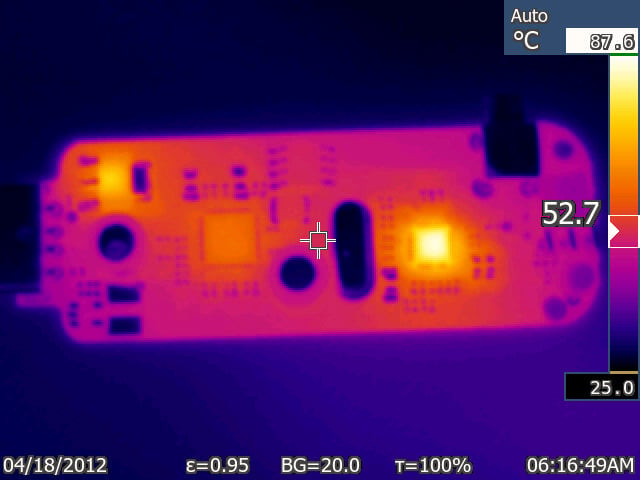
The RTL-SDR PCB seen with a thermal camera

Another L-Band Antenna Build and comparing L-Band reception on the RTL-SDR, HackRF and SDRplay

Over on Reddit user killmore231 has made a post showing his comparison of L-Band reception with RTL-SDR, HackRF and SDRplay software defined radios. killmore231 built the L-band patch antenna which Adam 9A4QV showed how to build on his YouTube channel late last month.

When testing the antenna on his RTL-SDR he saw no reception of any L-band signals at all. The RTL-SDR requires an external LNA to properly receive signals at this frequency range, which he did not have. Next he tried it on his HackRF and saw that some signals were weakly visible. When he tried it on his SDRplay the L-band satellite signals were clearly visible, probably due to the SDRplay’s good sensitivity at this frequency range and the fact that it has a built in LNA. His results show that the SDRplay is a good SDR for receiving L-band satellites as it does not need an external LNA for decent reception. An external LNA may still be needed if a long run of coax cable is used however.

SDRplay reception of L-band satellite signals with no external LNA.
L-band patch antenna

Comparing RTL-SDR’s on L-Band Reception, Tuner Temperatures and Passive Cooling

Over on Reddit user MaxWorm has been doing some experiments with comparing various RTL-SDR dongles on L-band (1 – 2 GHz) reception. Previously we wrote a tutorial on decoding Inmarsat signals which are at around 1.5 GHz and noted that the R802T/2 dongles can have some trouble at these frequencies.

It is known that the R820T/2 is not as good as the older now rare and expensive E4000 tuners at frequencies above 1.5 GHz, and it is also known that sensitivity decreases as the temperature of the R820T/2 increases, especially at frequencies above 1.5 GHz.

MaxWorm tested an R820T, R820T2 and two E4000 sticks at receiving L-band frequencies. He found that one of the E4000’s performed the best, but surprisingly the other E4000 dongle was totally deaf in the L-band. The R820T and R820T2 dongles performed similarly – not as good as the best E4000, but not as bad as the worst. All tuners exhibited reduced signal strength when warm.

In another post MaxWorm also measured the temperature of the tuner chips in each of his units, and created a simple heatsink for one of his R820T2 dongles. His results show that the heatsink passive cooling works well, significantly cooling the R820T2 chip. His measurements are copied below:

R820T2 in Plastic case:
R820T2: 77°C top / 74°C bottom
RTL2832: 56°C top / 54°C bottom

R820T2 bare PCB:
R820T2: 62°C top / 63°C bottom
RTL2832: 43°C top / 42°C bottom

R820T2 in Alu-Case with Alu “L-Bridge” on Tuner:
R820T2: top 37°C / bottom 47°C
RTL2832: top 49°C / bottom 40°C

E4000 in plastic case:
E4000: 37°C top / 37°C bottom
RTL2832: 46°C top / 40°C bottom

bare E4000 PCB:
E4000: 37°C top / 32°C bottom
RTL2832: 40°C top / 37°C bottom

Other experimenters have previously applied fan cooling and oil cooling to RTL-SDR dongles to cool them and increase sensitivity.

RTL-SDR with heat sink to aluminium case.
RTL-SDR with heat sink on the R820T2 chip connectoed to the aluminium case.
L-Band Reception Results for an R820T, R820T2 and two E4000 dongles.