Tagged: meshtastic

GridDown: An Offline-First Situational Awareness Platform with RTL-SDR, SARSAT, Meshtastic

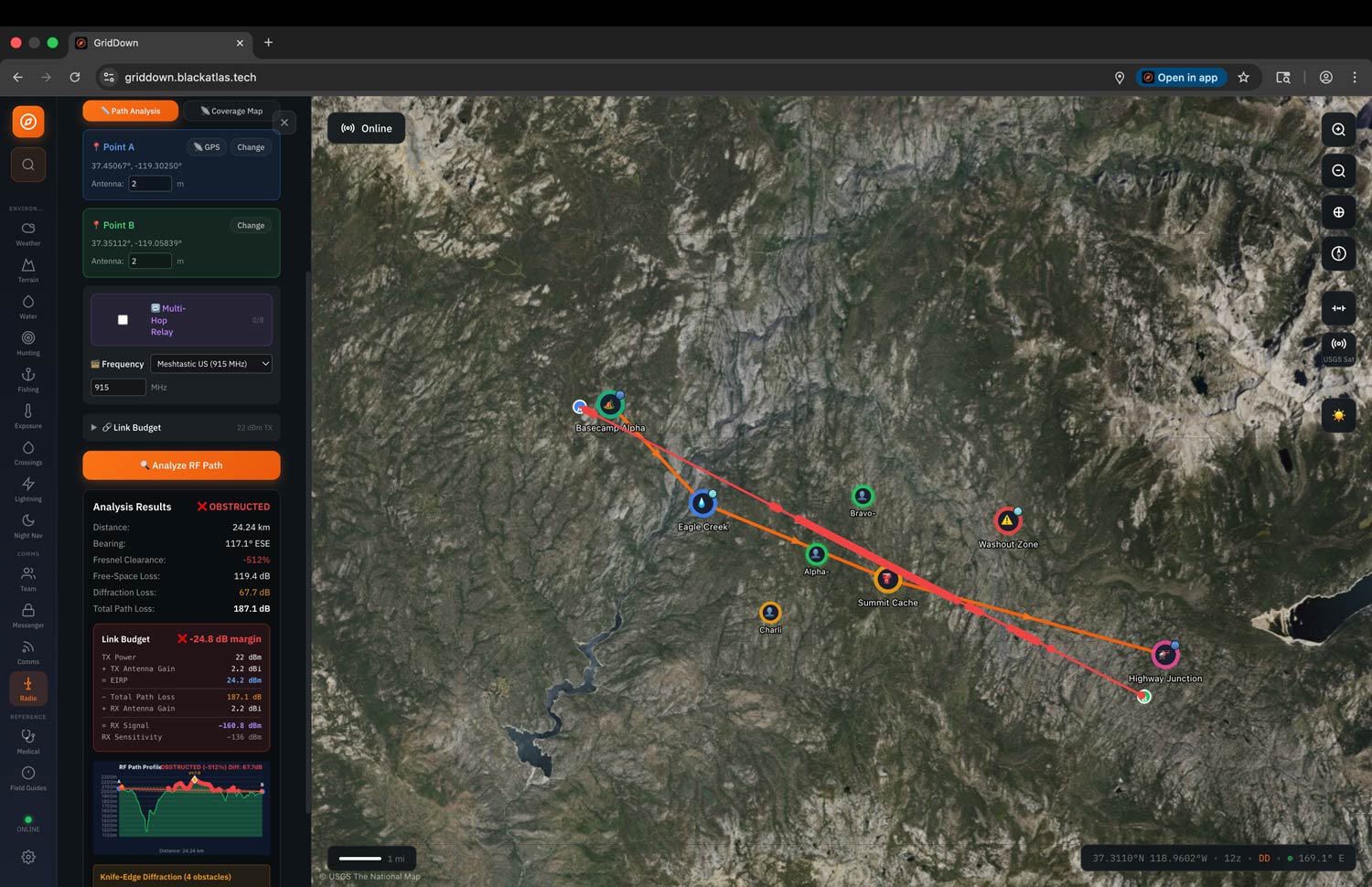
Thank you to Cameron from BlackAtlas LLC for submitting their project GridDown, which is an open source Android tablet-based situational awareness system designed to operate without an internet connection. At its core, it appears to be a tablet with custom software, and then you can add sensors such as an RTL-SDR for ADS-B+Remote ID, a SARSAT receiver, and a Meshtastic ESP32-S3+SX1262 device. A demonstration of the UI can be found at https://griddown.blackatlas.tech.

Cameron writes:

[GridDown is] an offline-first situational awareness platform built for emergency preparedness, field response, and tactical operations in infrastructure-degraded environments — designed to work when cell towers are down, internet is unavailable, and operators are fully off-grid.

The platform is a Progressive Web App (~120,000 lines of vanilla JavaScript, no frameworks) that runs on Samsung Galaxy tablets, laptops/PCs, and works completely offline after initial setup. It's built by BlackAtlas LLC and is available for trial at https://griddown.blackatlas.tech.

The system has many facets to it, including:

  • Encrypted voice and text messaging via an ESP32-S3 with SX1262 LoRa transceiver
  • Passive RF sensing with the ESP32-S3 and SX1262.
  • Three passive drone detection methods: WiFi fingerprinting, FAA Remote ID reception, and 900 MHz control/telemetry link detection
  • Automatic gunshot detection via a ES7210 quad-channel I2S microphone on the ESP32-S3.
  • Automatic RF jamming detection
  • SARSAT beacon receiver
  • SSTV Encode/Decode
  • Meshtastic integration
  • APRS via Bluetooth TNC
  • ADS-B reception
  • RadioCode gamma spectrometer integration
  • Offline maps

ADS-B detection is handled by a Raspberry Pi 5 running an RTL-SDR Blog V4 dongle. Cameron writes:

The Pi connects to the tablet's built-in WiFi hotspot (no internet required — the hotspot functions as a local network only), and a Node.js bridge reads aircraft data from readsb and subscribes to the Remote ID receiver's MQTT output, then serves a unified WebSocket and REST API to the tablet. GridDown renders aircraft and drone tracks as heading-rotated silhouette icons on its offline map with altitude labels, age-based alpha fade, and emergency squawk alerting (7500/7600/7700). A 10,000 mAh USB-C PD battery provides approximately 5 hours of field runtime for the Pi.

The full setup script, hub bridge, and hotspot connection scripts ship with the project.

The software is dual-licensed, with it being open source GPL v3 (note that the GitHub link appears to be broken - we have asked for clarification) for non-commercial use, or a commercial licence for hardware bundles and business deployments. 

Alternatively, BlackAtlas LLC is selling ready-to-use kits, with the core tablet coming in at $799. Other bundles include the Tablet + SARSAT receiver for $1,299, the Tablet + Meshtastic bundle for $1,299, and the Tablet + ADS-B/Remote ID bundle for $1,999.

The GridDown Web Interface

Transmitting and Receiving Meshtastic with SDR

Last month we posted about Aaron's video on Meshtastic, and how it's possible to decode the Meshtastic protocol using an RTL-SDR and GNU Radio project called Meshtastic_SDR

If you weren't aware, Meshtastic is software that enables off-grid mesh network based communications and can run on cheap LoRa hardware. The mesh based nature of the system means that communications can be received over long distances, without any infrastructure, as long as there are sufficient Meshtastic nodes in an area that can route the message to the destination node. One example application of Meshtastic is to use it as a mesh-based text messaging system. This might be useful for teams of hikers, pilots, or skiers who operate in remote areas without cell phone coverage.

In his latest video, Aaron shows how Meshtatsic_SDR can also be used to transmit the Meshtastic Protocol using a transmit capable SDR like the HackRF. Aaron writes in the video description:

In this video, we take a deeper dive into the setup and usage of the meshtastic_SDR repository, which now enables the transmission and reception of Meshtastic using Software Defined Radios (SDRs). Recent updates have made this possible by partially leveraging GNU Radio flow graphs for both RX (receive) and TX (transmit), and integrating Python scripts that connect to ZMQ sources for message input and ZMQ outputs for message decoding.

I demonstrate the setup using a HackRF for the transmit side and an Airspy R2 for receiving. We also verify the results of TX and RX using a standard Meshtastic receiver to ensure accurate performance.

DragonOS FocalX Transmit and Receive Meshtastic w/ SDR (hackRF, Airspy R2, R36)

Decoding Meshtastic in Realtime with an RTL-SDR and GNU Radio

Over on his YouTube channel, Aaron, creator of DragonOS and WarDragon has uploaded a video showing how it is possible to decode Meshtastic with an RTL-SDR and GNU Radio project called Meshtastic_SDR

If you weren't aware of it, Meshtastic is software that enables off-grid mesh network based communications and can run on cheap LoRa hardware. The mesh based nature of the system means that communications can be received over long distances, without any infrastructure, as long as there are sufficient Meshtastic nodes in an area that are able to route the message to the destination node. One example application of Meshtastic is to use it as a mesh-based text messaging system. This might be useful for teams of hikers, pilots, or skiiers who operate in remote areas without cell phone coverage.

In the video, Aaron shows how to install the Meshtastic GNU Radio software on DragonOS (Linux), and how to run the GNU Radio flowgraph and Python decoder script. Later in the video Aaron shows some test text messages being received by the software.

The Meshtastic_SDR project can also be used to transmit Meshtastic messages with an appropriate TX-capable SDR.

WarDragon Real-Time Decoding Meshtastic w/ GNU Radio & SDR (RTLSDR v3)

Tech Minds: Testing Meshtastic Compatible Lilygo LoRa Devices

In the latest video on the Tech Minds YouTube channel Matt tests out the Meshtastic software running on varius Lilygo LoRa devices. Meshtastic is software that can run on cheap LoRa hardware that enables off-grid mesh network based communications.

Being mesh network based means that there are no central repeaters, and instead each device can extend the range of the network by being a repeater itself. Meshtastic can run on various cheap 'Lilygo' branded LoRa devices that come in 433, 868 or 915 MHz license free frequencies depending on your regional band plan.

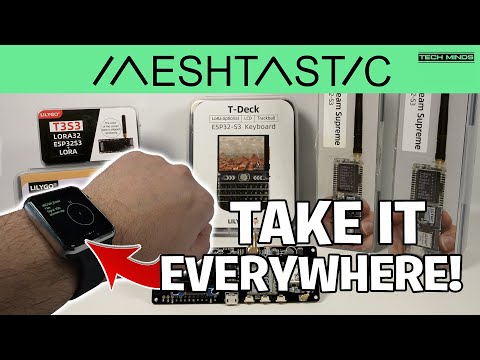
In his video Matt tests out various models in the Lilygo range, including a ESP32 based wrist watch and he also shows how to install the firmware on each using the online flasher.

Meshtastic Compatible Lilygo Lora Devices

TechMinds: Testing Off-Grid LoRa Radio Mesh Text Messaging with Meshtastic

Low cost ESP32 based LoRa capable boards have been available from marketplaces like Aliexpress for some time now. They typically include features such as LoRa, WiFi or Bluetooth and GPS all on a PCB board with small screen and battery holder for mobile use. LoRa is a modern IoT communications protocol that is designed to be operated with low power, and in a networked mesh-way for extended range. One application of this hardware is to use it as a mesh based text messaging system, using the Meshtastic firmware. This might be useful for teams of hikers, pilots, or skiiers who operate in remote areas without cell phone reception.

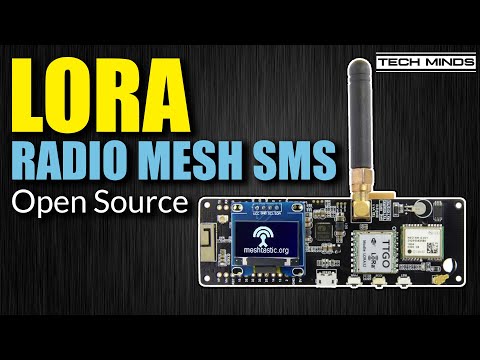
In his latest video Matthew from the Tech Minds YouTube channel shows how to install and use the Meshtastic firmware on a TTGO board. He uses the alpha firmware which has a web app, allowing users to send text messages through a web based GUI that users can connect to locally via WiFi.

OFF-GRID LORA Radio Mesh Text Messaging - Meshtastic