Turning the Raspberry Pi 5’s Onboard BCM43455 Wi-Fi Chip into a Receive-Only SDR
Inspired by the ESP32 ESP-SDR work, TheOddSock has posted on Reddit about 'pi5-wifi-sdr', which turns the Raspberry Pi 5's onboard Broadcom BCM43455c0 Wi-Fi chip into an experimental receive-only SDR. It repurposes a diagnostic collector in the chip that normally records only short baseband captures, as explained in the technical report.
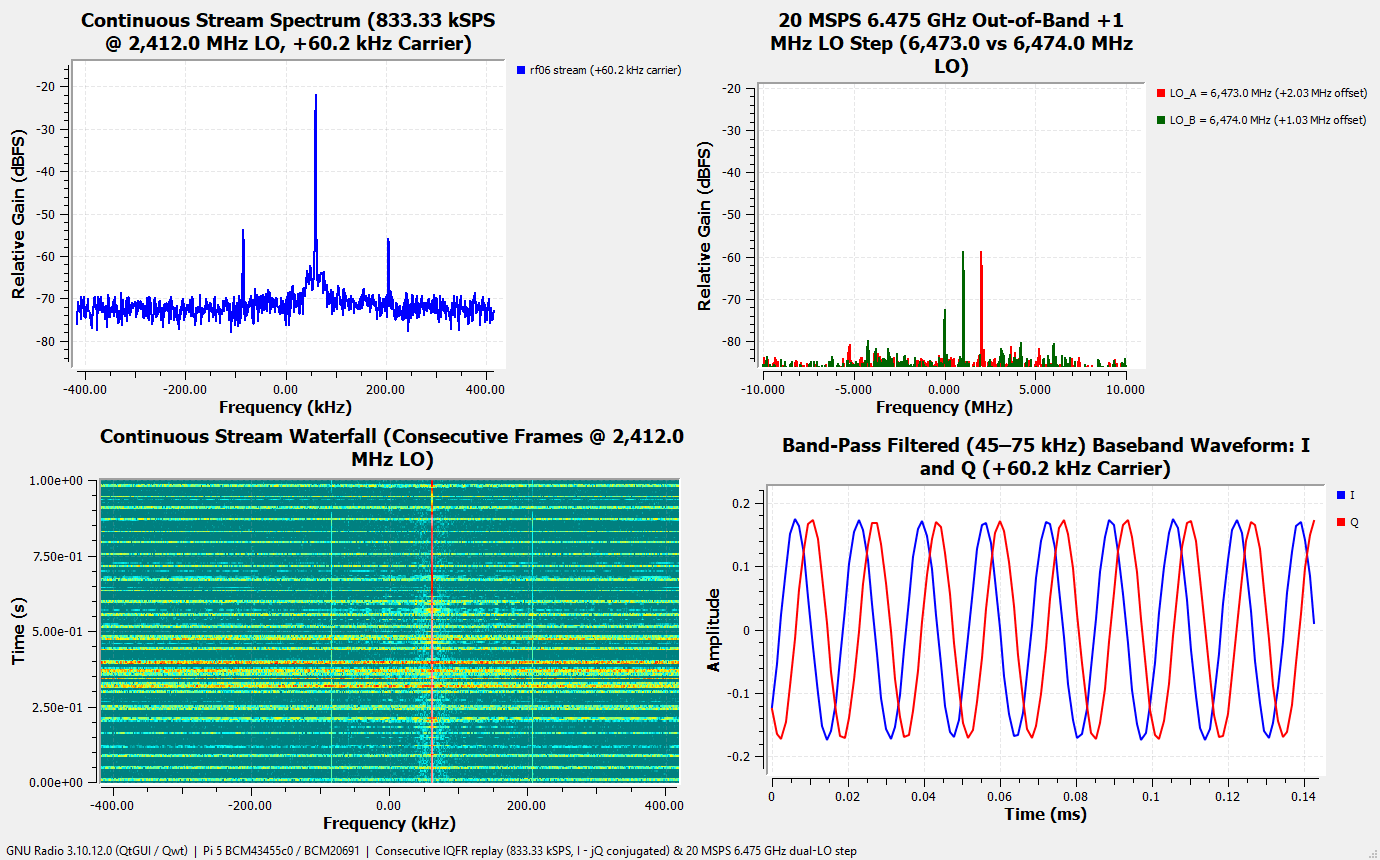
With patched firmware and a modified brcmfmac driver, the chip streams continuous I/Q at 833.33 kSPS on 2.4 GHz or 769.23 kSPS on 5 GHz (limited by the SDIO bus), verified over a one-hour run with no missing frames. The stock driver with manufacturing-test firmware can also take 16,000-sample snapshots at 20 or 80 MSPS, which were used to decode a Bluetooth LE packet and to show the LO tuning to tested points between 2220 - 3001 MHz and 4748 - 6474 MHz. An rtl_tcp bridge lets SDR++, SDR# and GQRX connect, but only at a fixed frequency.
TheOddSock notes that this is an uncalibrated diagnostic path, not a dedicated SDR replacement, and Wi-Fi is suspended while streaming. The code is open-source under GPL-2.0-or-later.
This is yet another development in the "Sleeper SDRs" being discovered in everyday devices. Just recently we've posted about the newly discovered ESP32 SDR capabilities, WiFi dongle and router SDR capabilities, old LG and Wileyfox Swiftphone cell phone SDR capabilities, and LoRa chip SDR capabilities.
AI Disclaimer: TheOddSock notes that Sol and Gemini were heavily used to achieve this, and the repository's AI assistance notes state that Codex was also used extensively.
Suggested categories: Sleeper SDR, Applications, Other
Suggested tags: Raspberry Pi 5, Raspberry Pi, BCM43455c0, Broadcom, Wi-Fi, brcmfmac, ESP-SDR, Nexmon, Bluetooth LE, rtl_tcp, GNU Radio, Sleeper SDR
---
## Notes for the author (not part of the post)
- **Source/credit:** I assumed this came from the r/RTLSDR thread and wrote "posted on Reddit". If TheOddSock emailed it in, swap the opening to "Thank you to TheOddSock for writing in and sharing…". I used their GitHub handle; I couldn't confirm the Reddit username matches.
- **Why it can't be run yet (verified 2026-11-27):** The private acquisition/recovery controller is the blocker, not the firmware. `tools/pi5_specan/README.md` says the live `pi_agent.py` imports withheld modules (`pi5_mfg_capture`, `pi5_mfg_protocol`, `pi5_mfg_transport`) and errors out on a public clone. That blocks even the stock-driver snapshot mode. `src/device-abi37/INTEGRATION.md` says the package "does not install a receiver", and `docs/reproducing.md` gives the reason it's withheld: it depends on "private freshness, installation, recovery and health records". It also says a public runner is a future milestone. The firmware/driver build is also pinned to kernel 6.18.39+rpt-rpi-2712. Raw ambient recordings are private, so the rtl_tcp bridge and the specan/radar dashboards only run on synthetic demo data from a public clone.
- **The "user-supplied firmware" isn't hard to get:** The pinned input (507,048 bytes, SHA-256 a8793f02…ab8a) is byte-identical to `bcmdhd_mfg.bin_blob` in the public seemoo-lab/nexmon repo (`firmwares/bcm43455/7_120_5_1_sta_C0/`). The project just doesn't redistribute Broadcom's binary itself. `RIGHTS.md` notes that "no download location grants redistribution permission".
- **rtl_tcp bridge:** It ignores client SET_FREQ/SET_SAMPLE_RATE. The capture stays at 2412 MHz / 833.33 kSPS or 5200 MHz / 769.23 kSPS, so you set the client's display frequency to match.
- **Out-of-band tuning:** It tracked a test signal at 6 of 9 tested LO pairs (low band) and 7 of 11 (high band), with the failures at the band edges. The README says coverage between tested points is unverified, hence "tested points".
- **Nexmon context:** Our 2018 Nexmon SDR post covered transmit only. The repo's prior-art table also credits nexmon_csi (CSI on the Pi 5, not raw time-domain I/Q) and Pair-Fi (raw RX on a different Broadcom chip). The project explicitly makes no "first" claim, so the post doesn't either. The Nexmon sentence is the easiest cut if you want it shorter.
- **Left out for length:** `pi5-specan` (a stitched 2.4 - 5.835 GHz spectrum analyzer/waterfall with a BLE advertising sniffer that runs on the stock driver), `pi5-radar` (passive Wi-Fi CSI motion/micro-Doppler detection), the 18.99 dB first-alias rejection on the continuous path, the fixed spur at +9.985 MHz in 80 MHz mode, and the fact that 5.8 GHz channels 149 - 165 need the country code changed to US/XZ.
- **Image:** The suggested figure is a real capture replay (2412 MHz stream waterfall plus a 6475 MHz LO-step test). For something simpler, `paper/figures/architecture-overview.png` is a block diagram of normal Wi-Fi vs. the diagnostic capture paths.
- **Licence:** Code is GPL-2.0-or-later. The docs and report are CC BY 4.0. The kernel patch context keeps GPLv2-only/ISC terms, and ESP-SDR-derived parts keep GPLv3.
