Tagged: wi-fi

ESP-WiFi-Jam-Detector: A Standalone 2.4 and 5 GHz Interference Detector Built on an ESP32-C5 Touchscreen Board

Back in October, we posted that several projects found that ESP32 microcontrollers can capture raw I/Q samples and therefore be used as an SDR. Now Jordan has written in to share his 'ESP-WiFi-Jam-Detector', a standalone, receive-only interference detector built on the ESPARGOS esp-sdr code and a Waveshare ESP32-C5-Touch-LCD-3.5 touchscreen board.

Using the ESP32-C5's own Wi-Fi receiver, the device sweeps 2400 - 2483.5 MHz and 5150 - 5895 MHz at 80 MS/s, with no PC needed. It learns a 60-second baseline of the normal RF background, then raises an alarm on a raised wideband noise floor, persistent narrowband carriers, or swept signals, while flagging pulsed wideband energy as suspect. The touchscreen shows a live spectrum and waterfall, and with an SD card inserted, it logs every state change and saves a waterfall image centered on each alarm, so you can see what happened while you were away.

The firmware is open-source under GPL-3.0, and a prebuilt binary is available on the GitHub releases page. The README notes that the device can only show that the RF environment has changed, not prove intent, and that a running microwave oven will look like interference on 2.4 GHz.
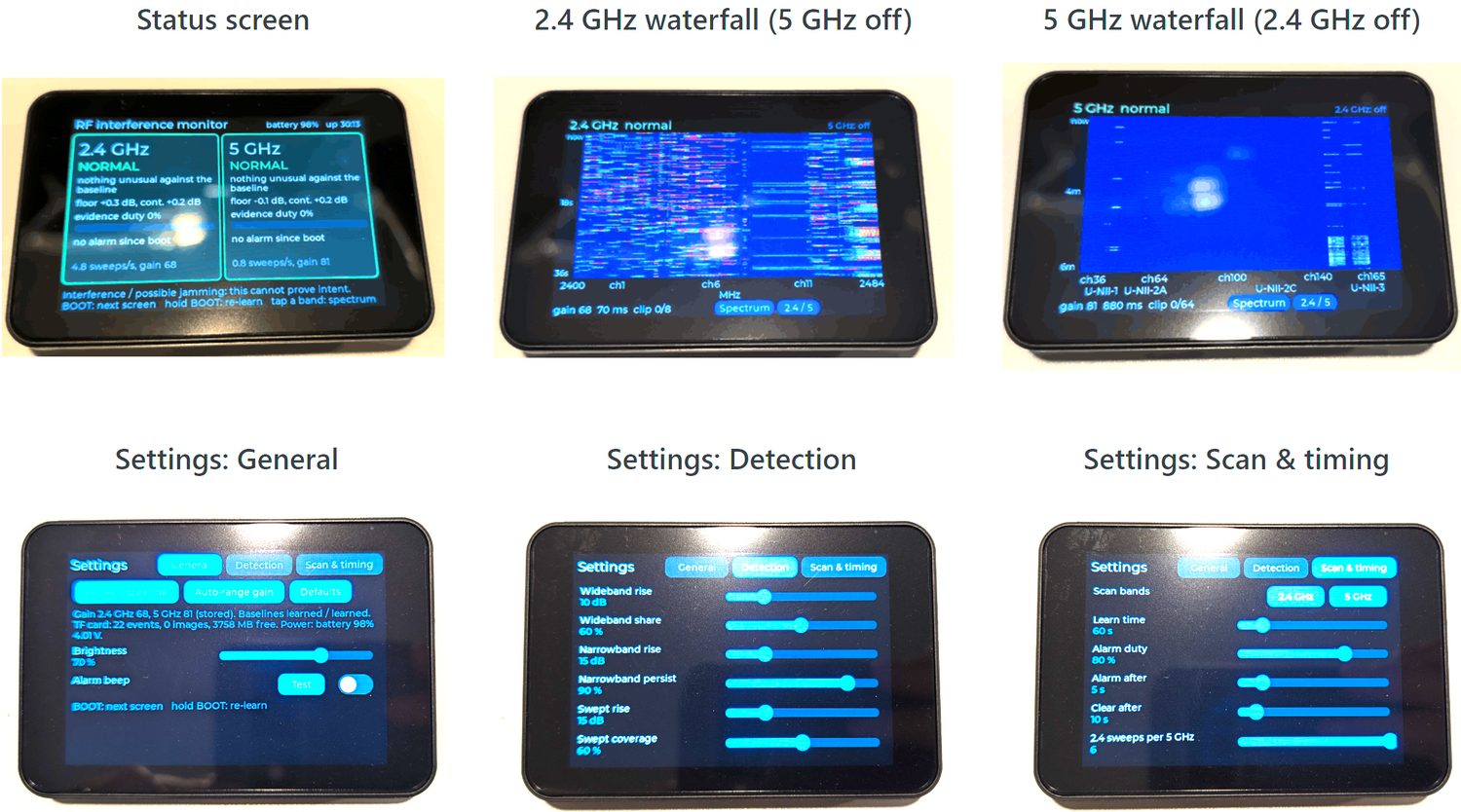
Screenshots from ESP-WiFi-Jam-Detector running on a Waveshare ESP32-C5-Touch-LCD-3.5

AI Disclaimer: Jordan notes that the firmware was written entirely by Claude Code, with Jordan directing it and testing on the hardware.
Router CSI Toolkit: Capturing 80 MHz Wi-Fi Channel State Information from a GL-MT6000 Router

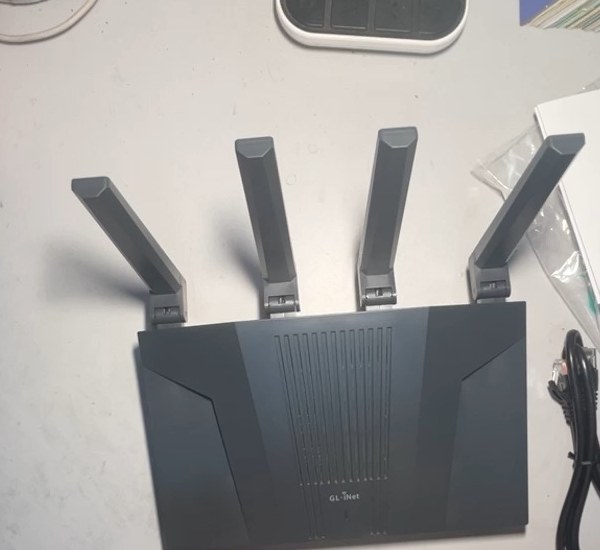
Thank you to Wu Jun (aka jjjwu on GitHub) for writing in and sharing a guide to capturing Wi-Fi channel state information (CSI) from a GL.iNet GL-MT6000 router, along with the 'Router CSI Toolkit' scripts that go with it. CSI is the per-subcarrier amplitude and phase data that a Wi-Fi receiver measures to equalize the channel. Because it changes as people move through a room, it is often used for experimental Wi-Fi sensing.

The router is based on the MediaTek MT7986 chipset and runs OpenWrt with an existing mt76 driver CSI patch from the ossiemarks OpenWrt fork. A small daemon on the router streams 80 MHz, 256-subcarrier CSI from the 5 GHz radio over UDP to a host PC. There, Python scripts check the capture quality and produce amplitude heatmaps and a simple motion metric. A 10-minute test run produced 57,293 per-chain records at about 95.5 records/s.

While this project doesn't use an SDR, it may interest readers who followed BirriaSDR and Mtk79ICAP, which also patch the mt76 driver to turn MT7921 Wi-Fi dongles into SDRs. The scripts are MIT-licensed and available on GitHub, and the 10-minute dataset is on Zenodo under CC BY 4.0.

The GL-MT6000 (MT7986) Router used in these experiments
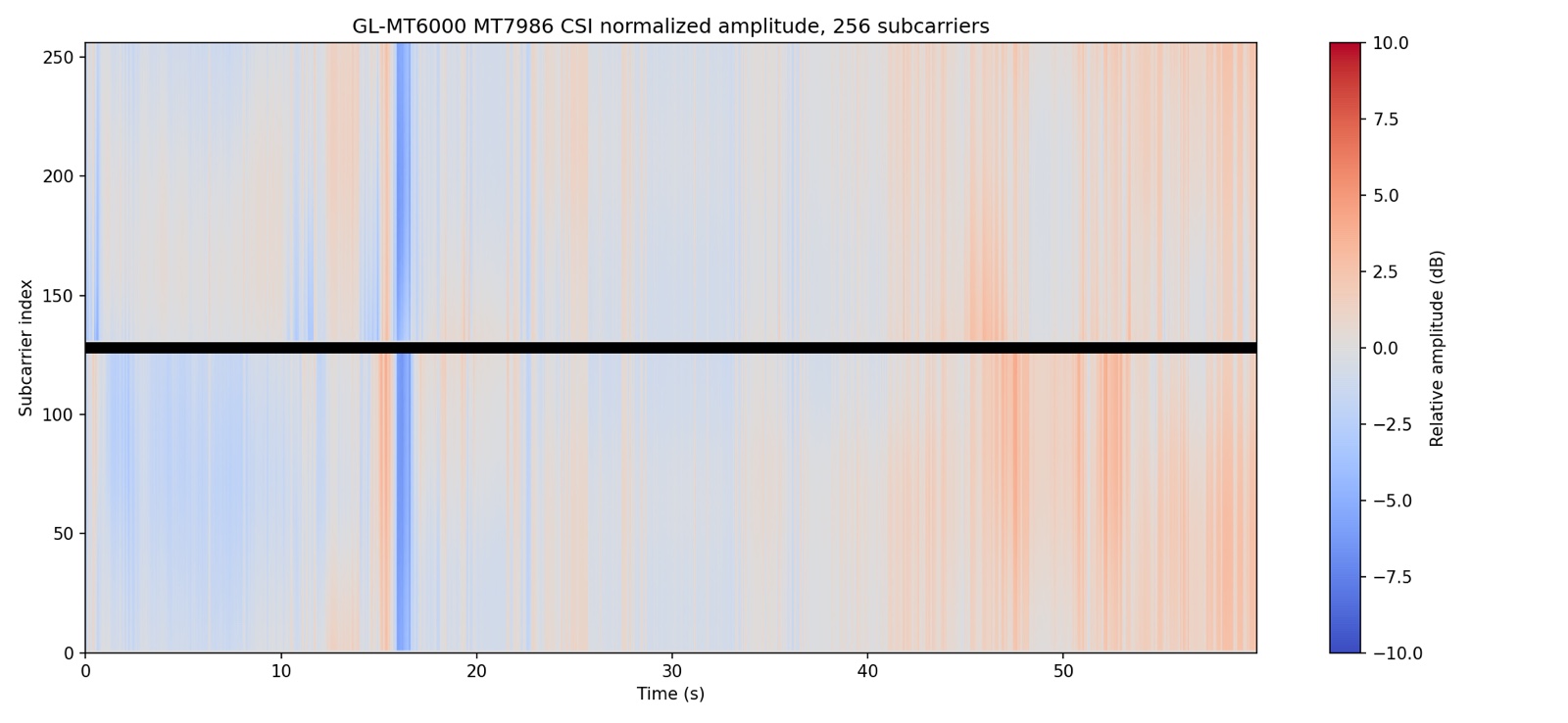
Example 80 MHz / 256-subcarrier CSI amplitude heatmap from the GL-MT6000 10-minute capture. Brighter colours indicate higher amplitude; timestamp gaps and chain transitions remain visible. Source: Router CSI Lab (Wu Jun), CC BY 4.0.

sdrtop Update: Wi-Fi Airtime Tools, POCSAG Pager Decoder and Native Airspy R2 Support

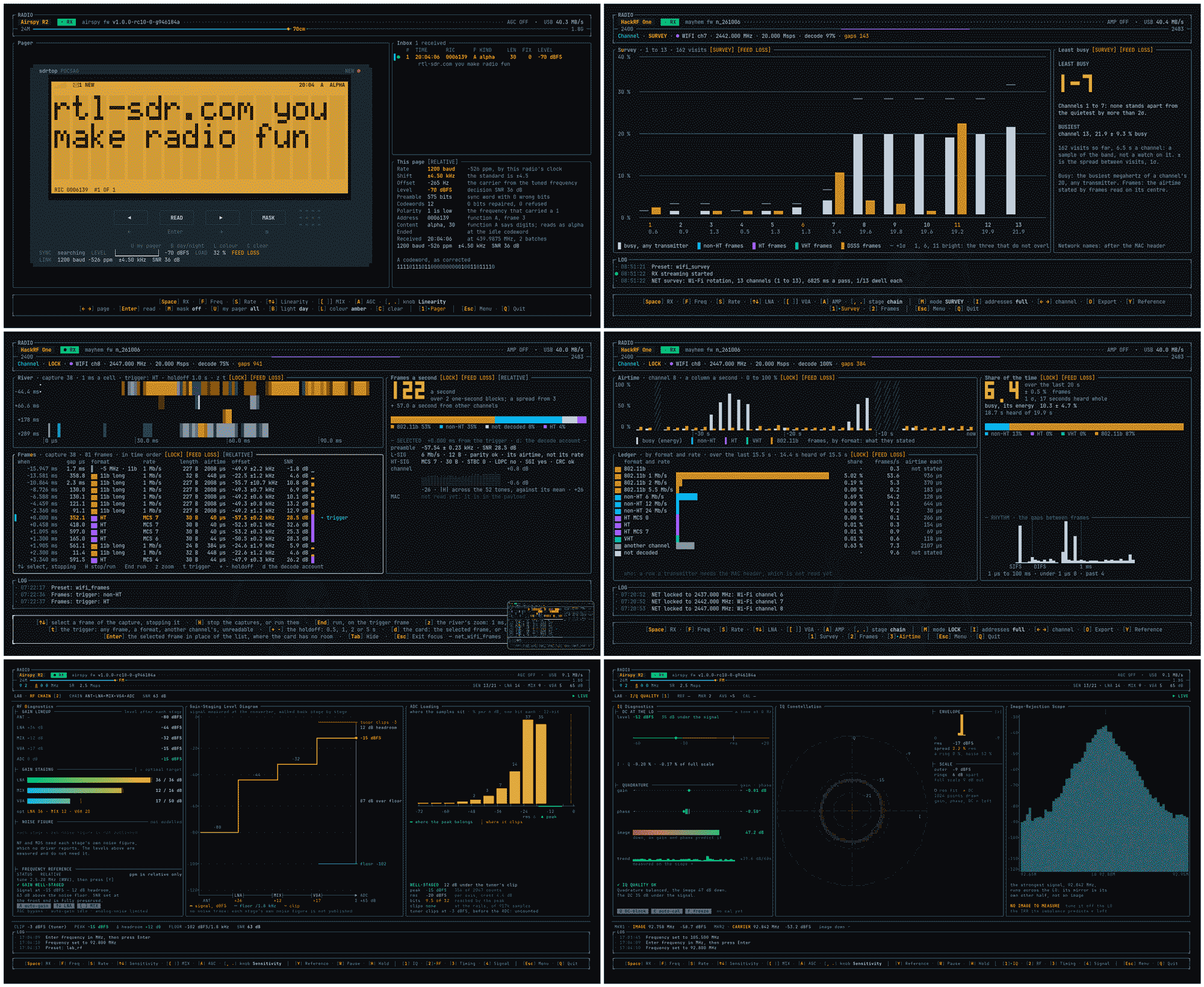
Earlier this month we posted about sdrtop, a Rust-based SDR bench instrument that runs in a terminal and is aimed at measurement rather than listening. Viktor László (MusiThang on GitHub) has now written in again to share several updates. Viktor notes that the goal is still to "make radio signals and the measurements behind them inspectable, rather than hiding everything behind a decoded result."

The biggest additions are new Wi-Fi tools. sdrtop can now survey 2.4 GHz channels 1 to 13 and name the least busy one, inspect a single channel frame by frame at three time scales, and show a channel's airtime use second by second. These tools need 20 Msps, so you need an SDR like the HackRF. There is also a new POCSAG pager decoder written from the ITU standard without external libraries. Viktor tested it over the air by transmitting with a HackRF and PortaPack Mayhem and receiving with an Airspy R2.

The Airspy R2 is now natively supported too. Its gain staging follows the R2's Linearity and Sensitivity gain curves, and sdrtop warns you before the tuner clips. RTL-SDRs are still fully supported, and native support for the SDRplay RSP1B and Airspy HF+ Discovery is in progress. The code is open source under the GPLv3 and available on GitHub.

Some screens from sdrtop

AI Disclaimer: The project's CREDITS.md file notes that Claude Code was used for implementation, architecture discussion and problem-solving.

SLZB-Ultima: A Quad-Radio Smart Home Radio Controller Supporting Various Protocols

While not based on SDR technology, we think that some readers may be interested in this product.

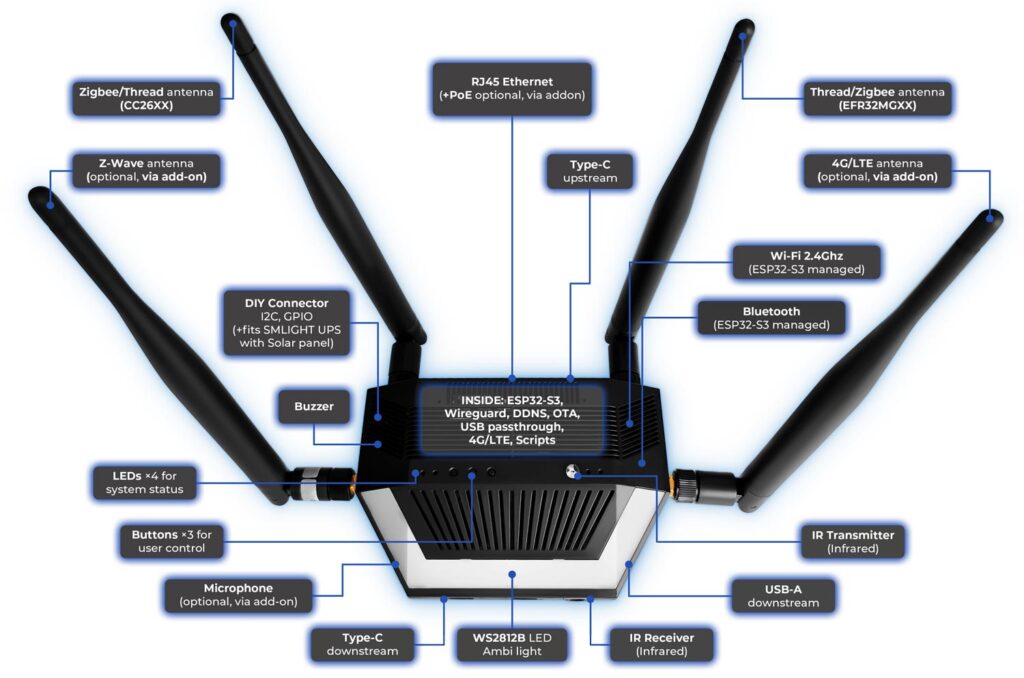
We'd like to thank Serhii, who writes on behalf of SMLIGHT in Ukraine. SMLIGHT recently released its "SLZB-Ultima" device, a compact radio platform supporting multiple wireless technologies commonly used in smart homes. 

These technologies include Zigbee, Thread, Wi-Fi, and Bluetooth. The device also optionally supports Z-Wave, LTE, Power-over-Ethernet, UPS backup, infrared control, and USB-over-Ethernet. The cloud-independent software supports WireGuard VPN, Dynamic DNS, Internal Zigbee hub mode, local IF-THEN automations running directly on the device, and one-click OTA updates.

The full press release is available here in this PDF.

The device is priced affordably at only US$40 on Aliexpress.

The SLZB Ultima
The SLZB Ultima


Spectrum Slit: A Wall Art Display That Visualizes Wi-Fi Activity via a HackRF

Over on YouTube, RootKid, who specializes in creating engineering-based art projects, has developed an interesting wall-mounted art display panel that visualizes Wi-Fi activity by using a HackRF as the monitoring software-defined radio. The display uses a Raspberry Pi, a HackRF, and a custom-made LED light bar. The HackRF receives a 5 GHz Wi-Fi channel, and the Pi translates this into activity on the LED display, creating a visual piece that lets those around know when Wi-Fi activity is high.

The idea is to show that "we live surrounded by ghosts of our own making", which refers to the invisible storm of electromagnetic signals that we created to serve us in our modern lives.

If you are interested in other projects that combine SDR and art, you might enjoy our posts on HolyPager, Hystérésia, Signs of Life, Ghosts in the Airglow, and Open Weather.

I built a light that can see radio waves