Tagged: RC car

OpenStint: An Open-Source RC Car Lap Timing System Using an RTL-SDR or HackRF

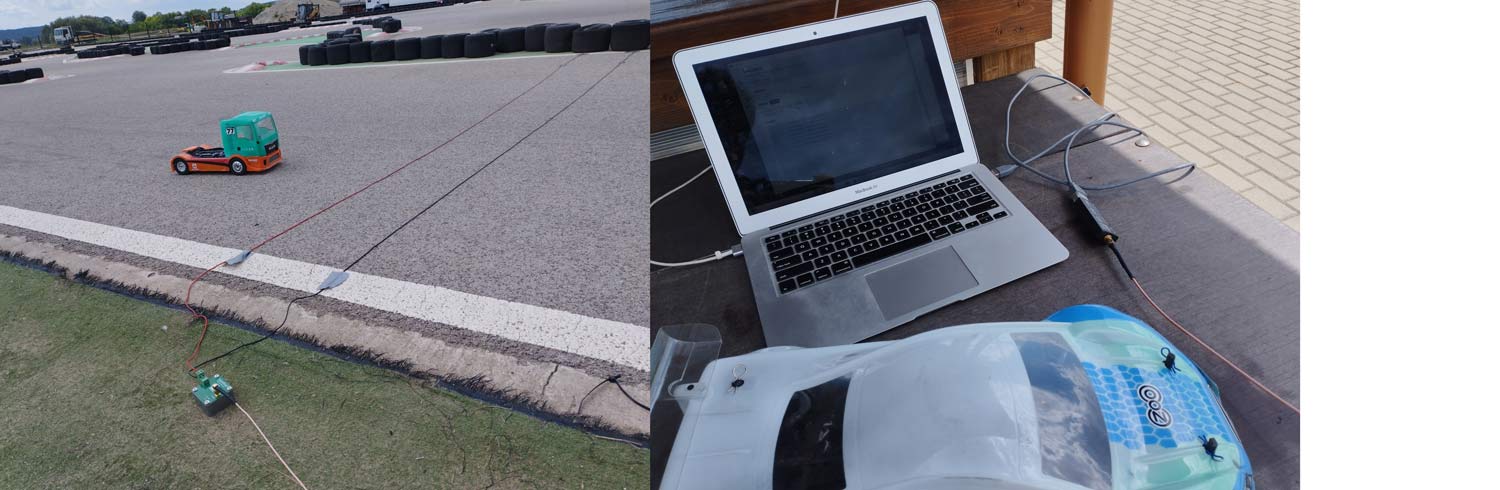
Thank you to Attila for submitting news about OpenStint, an open-source lap timing system for radio-controlled (RC) car racing that uses an RTL-SDR or HackRF One as its receiver. In RC racing, each car carries a small active near-field transponder that transmits a unique identifier on 5 MHz using BPSK modulation. A wire loop embedded in the track acts as the receiving antenna, picking up each transponder's signal only within a short distance, which allows the exact crossing point to be detected. OpenStint digitizes this signal with the SDR and performs the decoding and pass detection entirely in software, with sufficient accuracy for RC racing.

Professional timing systems work on the same principle, but rely on dedicated proprietary hardware and software, with even entry-level systems typically costing thousands of dollars. OpenStint is compatible with the transponders used by the vast majority of RC racing clubs (MyLaps RC3 and RC4), while also supporting its own fully open-source transponder design. A complete decoder can be built from inexpensive off-the-shelf components, typically consisting of an RTL-SDR dongle, a simple loop interface, and a laptop or even a Raspberry Pi 3. The software has also been tested with existing timing software including LapBeeps, RCGTiming, and ZRound.

Besides the decoder itself, the project documents an open-source transponder protocol, includes an ATtiny-based transponder reference implementation, and describes the signal processing used for reliable pass detection. Documentation and source code can be found on the OpenStint website and over on the project's GitHub page, with the open transponder design available here.

Atilla also sells the transponder boards on the OpenStint website's sales page for a reasonable €30/panel + shipping (8 pcs per panel), and notes that larger quantities can easily be manufactured by JLPCB.

AI-Disclaimer: We note that Claude is listed as a contributor to the code.
OpenStint: RC Car Lap Timing with RTL-SDR or HackRF

Controlling a Toy RC Car with a HackRF

Over on his blog Radoslav has created a post showing how he has used a HackRF to wirelessly control a toy RC car by reverse engineering the wireless control protocol, and generating the control signals in a C++ program.

Having already created the rf-car HackRF RC car control software on GitHub a few years ago, Radoslav was easily able to modify it for a new RC car that his daughter received. The process was to simply look up the FCC data on it, finding that it operated with 2.4 GHz and used GFSK modulation. He then used the Inspectrum signal analysis tool to determine the bit strings used to control the car. Finally using, his C++ interface to the HackRF he implemented the new bit string and GFSK modulation.

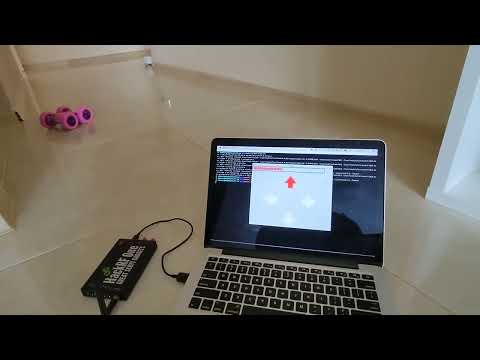
The video below demonstrates Radoslav controlling the RC car with the keyboard on his laptop.

Controlling 2.4GHz FSK car with HackRF

In the past we've posted about another project that also used a HackRF and computer to control a RC drift car, and another project that used the RPiTX software to control an RC toy car with GNU Radio and a Raspberry Pi.

[Project also seen on Hackaday]

Controlling an RC Car with RPiTX

RPiTX is a piece of software that you can run on your Raspberry Pi unit, which with no additional hardware turns it into a full radio transmitter, capable of transmitting FM, AM, SSB and other signals anywhere from 5 kHz to 500 MHz. Of course remember that the methods used to do this emit a lot of harmonics, so to be legal and safe filtering should be used on the signal output.

Over on Twitter Cyril‏ @kotzebuedog has been experimenting with RPiTX and his radio controlled toy car. From the videos and images, it appears that he’s used GNU Radio to create the required control signals which then transmits the data to the RC car via RPiTX. With this he’s been able to create a program to control his RC car with his computer gaming joystick.