BirriaSDR: 2.4 / 5 GHz SDR Discovery on a Mass-Produced USB3.0 Wi-Fi Dongle
With AI-in-the-loop reverse engineering, things are heating up, and we're starting to see a gold rush of reverse-engineered Wi-Fi radios turning into software-defined radios. Just yesterday, we posted about h0m3us3r's discovery of how a Gemtek W1700K Wi-Fi 7 router could be turned into a 320 Msps SDR. And the week before, we posted about the ESP32-SDR discovery.
Today, a new Wi-Fi dongle-turned-SDR has been discovered, and this time it is probably the most accessible one. Over on X @luigifcruz, author of the popular CyberEther tool, has announced that he has reverse engineered a commodity US$30 USB 3.0 Wi-Fi dongle with the help of GPT-6 Astra, and discovered a RAW I/Q stream which can be exported over USB3.0. This effectively turns the Wi-Fi dongle into a 2.4 GHz / 5 GHz SDR, capable of exporting 40 Msps at 14-bit ADC resolution. Luigi named the new SDR 'BirriaSDR' after the Birria Taco he was eating at a restaurant while using AI to reverse-engineer the WiFi dongle. The open-source repo is available on GitHub.
This is probably the most accessible of the newly discovered Wi-Fi SDRs because it is cheap, mass-produced, readily available, and has useful export bandwidth. The ESP32-SDR suffers from a lack of usable export bandwidth, meaning that getting usable amounts of IQ data onto a PC is impossible without hacking in an FPGA. The Gemtek W1700K Wi-Fi 7 router has an incredible 320Msps IQ bandwidth and an effective export via Ethernet, but it is expensive and not really available for purchase anywhere anymore.
BirriaSDR supported dongles are any Wi-Fi dongle using the MT7921 chip. These are available in USB dongle format on Amazon, currently for US$26.99. There are also various MT7921 based M.2 and PCIe cards available for anywhere between US$16 and US$34. Many laptops may already have these Wi-Fi cards pre-installed.
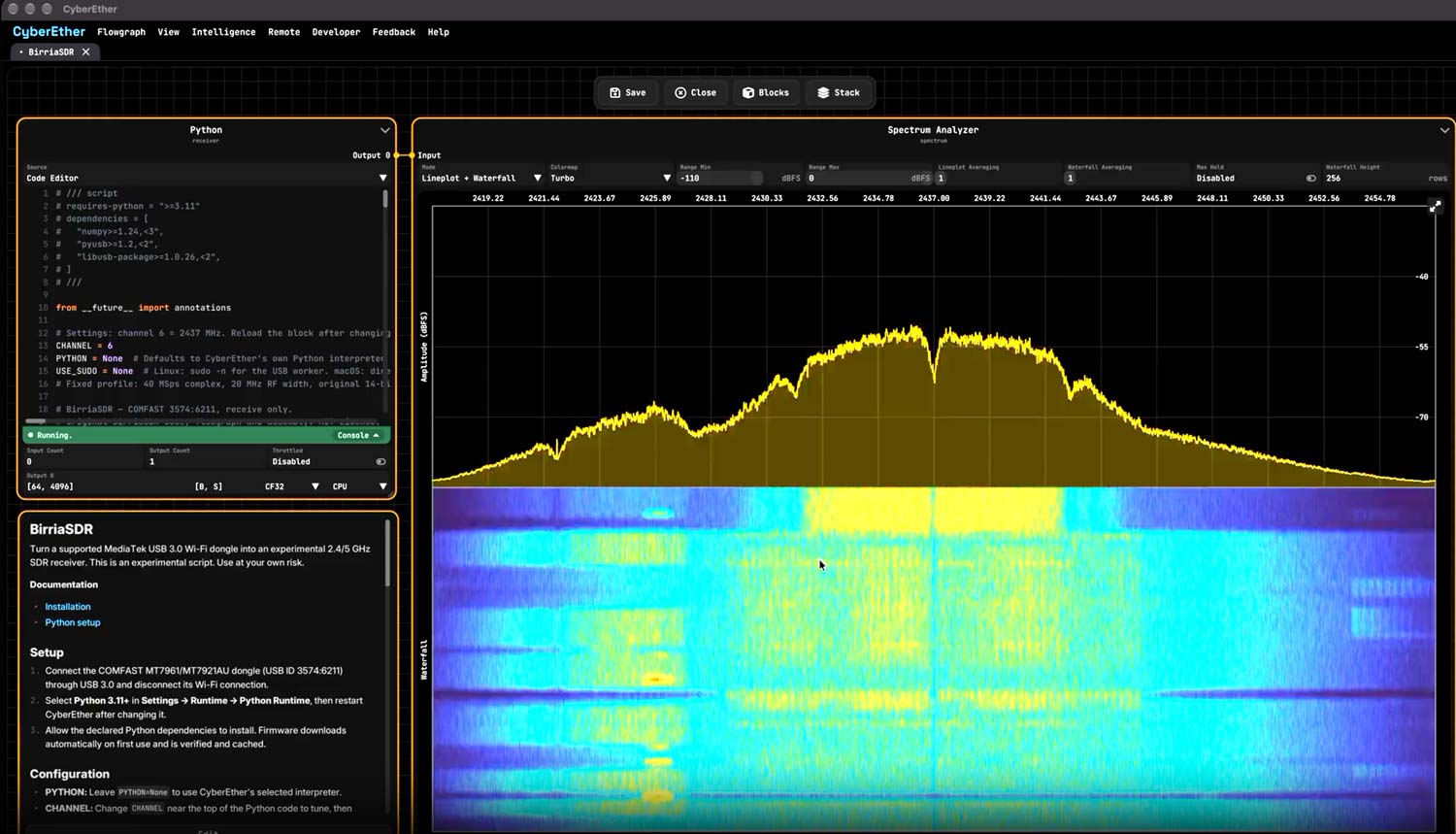
Luigi has added support for the BirriaSDR in his CyberEther software through an input block and sample flowgraph.
It remains to be seen how popular these dongles will become, and if they'll become a new type of RTL-SDR like device. If there is a sudden influx of purchasers, sellers may put the pricing up. We also note that Wi-Fi dongles are limited to the 2.4/5 GHz bands, where there aren't that many interesting signals to play with. However, as Luigi suggests, modifying the dongle to add a front-end mixer is a possibility. The HackRF already uses a 2.4 GHz IF architecture, so a similar type of front end could be used.





























Can we try this with even more wifi chips like Intel ones? Imagine if the small Wi-Fi card installed in so many laptops can become all of a sudden a super cool sdr.