SDR– Updated to V2.2: Many New Decoders, Tools and KrakenSDR Direction Finding and Beamforming Support Added
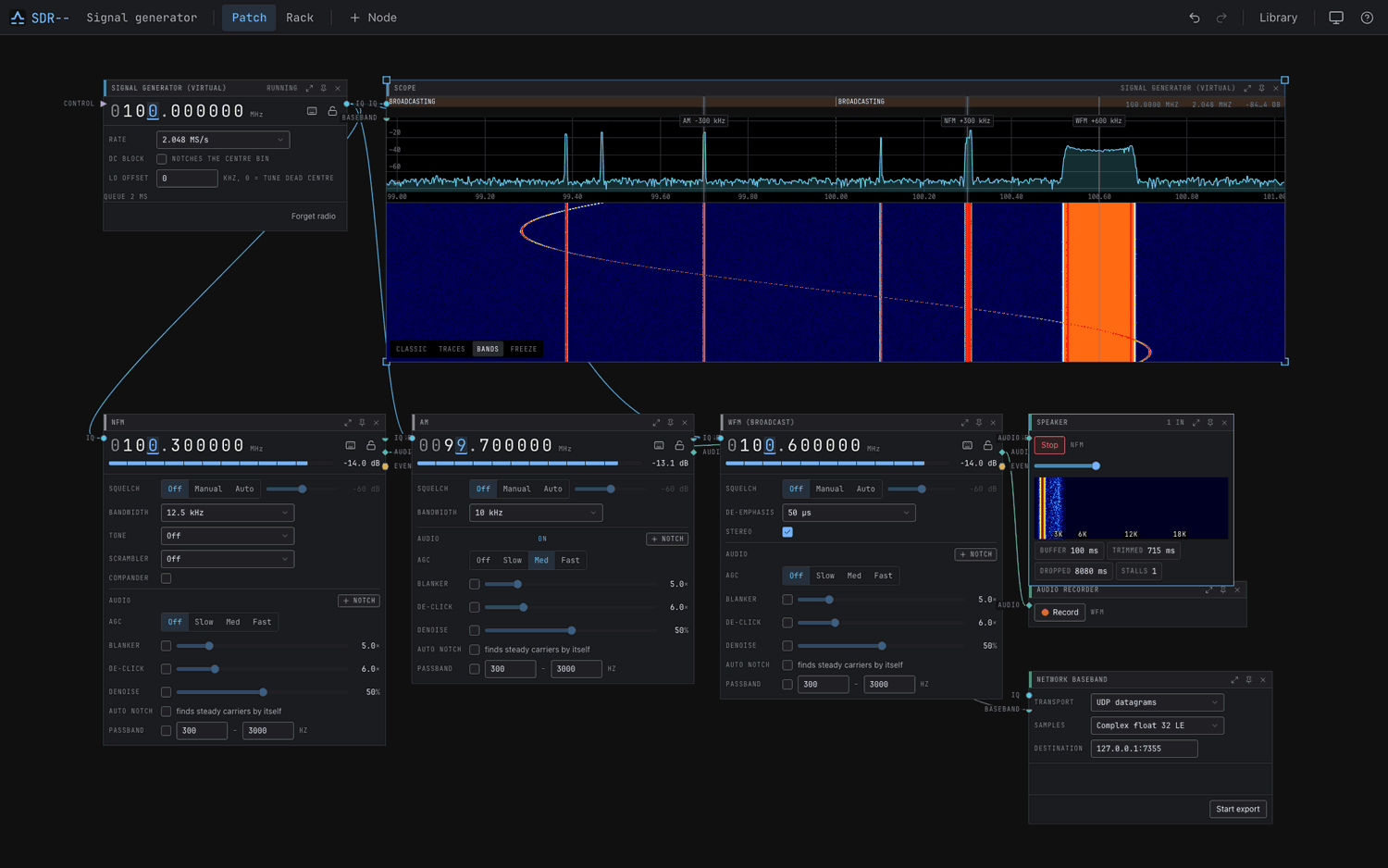
Last month we posted about the release of SDR-- (SDR minus minus), an open-source app that lets you visually wire together a receiver on a canvas. Since that time, Julian, the developer of SDR--, has been busy adding support for many decoders, various tools, and improving performance. Julian has also added KrakenSDR support, with radio direction-finding and beamforming blocks. Julian shares the following update for SDR-- V2.20:
New Decoders
- Aviation and satellite: VDL2, HFDL, Inmarsat Aero and STD-C, Iridium, Drone Remote ID, 406 MHz beacons
- Voice: TETRA, Tetrapol, GSM downlink, DECT, D-STAR, FreeDV, NXDN, dPMR
- Data: LoRa (LoRaWAN, Meshtastic, MeshCore), ISM sensors, End-of-Train, DSC, BLE, Wi-Fi survey
- Weather: NOAA APT, Meteor LRPT, WEFAX, radiosondes with landing forecast
- Broadcast: DVB-T/T2, DVB-S2X, DAB packet mode, DRM with xHE-AAC
Coherent and mobile
- Direction finding, beamforming and passive radar on the KrakenSDR
- An iOS app with CarPlay for DF while driving is in TestFlight. Android is coming soon.
Hardware
- Native Support: KrakenSDR, RTL-SDR Blog V4 Lite, AntSDR, PlutoSDR, SDRplay, Airspy, bladeRF and ESP-SDR
- NanoVNA and antenna rotators
- rtl_tcp and ADS-B Beast output for other apps
Tools
- A satellite node with Doppler correction, plus a map with footprints and tracks
- A spectrum monitor that classifies signals automatically, and a scanner with priorities and lockouts
- Antenna calculator, noise figure, PER tester, SID monitor
- Audio denoise, call recording, and a decoder log grouped by station
- Event outputs: CSV, desktop notifications, PostgreSQL, InfluxDB
App
- A redesigned UI with a unified look for every node
- Multi-user editing, remote access from a browser, built-in HTTPS
- An MCP server, so an AI assistant can build and tune a canvas
Performance
All measured on an M4 Max, full results at https://sdrmm.com/benchmarks:
- DSP against GNU Radio:
- FIR is 3.5x faster
- NCO is 3x faster
- FM demod is 4x faster
- DDC is 1.6x faster
- A 4096-point FFT is 1.6x faster than FFTW
- Decoding rate in noise (48 trials per decoder across an SNR range):
- ADS-B: 68%, against 56% for readsb and 50% for dump1090-fa
- POCSAG: 73%, against 50% for multimon-ng
- DMR: 81%, against 60% for dsd-fme
- NXDN: 67%, against 23% for dsd-fme
(feel free to verify yourself with cargo xtask compare dsp)
The speed comes from hand-written SIMD kernels (NEON, AVX2, AVX-512), one shared downconversion for all channels on a radio, and a DSP path that never locks or allocates. The noise gains come from decoding IQ directly with
coherent receivers and soft decisions.
AI Disclaimer: This software is likely to be AI-assisted or vibe-coded.