Khanfar Software: Analog Radio Hunter
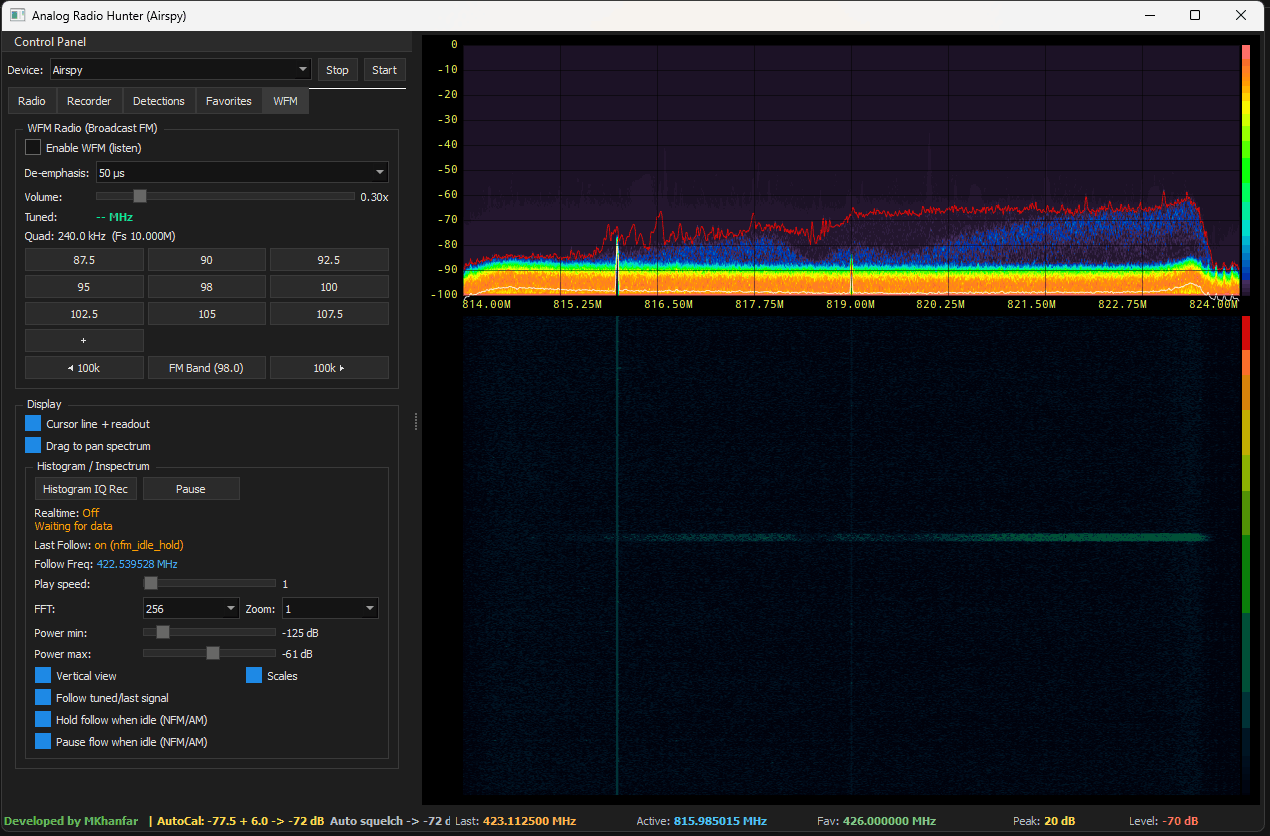
Recently, M. Khanfar released a new free program, "Analog Radio Hunter," described as a "professional RF analysis and monitoring application built around GNU Radio and Fosphor." The software currently supports RTL-SDR, Airspy, and HackRF. Khanfar writes:
Analog Radio Hunter is a professional RF analysis and monitoring application built around GNU Radio and Fosphor.
It is designed to scan large RF spans, quickly lock onto active signals, and monitor analog transmissions with NFM, AM, or WFM audio demodulation.
- Real-time FFT + waterfall spectrum display
- Fast scan with dwell, pause-on-squelch, and skip-ignored channels
- Detection list with hits, timestamps, and smart deactivation
- Favorites profiles with monitor and favorites-only scan modes
- Built-in recorder with auto-record and event log
- Dedicated WFM broadcast receiver with presets
- Multi-SDR device support (RTL-SDR, Airspy, HackRF) with auto-detect and device switching
- NFM and AM audio demodulation (in addition to WFM)
- Peak-follow in span (auto-tune to strongest signal inside the current MS/s window)
- Frequency list filtering to skip/mute ignored channels
- Scan and detection profiles (save/load named presets)
- PPM correction for RTL-SDR calibration
- Spectrum interaction controls (cursor readout, click-to-tune, wheel step, drag-pan)
- Recorder options (record when muted, timestamp/frequency in filename, beep on favorite)
- WFM de-emphasis selection (50/75 µs) and preset management
- Audio Output menu with refresh (route audio to speakers, VB-Cable, or USB output)
- Signal Stability Filter with Min Open + Grace timing and per-target routing
- Histogram IQ Rec with live IQ follow controls and inspectrum integration
- Auto Squelch Calibrate (noise floor + margin) for faster field setup
- Smart Deactivate dual-layer logic (time-based + hit-rate busy rule)
- Favorites cooldown auto-reactivation for busy channels
- Favorite TX tones (Tone 1-9), edge selection, and tone test buttons
- Learning Mode hover guidance for faster onboarding
- Status bar live metrics for Last, Active, Favorite, Peak SNR, and Level
Unique scanning and detection approach: Traditional sweep scanners only see the center frequency they step to. Analog Radio Hunter monitors an entire chunk of spectrum at once and reacts to peaks inside it. That is a major differentiator.High-Impact Capabilities
- Wide-span reactive scan engine that hunts activity across a full chunk, not one center point at a time.
- One-click IQ capture and histogram visualization with follow and idle flow controls.
- Carrier-resilient channel management using Smart Deactivate + favorites cooldown logic.
- Field-ready setup speed using Auto Cal squelch and persistent live status metrics.
- Operator-selectable audio routing to speakers, VB-Cable, or USB audio output devices.
- Operational clarity from GUI color heatmaps, scan debug reasons, and learning-mode tips.
Signal Stability Filter: Logic and Tuning
- Purpose: reject short squelch flicker and noisy open/close chatter before actions trigger.
- Min Open (ms): raw squelch must stay open this long before stable-open is accepted.
- Grace (ms): stable-open is held briefly after raw close to avoid tiny dropouts.
- Apply targets: Detection, Rec+Alerts, Scan Hold, and optional Audio Out gating.
- Start values: Min Open 150-250 ms, Grace 40-80 ms, then tune by channel behavior.
Like his other software, which we previously covered, it is free but not open source. Anti-virus programs may flag the software as suspicious due to heuristics. We believe this to be a false positive, but as with all software that isn't open source, we recommend being highly suspicious and only run it in a sandboxed environment like a VM to be sure.





























Khanfar RSA: The Only Windows Software Running the Real gr-fosphor Engine at High FPSA Gap Nobody Else Has FilledFor over a decade, the SDR (Software Defined Radio) world has had a well-known split. On one side sits gr-fosphor — the GPU-accelerated, OpenCL/OpenGL-driven spectrum visualization engine built for the GNU Radio ecosystem, developed by Sylvain Munaut as part of the Osmocom project. It produces a fluid, “phosphor persistence” style waterfall and histogram display that makes brief, bursty signals visually pop in a way flat, traditional waterfalls don’t.
On the other side sits Windows — the platform most hobbyists, RF enthusiasts, and field operators actually work on day to day.
The problem: those two worlds have never fit together easily. gr-fosphor is Linux-native, and its own documentation is blunt about the difficulty of a Windows build — the standard Microsoft Visual C++ compiler can’t even compile it due to C99 constructs it doesn’t support, forcing developers toward the Intel compiler or manual Clang builds. It’s possible, but nowhere near trivial.
That’s the gap Khanfar RSA (and the broader family of Khanfar SDR tools) has stepped into — and, as of today, it appears to be the only software in the world that combines the genuine gr-fosphor engine, native Windows packaging, and a high-refresh-rate (120 FPS) GPU-accelerated display in one ready-to-run application.
What Makes It DifferentMost SDR software falls into one of two camps:
Khanfar RSA occupies a third space: it wraps the actual gr-fosphor engine — not a lookalike, the real GPL-licensed codebase — inside a single, pre-wired Windows executable. No GNU Radio install, no flowgraph building, no compiler wrangling. You download an exe, plug in an RTL-SDR, Airspy, HackRF, or other supported device, and the fosphor-style waterfall is running.
Why It’s Genuinely Hard to Compete WithThis isn’t a case of nobody else wanting to build something similar — it’s a case of the engineering barrier being unusually high:
Put together, those three factors explain why, despite gr-fosphor being public and GPL-licensed since the 2010s, nobody had packaged it this way for Windows users until Khanfar did.
The Practical Advantages
A Fair Word of CautionIt’s worth being clear-eyed about what this software is — and isn’t. A smooth, GPU-accelerated waterfall is a display advantage, not a substitute for the calibrated, traceable measurements you’d get from dedicated professional RTSA hardware (Signal Hound, Aaronia, etc.). Those instruments bring purpose-built RF front-ends, wider instantaneous bandwidth, and calibration that no amount of rendering polish on a consumer SDR dongle can replicate. Khanfar RSA’s achievement is real and specific: it solved a genuine, long-standing Windows packaging problem for the fosphor engine. That’s a meaningfully different claim than being a replacement for professional-grade RF instrumentation — and it doesn’t need to be, to be valuable.
The Bottom LineAs of today, Khanfar RSA stands alone as the only known software that puts the real gr-fosphor engine, native Windows support, and a 120 FPS GPU-accelerated waterfall into a single free package. Whether that remains true depends on whether other developers pick up the now open-sourced codebase — but for now, it fills a gap that the broader SDR software ecosystem left open for over a decade.
Now new name Khanfar RSA SOFTWARE
The Singularity of Khanfar RSA: Bridging the “Engineering Gap”
In the world of Software Defined Radio (SDR), there is a significant divide between experimental research tools and professional-grade operator consoles. Khanfar RSA occupies a unique position in this landscape. While many hobbyist tools exist, Khanfar RSA is one of the few platforms that has successfully bridged the gap between raw signal-processing power and a professional, unified workflow on Windows.
Here is why this software is unique, why it has few competitors, and why the “all-in-one” experience it provides remains rare.
1. Why Khanfar RSA is Unique
Most SDR software falls into one of two categories: Modular toolkits (like GNU Radio) or Application-specific receivers (like Gqrx or SDRangel). Khanfar RSA breaks this dichotomy by acting as an Operations Console.
The Fosphor-Console Integration: The core of its uniqueness is the high-performance integration of the gr-fosphor engine. While gr-fosphor is a standard component for Linux-based research, it is notoriously difficult to port to Windows. Khanfar RSA does not merely “display” a signal; it wraps the gr-fosphor engine into a polished, high-refresh-rate (120 FPS) interface that feels like a dedicated hardware spectrum analyzer.
Workflow-First Design: Unlike modular tools that require the user to build a “flowgraph” to perform a task, Khanfar RSA provides a pre-wired, operator-ready surface. It keeps RF control, decoding (AM/SSB/Digital), mapping (ADS-B/AIS), and IQ replay on a single screen. This minimizes “context switching,” which is the biggest productivity killer in professional signal hunting.
Intelligent Signal Analysis: It includes professional-grade features such as CFAR (Constant False Alarm Rate) detection. This allows the software to dynamically adjust thresholds based on the local noise floor, enabling the detection of weak signals that fixed-threshold scanners would miss.
2. Why “Competition” is Scarce
The reason you don’t see dozens of clones of Khanfar RSA is due to the extreme technical and architectural hurdles involved:
The “Heavy Lifting” of Cross-Platform Porting: gr-fosphor was built for the GNU Radio environment, which is native to Linux and relies on specific OpenCL/OpenGL/CUDA libraries. Creating a stable, high-performance Windows version requires deep expertise in low-level graphics acceleration and runtime management. Most developers prefer to write their own, simpler visualization engines rather than undertaking the complex task of “taming” the real gr-fosphor engine on Windows.
Development Cost vs. Market Size: Developing a console that integrates multiple SDR drivers, mapping APIs, real-time decoders, and a GPU-accelerated visualization engine is an enormous undertaking. Because the professional SDR market is specialized, there is little financial incentive for large commercial entities to invest the years of development required to build a “console” of this caliber.
The “Flowgraph” vs. “Console” Paradigm: The open-source community generally favors the “flowgraph” approach (where users build their own custom systems). Khanfar RSA represents the “operator” approach, which is a different philosophy entirely. It is designed for someone who needs to use the radio immediately rather than someone who wants to engineer the radio receiver from scratch.
3. The Future of SDR Consoles
We are currently in a transition period. For the last decade, high-end RF analysis was only possible with dedicated hardware RTSAs costing thousands of dollars. Khanfar RSA represents a shift toward “Software-Defined Instrumentation,” where the hardware (SDR dongles) becomes a commodity, and the Software Console becomes the true “instrument.”
As GPU technology improves and the need for portable, field-ready RF monitoring grows, we may eventually see more consoles emerge. However, Khanfar RSA currently holds a significant head start in having solved the most difficult technical barrier: making the high-speed Fosphor engine perform reliably and intuitively on the Windows platform.
Summary for the Field Operator:
If you have found in Khanfar RSA the speed, stability, and unified workflow you need for your rugged tablet setup, you are essentially using a “best-in-class” tool. You are not seeing competitors because most other projects are either building simpler tools for hobbyists or more complex tools for researchers, leaving the “professional-grade console” space largely occupied by this singular, highly-optimized solution.
STO CERCANDO DI FAR PARTIRE ADS-B MA NON ESISTE NELLA LISTA DECODER. POTREBBE ESSERE SOTTO UNALTRA VOCE. QUALCUNO PUO AIUTARMI. GRAZIE IN ANTICIPO
The software is buggy and never functions the same way each time you run the .exe. Most settings don’t work consistently, and the json file it uses for settings is constantly changing things that don’t work. Not ready for prime time.
its avirus
This guy makes some cool software but why not just open source it if you aren’t selling it anyways? Allow people to donate their time (instead of just money) to work on bugs, and put to rest any concerns about viruses?
Yes, I confirm that their binary is infested with malware, Here is the VirusTotal report
https://tinyurl.com/2y6cuc2p
How can this happen, why upload an infested file. what an ass
All his software shows up as a virus. He says it’s all false positives, which could be true as many AV programs show new and rarely downloaded software as a virus. Even SDR# triggers AV sometimes when it’s updated. But as always, with free software that isn’t open source I suggest being very wary, and installing in a sandboxed environment like a VM.
its virus with trojan inside .. wonder why it have remote control server .. im not bs .. check in vstotal