Tagged: hermes lite 2

Rigflow: A Networked HF SDR Transceiver App in Rust with Real-Time DSP Over UDP

Thank you to David Bourgoyne (KK7TCY) for submitting news about his new software called Rigflow, an open source client/server SDR application for amateur radio written in Rust and released under the MIT license.

The core idea behind Regflow is to split the radio from the operating position over the network. A lightweight server owns the radio hardware and DSP and runs on a low-power machine right at the antenna, such as a Raspberry Pi, while a desktop client provides the spectrum and waterfall display, tuning, and controls. The two communicate over a small WebSocket control channel plus UDP for media, so you can sit anywhere on the network, and one client can work with multiple radios.

For receivers, the RTL-SDR is supported as a source, including direct sampling HF, and you get WFM, NFM, AM, SSB, CW, and Data modes, a real-time spectrum and waterfall, NR2 noise reduction, AGC, squelch, bookmarks, amateur band and privilege overlays, and IQ recording and playback. Paired instead with a TX capable Hermes Lite 2, the software also transmits, with SSB from your microphone, CW via straight key or text to CW macros, and digital modes like FT8 through WSJT-X over virtual audio or TCI. There is also optional Hardrock-50 amplifier control with band tracking, ATU and SWR/power monitoring over USB serial.

Rigflow can be run on Linux(x86/x64) and Raspbery Pi/ARM as well as MacOS. Prebuilt binaries are available on the GitHub Releases page.
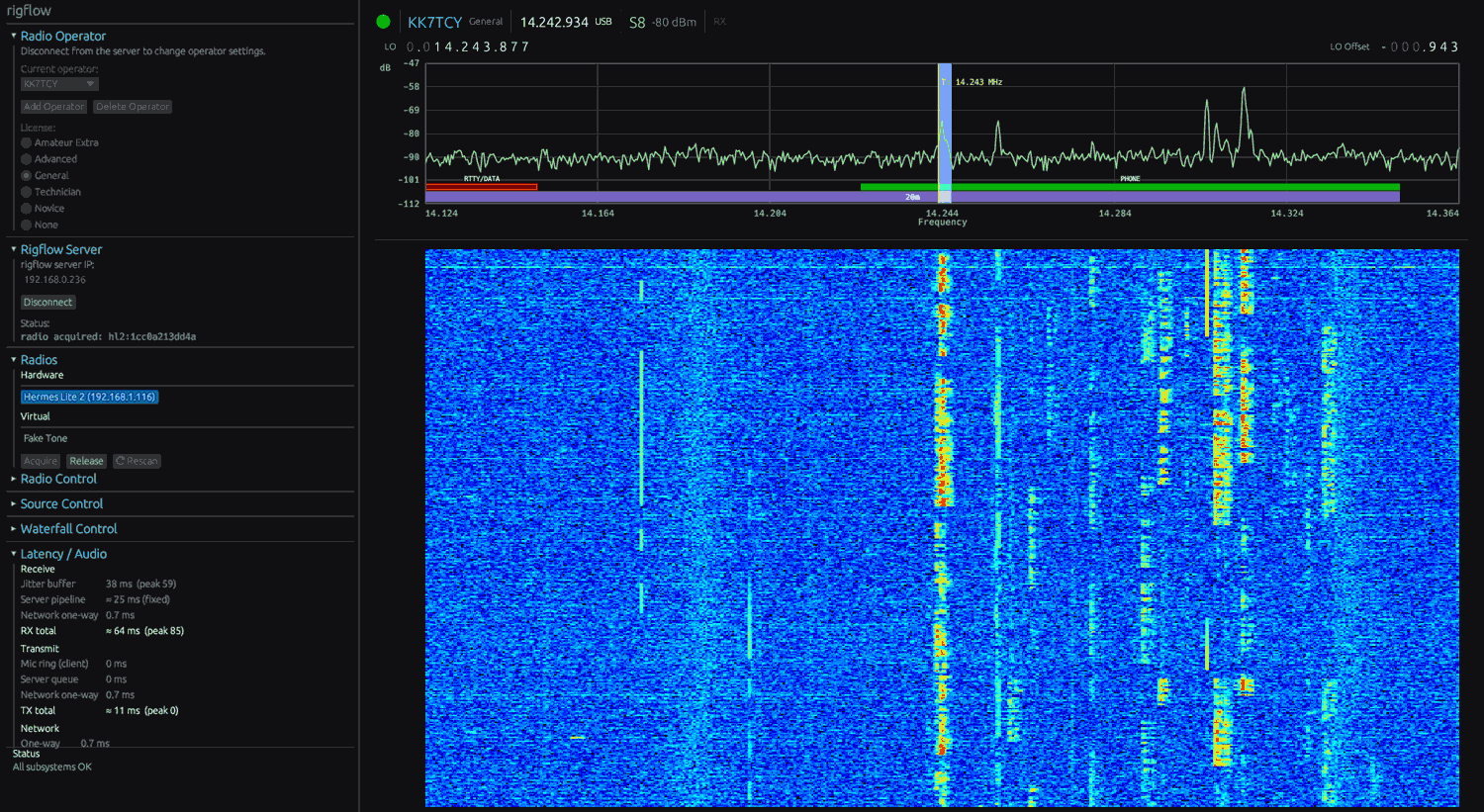
Regflow Screenshot
Regflow Screenshot

TechMinds: Testing the SDR++ Brown Fork with Built-In DSD and Remote KiwiSDR Support

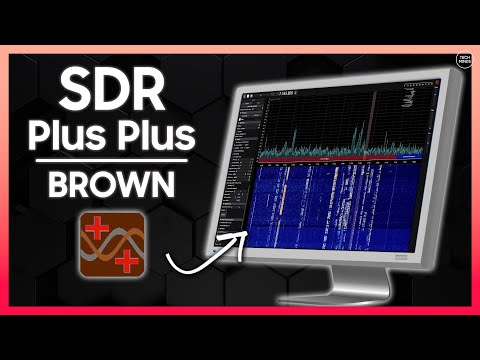
Over on YouTube, Matt from Tech Minds has uploaded a video in which he demonstrates and tests an unofficial fork of the popular SDR++ software called "SDR++ Brown."

SDR++ Brown has some unique features such as the ability to connect to remote KiwiSDR WebSDRs directly within the UI, built-in FT8 and FT4 decoders with PSK reporter, a built-in DSD decoder allowing for DMR, P25 and NXDN to be decoded directly in the software, Hermes Lite 2 support, and various Android UI improvements for small screens.

Matt also notes a few bugs with the software, such as PSK Reporter and Multi-WebSDR waterfall display features being broken.

Over on X, Alexandre Rouma, creator of the original SDR++, has expressed concern about this fork. He notes that this is an unofficial fork that is not up to his standards and that support requests for SDR++ Brown should not be made to him. Instead, support requests should be made directly to the fork owner, Sanny Sanoff.

SDR Plus Plus - Brown Edition Adds New Features Including DSD!

TechMinds: Testing the RadioBerry an HF SDR Transceiver Raspberry Pi Hat

The RadioBerry is a HF transceiver board designed to be used as an add on 'hat' for the  Raspberry Pi. It uses the same AD9866 chip as the Hermes Lite 2 SDR which gives it a 12-bit ADC with one RX and one TX channel, a maximum bandwidth of up to 384 kHz, and an operating frequency range of 0 to 30 MHz. 

In the video TechMinds shows how to connect and setup the Radioberry software on the Pi and how to stream from the Pi to SDR-Console V3 on a PC. He goes on to demonstrate the Radioberry receiving HF signals, noting that the performance is good, although he uses an Ethernet connection and Pi 4 for best performance.

TechMinds notes that he will test the transmit functionality in a future video, once he receives a preamp designed to be used with the Radioberry.

RADIOBERRY - HF SDR TRANSCEIVER PI HAT

Hermes and Red Pitaya now Supported in OpenWebRX

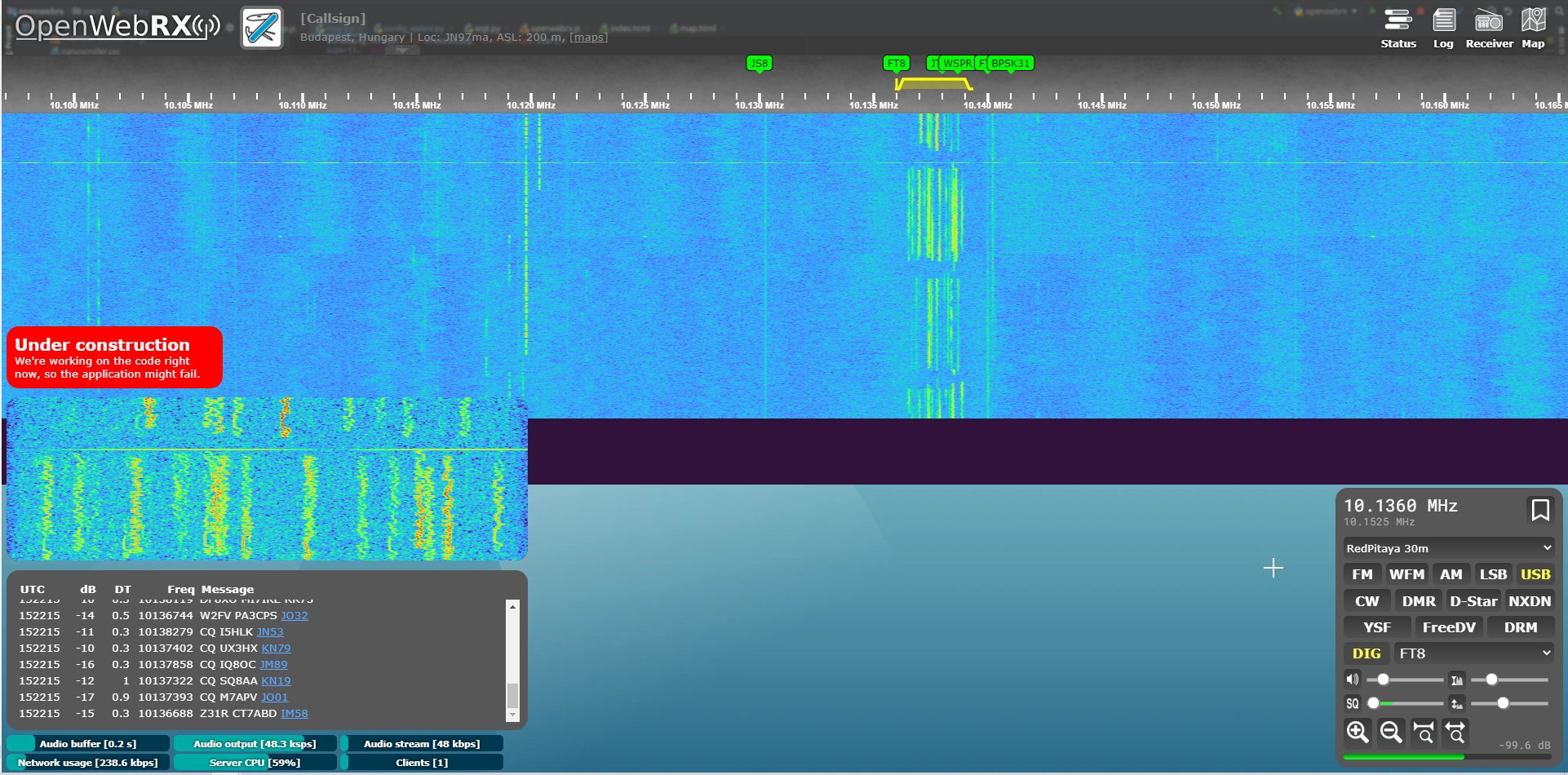
Thank you to Stefan Dambeck (DC7DS) for submitting news about OpenWebRX adding support for Hermes HPSDR compatible SDRs. Hermes is a single board version of the open source high performance SDR (HPSDR) design. There are several compatible Hermes designs including the newer Hermes-Lite 2 . The Red Pitaya is an open source electronics laboratory instrument, but custom software can be installed allowing it to function as an HPSDR type SDR. OpenWebRX is software which allows you to access your SDR remotely via the internet or local network through a web browser. Stefan notes:

I built a test setup today using a Red Pitaya 125-14 SDR in HPSDR mode, and this is now also supported, see screenshot.

At the moment, only one receive stream is supported, for the red pitaya with 192KHz bandwidth.

The Red Pitaya running in OpenWebRX

Hermes Lite 2 HF Amateur Radio SDR Group Buy Now Active

The Hermes Lite 2 (HL2) amateur radio direct sampling HF SDR transceiver board is now active for a group buy over on Makerfabs. The price is $225.70, and there need to be 25 orders before the group buy is confirmed. If confirmed, production will begin on 23 September, with production estimated to take about one month. More information about the group buy available on the Hermes Lite 2 Wiki. The N2ADR filter board for transmitting with the HL2 is also available on Makerfabs for $52.70.

The HPSDR Hermes SDR is an open source amateur radio SDR transceiver project that was released as far back as 2011. More recently Steve Haynal has been working on a Hermes-Lite project which is intended to be an opensource open hardware low cost amateur radio HF transceiver that is based on the HPSDR Hermes SDR project software and FPGA DSP implementation.

The Hermes-Lite is able to be very low cost because at it's core is the AD9866 chip which is a mass produced RF front end (LNA + ADC & DAC) that is commonly used in cable modems. Because it is a mass produced commodity, the chip only costs approx. US$35-$25 on Mouser depending on quantity. The chip has a 12-bit 80 MHz ADC and DAC, meaning that if used without any analog mixer front end (like in the Hermes-Lite) it can receive the entire spectrum between 0.1 to 38 MHz all at once.

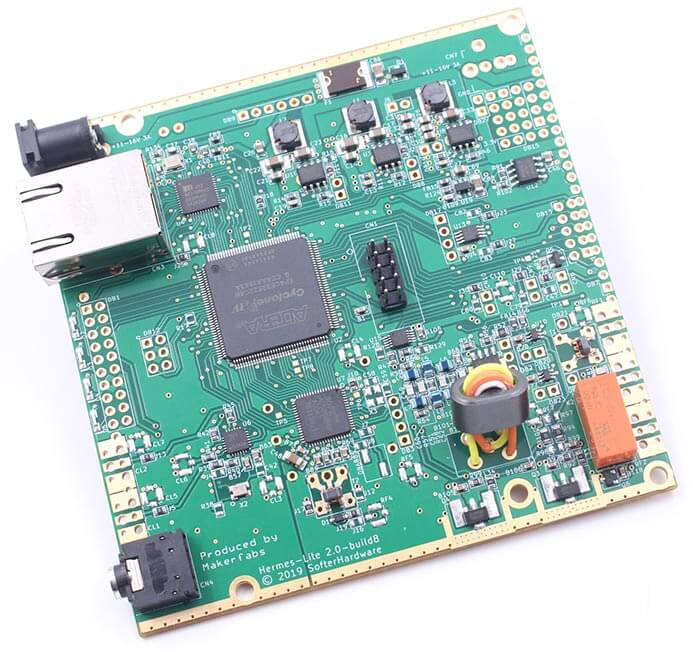
The Hermes-Lite is also a lot more than just the RF chip, as it contains a set of switched RF filters and a 5W power amplifier for TX. It also interfaces with a PC via Ethernet and has a built in FPGA for DSP processing.

The Hermes Lite 2 PCB