Tagged: ionosphere

SimTX: A Multiplayer Shortwave Radio Simulator with Realistic Propagation and rtl_tcp Support

Recently, we came across SimTX, an open-beta multiplayer shortwave radio simulator. Everyone shares the same simulated band, so whatever one user transmits from their virtual station can be picked up by anyone else, simulated propagation permitting. The website suggests running a pirate station, making your own numbers station, or just tuning around and listening.

For realism, the ionosphere is based on IRI-2020 climatology with live ionosonde data assimilated on top, groundwave and noise follow ITU-R models, and every link passes through a Watterson fading channel with Doppler, multipath and storms. Users can transmit from a mic, an audio file or raw IQ from GNU Radio in modes including AM, SSB, CW, NFM, WFM, WSPR and FT8, and can even launch and track their own satellites.

To receive, the SimTX app runs a local rtl_tcp bridge, so SDR++ or any other rtl_tcp-capable SDR program can tune the simulated band as if it were an RTL-SDR, without any real radio hardware. The app runs on Windows, macOS, and Linux, and accounts are created via Discord. The software does not appear to be open source. The demo video below shows a song broadcast from a simulated Amsterdam and received 1145 km away in Budapest.

This may be useful for playing around with and seeing what different TX/RX variables and propagation effects do to signal reception.

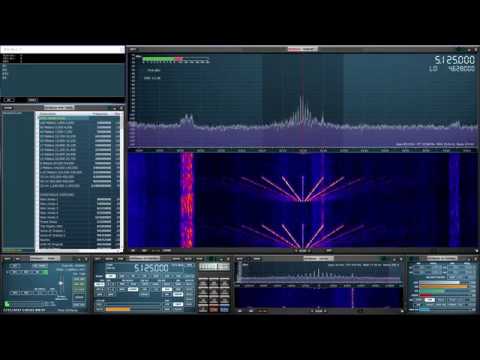
We broadcast a song through a simulated ionosphere

Listening to July’s Arecibo Observatory Ionospheric Heating Campaign

During July 24-31 the large Arecibo Radio Observatory in Puerto Rico (the big dish antenna that you may be familiar with from the movie ‘Contact’) ran an Ionospheric heating experiment which involves transmitting 600kW of net power up into the Ionosphere. This type of experiment is used for researching plasma turbulence in the ionosphere and upper atmosphere.

“The new Arecibo ionosphere HF heater nominally transmits 600 kW net power and has a unique Cassegrain dual-array antenna design that increases gain of three crossed dipoles for each band, using the signature 1000-foot spherical dish reflector,” explained Chris Fallen, KL3WX, a researcher at the University of Alaska-Fairbanks HAARP facility. He has reported that Arecibo would use 5.125 or 8.175 MHz, depending upon ionospheric conditions, but emphasized that these are estimates and frequencies may be adjusted slightly. On July 25, Arecibo was transmitting on 5.095 MHz.

Over on YouTube Mike L. used his SDRplay RSP1 together with our BCAM HPF to record some transmissions from the observatory.

Monitoring Ionosondes and Creating Ionograms with a USRP and GNU Chirp Sounder

In the HF region between about 0 – 30 MHz it is common to see and hear “chripers” – signals which quickly sweep through the HF frequency band and produce an audible chirp. These chirps are actually signals from Ionosondes which is a type of radar system used to monitor the Ionosphere. The Ionosphere exists about 50km above the surface of the earth and is the atmospheric layer responsible for a large part of long range HF communications. In a previous post by Mario Filippi we also discussed Ionosondes.

Usually it is scientists who transmit and monitor these Ionosondes, however if you have wide band radio that can cover a majority of the HF spectrum then you can also monitor these chirpers yourself. Over on his blog Fabrizio Francione has created a post showing how to use a USRP, together with a GNU Radio Program called GNU Chirp Sounder to create his own amateur Ionogram monitoring station. The USRP is a fairly expensive SDR with a bandwidth of 25 MHz, but we add that we think that next generation of low cost wide band SDRs like the up and coming LimeSDR should also be able to do the same job.

The Ionograms show at what frequencies HF propagation is currently optimal for a specific distance (or number of signal bounces from the Ionosphere). Below is an example Ionogram animation showing the reception of Ionosondes taken over time. Video from the GNU Chirp Sounder page.