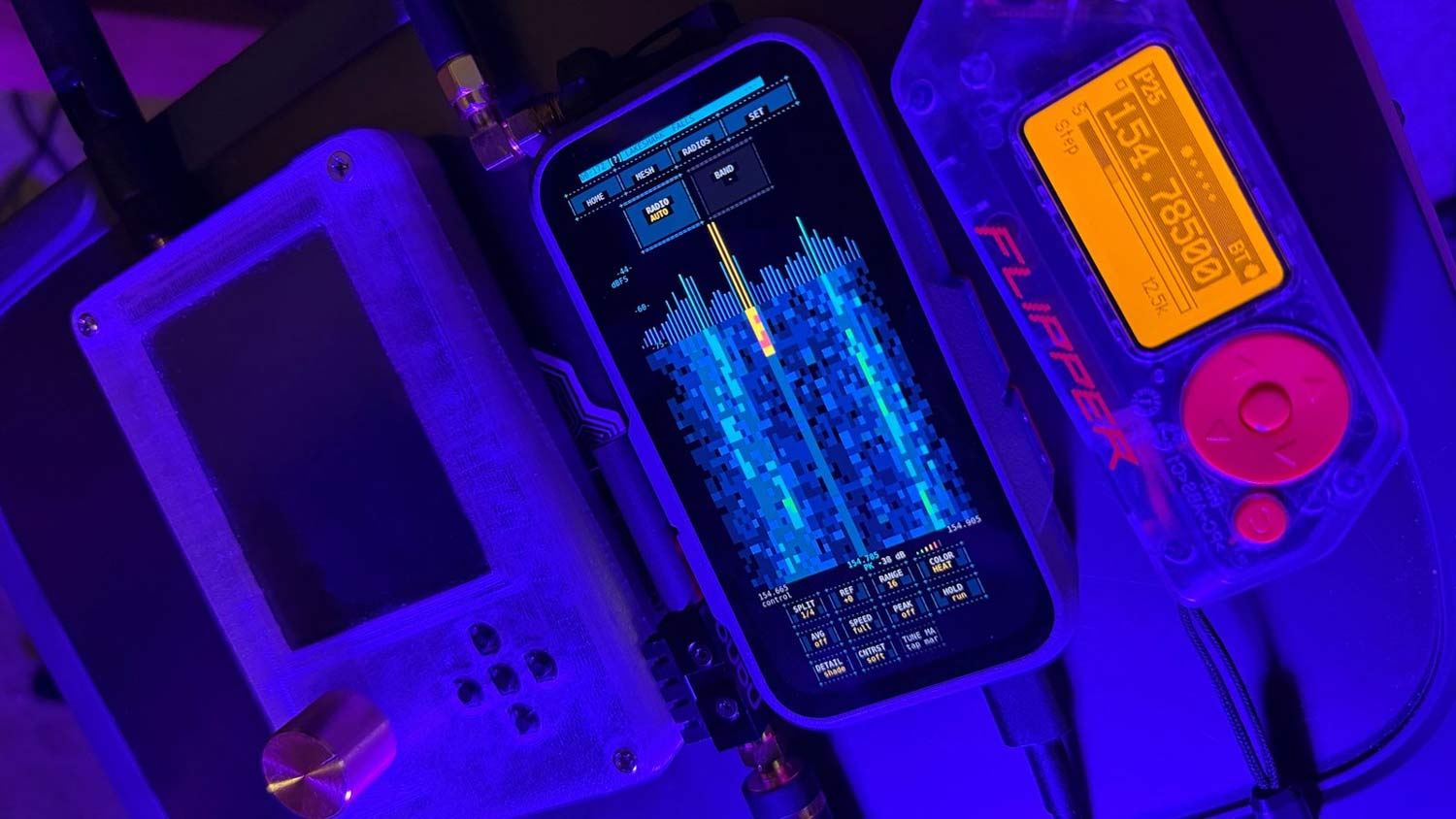
LakeShark Update: Using an LR2021 LoRa Chip as an SDR for Portable P25, POCSAG and FM Reception on the ESP32-P4
Back in September, we posted about LakeShark, Samuel Reynolds’ (aka SAMS0N1TE) T-Display P4 ESP32-P4 firmware that turns a USB-connected RTL-SDR into a handheld P25 Phase 1, POCSAG, and FM receiver.
Samuel has now written in to share news that with the T-Display P4 variant containing a Semtech LR2021 LoRa chip, LakeShark no longer needs an RTL-SDR at all. Instead, it can pull raw I/Q samples directly out of the built-in LR2021 LoRa transceiver chip and demodulate them on the ESP32-P4. Back in May, we posted Zoltán Papp and team's discovery that showed how an LR2021 could receive ADS-B. But this relied on the chip’s built-in OOK mode.
With raw I/Q available, the chip’s built-in modes no longer limit what it can receive. Both of the LR2021’s RF paths work, providing continuous coverage from 100 MHz to 2.74 GHz, and no upconverters, external tuners, or extra front-end hardware are used. The sample rate is relatively low at 250 Ksps max, meaning only a narrow bandwidth slice is available, but this is more than large enough for narrowband channels like P25. Samuel notes that it’s pretty unreal being able to listen to his local analog NFM fire department channels from such a low-power chip.
Smanuel notes that the LR2021 is still pretty new, and few products use them. However, it is possible to DIY a receiver for about $28 with Waveshare’s Core2021 LR2021 modules and their ESP32-P4-WIFI6 board. Samuel also has an experimental transmit path working, which has sent custom waveforms, temperature packets and P25 test-tone bursts. In one test, an independent receiver decoded 72 P25 voice frames from a single transmission and recovered the expected tone.
The radio access layer has been released as a separate project called LR2021-SDR. It includes a portable C library, capture firmware, waveform tools and measurements, along with graphs from a real received P25 call and a recording of the recovered transmit tone. The updated handheld firmware is available on the LakeShark GitHub.