Thermal Noise Communication: Sending Data Without a Carrier Signal, with an RTL-SDR as the Receiver
Thank you to RTL-SDR.COM reader Andrea for writing in and pointing us to a recent Stanford University press release about Zerina Kapetanovic and her team's research on "thermal noise communication", a way to send data wirelessly without generating any RF signal at all.
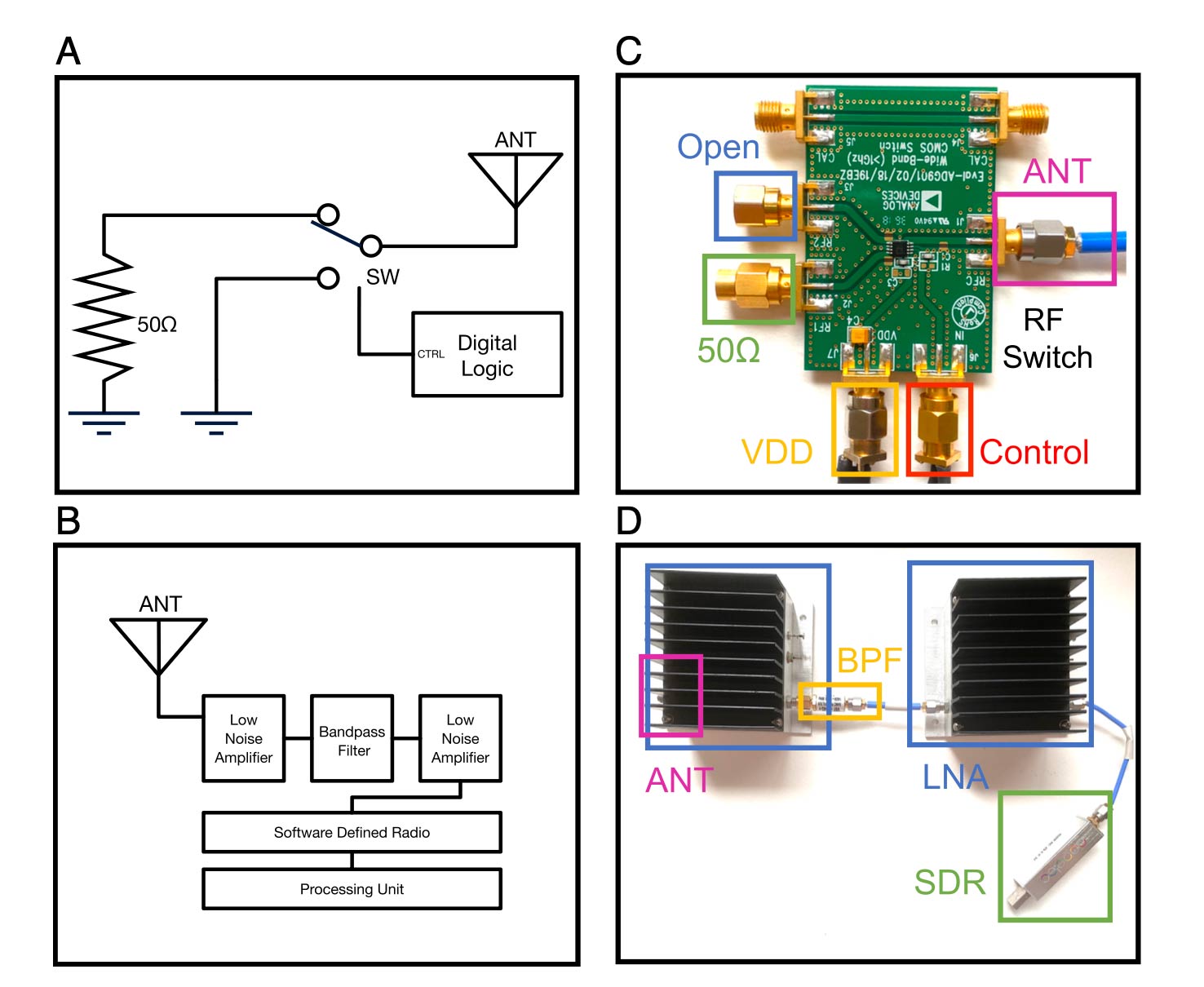
With this communication method, the transmitter simply switches its antenna between two loads, such as a dummy load and an open circuit, which the receiver sees as slightly "hotter" or "colder" thermal noise that encodes binary data. The study claims that a conventional RF transmitter uses up to 1,000 times more energy, making this a possible alternative to RFID tags and low-power wireless sensors.
Our reader Andrea also pointed out that the receiver in one of Zerina Kapetanovic's earlier experiments on the same topic was built around an RTL-SDR. Back in 2022, Zerina Kapetanovic and her team published a paper (pdf upload) demonstrating the idea at 1.42 GHz. Their receiver was a horn antenna, two LNAs with about 84 dB of combined gain, a bandpass filter, and an RTL-SDR, with processing on a laptop or Raspberry Pi. The transmitter was a simple RF switch connected to an antenna and switched between a 50 Ohm dummy load or ground. They achieved a data rate of up to 26 bps and a range of up to 7.3 m at 5 bps, and built a solar-powered, battery-free transmitter that sent indoor temperature readings over five days.
A new paper (not available freely yet) from Kapetanovic and her team builds on this idea and improves the data rate to the kilobit-per-second range, and adds capacity measurements and error correction, which was a limitation of their earlier experiment. The paper and press release also explain why this idea works at room temperature, making the analogy that the receiver's LNA works as a sort of 'electron refrigerator', slowing down electrons and making them appear colder.
We are unsure if the new setup still uses an RTL-SDR. However, readers who have built a Hydrogen line radio telescope have already built a nearly identical setup to the 2022 paper. In the press release Kapetanovic notes that "We've built a system that others could very easily implement", so this may be an interesting experiment to try for anyone who already has an H-line setup.