SPECTER: Leaking Data from Air-Gapped Computers by Toggling USB Power States
This October, researchers Hyeongjun Choi, Ji Hyuk Jung and Ji Won Yoon from Korea University and 78ResearchLab in Seoul have published a paper describing "SPECTER", a covert channel that leaks data from air-gapped computers by repeatedly switching the power state of attached USB devices. This first requires installing malware with root or administrator privileges, which then controls power via the operating system's suspend or disable/enable controls. No modification to the peripheral's hardware or firmware is needed.
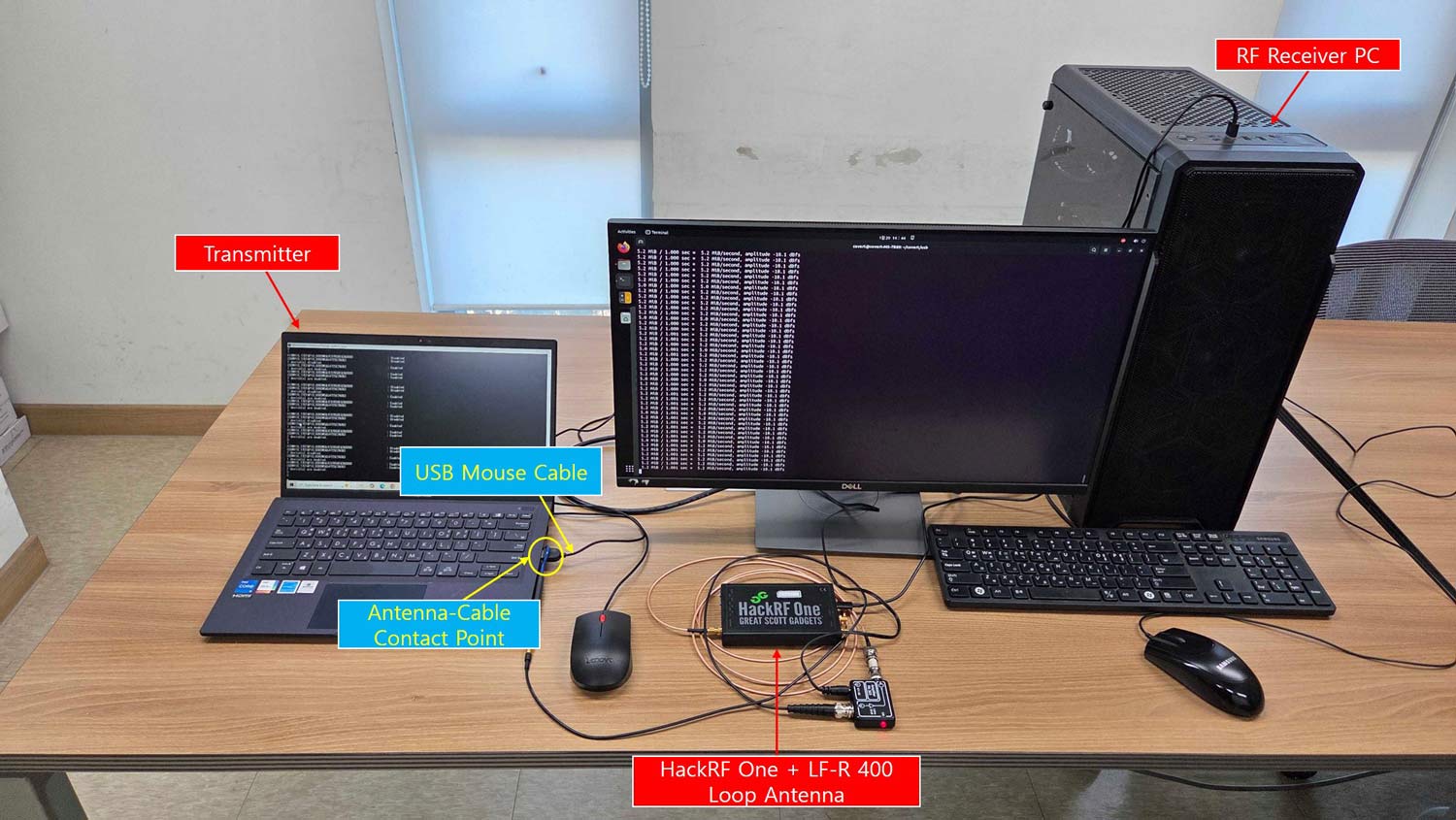
Three receiving methods were demonstrated, with one being RF based. The first method uses a phone plugged into the port, which then simply logs its charging state as on/off binary data. The second method uses a connected mouse, webcam or USB hub whose status LEDs can be watched by a person or camera. The final method uses a HackRF One with a near-field loop probe to pick up the switching emissions at around 5 MHz. Data rates are only 0.2 to 1 bit per second, so the channel is only useful for short secrets like passwords or keys.
We note that so far, the RF method was only tested with the probe touching the USB cable. This project is similar to USBee, which we posted about in 2016, where an unmodified USB device was also turned into a transmitter via malware. The difference is that USBee requires a data transfer USB device like a thumb drive to be connected, whereas SPECTER can use any connected USB device, even those that are charge-only.