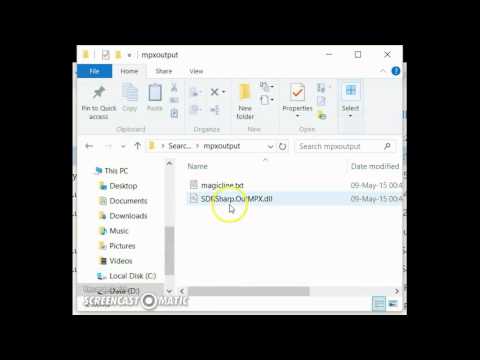
Adds a new display that shows a compressed image of the entire waterfall and shows where in time the playback is up to.
Allows you to modify the waterfall play time position with the mouse.
Adds a stop and pause button.
Note that to install this plugin you do not add the magicline to the plugins.xml file. Instead you need to add it to the <frontendPlugins> section of the SDRSharp.exe.Config text file.
The lowest frequency that a standard RTL-SDR dongle can receive is about 24 MHz. However, by applying a hardware hack called the direct sampling mod, it is possible to use the RTL-SDR to listen to the HF frequencies.
Along with the diplexer Martin added an impedance transformer, added additional coupling capacitors to the power rails and removed the IR LED components to make space for the transformer. Martin writes that the final modded RTL-SDR allows for tuning between 15 kHz to 1.8 GHz.
DSD+ stands for Digital Speech Decoder Plus and is a software program that can allow you to decode digital voice signals such as P25 and MotoTRBO/DMR. DSD+ is under continual development, and in their last public update they began offering early access to the latest DSD+ features in development through their fast lane subscription. The fast lane subscription costs $10 USD for one year and $25 for unlimited early access. Information about joining the fast lane service can be found in the readme file of the latest DSD+ 1.074 public release.
Over on YouTube user John Miller has been testing the latest early access version DSD+ 1.08t. This new version adds trunking support which allows you to follow conversations. Previously other software like Unitrunker was required to follow the trunking signal. On YouTube John has uploaded a video first showing trunking in action, and a second video showing how to set up DSD+ 1.08t for trunking.
Adam 9A4QAV is mostly known as the manufacturer of the popular LNA4ALL, a low cost low noise amplifier which is often used together with the RTL-SDR to improve reception of weak signals. He also sells an ADS-B bandpass filter and an ADS-B antenna, the latter of which we reviewed in a previous post.
The first new filter that he has developed is for FLARM (FLight Alarm System). FLARM broadcasts at 868 MHz and is a protocol similar to ADS-B. It is used by Gliders and some Helicopters for collision avoidance. It is possible to decode FLARM with an RTL-SDR which allows you to track gliders on a map, as discussed in one of our previous posts.
Characteristics of Adam’s FLARM Filter.
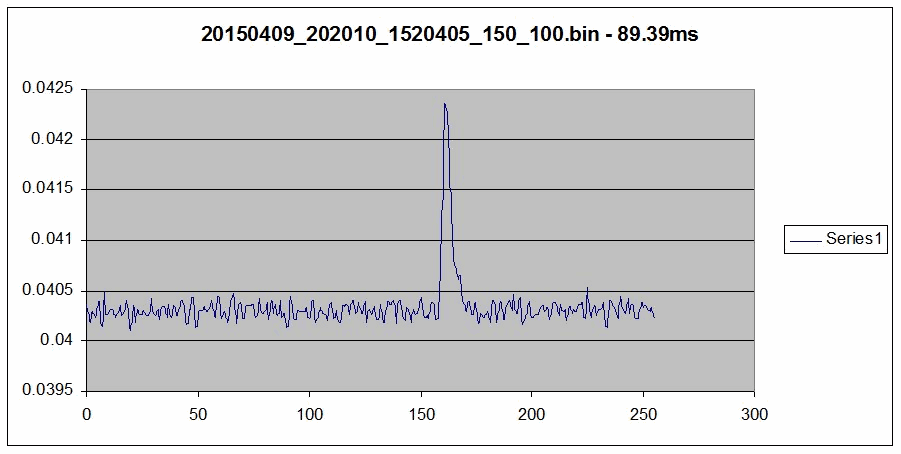
The second filter is for amateur radio astronomers who wish to detect the Hydrogen Line at 1420 MHz. Hydrogen molecules in space occasionally emit a photon at 1420 MHz. A single emission can’t be easily detected, but space and the galaxy is full of Hydrogen and the net result is an observable RF power spike at 1420 MHz. This can be detected with a high gain antenna, LNA, RF filter and radio like the RTL-SDR. The Hydrogen line can be used to measure things like the rotation and number of arms in our galaxy. Filters are very important for radio astronomy work as man made interference can easily drown out the relatively weak cosmic signals.
By using a Python script to make the Crazyradio constantly transmit, and then by using GNU Radio, Arnuad was able to sniff and demodulate the GFSK signal from the nRF24 based Crazyradio and pipe the demodulated signal into a nRF24 decoder.
ADS-B decoding allows you to receive GPS and other information from aircraft in your vicinity. We also have a tutorial about ADS-B decoding available here.
The BeagleBone Black is a small embedded Linux computer, similar to the Raspberry Pi. It has enough computational power to run the RTL-SDR and ADS-B decoder.
The Outernet project aims to be a “library in the sky” satellite based service that will provide free access to daily downloads of data such as books, news, videos and other information. It’s goal is to provide people who may not have easy physical or uncensored access to the internet an easy way to access daily information.
Outernet Overview Poster
To achieve this goal the Outernet project needs a good low cost satellite receiver. The RTL-SDR is a good candidate, but it’s performance at about 1.5 GHz isn’t great, and this appears to be the frequency Outernet wants to use. To improve the performance for satellite reception at these frequencies they have redesigned the RTL-SDR by replacing the R820T2 tuner with a MAX2120 tuner chip which tunes from 925 MHz to 2175 MHz. They have also improved the components used and the PCB layout. The regular RTL2832U chip is used as the ADC and USB interface, so the maximum bandwidth and ADC bit depth remain the same.
The Lantern is currently being prototyped and there is a discussion about it on Reddit. They are aiming for a price point below $20, but note that it will take time to get to that low price as mass production will be required.
RTL-SDR.com reader Marty Wittrock has written in to let us know that he has been successful in getting his HF modified “KN0CK” RTL-SDRs (and by extension standard RTL-SDRs) to work with Zadig and HDSDR on a PC running the Windows 10 technical preview on a VMWare image.
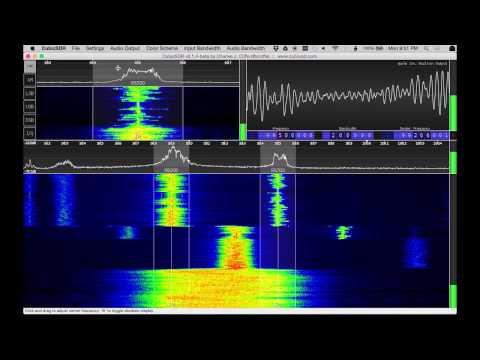
We decided to also test RTL-SDR compatibility with other common software on our own Windows 10 system. We tested SDR#, SDR-Radio, CubicSDR and Unitrunker and found them all to work fine with no problems either. Finally, we also tested the Airpsy and SDRPlay on Windows 10 and found no problems with those devices either.