3D Printing a V-Dipole Bracket

Over on his YouTube channel user Tysonpower has uploaded a video that shows how to make a V-Dipole antenna. Back in March we posted about the V-Dipole which Adam 9A4QV first described. A V-Dipole is a simple antenna that normally consists of two metal rods, a terminal block and coax cable. It is particularly effective for reception of low Earth orbit satellites like the NOAA and Meteor M2 weather image satellites with an RTL-SDR or other similar SDR.

In his video Tysonpower shows how to build a slightly more rugged version using a 3D printed part instead of a terminal block. Aluminum welding rods are used for the elements. The 3D printed part ensures that the correct 120 degree ‘V’ angle is maintained and also provides a means for mounting the antenna to a pole. The 3D printing STL files are available on Thingiverse. Note that the video is in German, but English subtitles are available.

Note that we will also have a dipole antenna capable of being used as a V-Dipole available in our store in a few weeks time.

[EN subs] Bau einer V-Dipole Antenne - 3D Druck für mehr Genauigkeit und Stabilität

Nongles.com N3 RTL-SDR Available in our Store

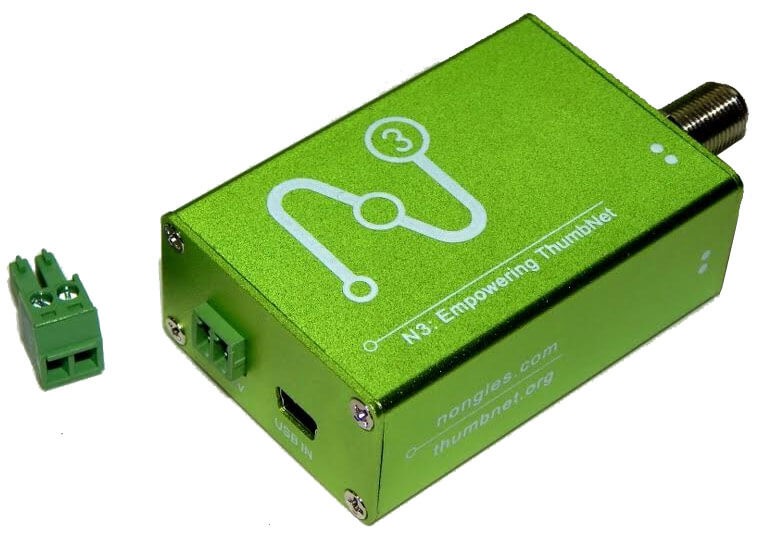
Late last year the ThumbNet team announced their custom RTL-SDR dongle which they named the “Nongles N3”. This is a standard R820T2 RTL-SDR, but with some interesting additional features. Some of the changes they made include:

  • Shielding can on the PCB
  • Thick rugged metal case
  • F-Type connector
  • External 5V power input
  • Low noise PCB design

As explained in our previous reviews (prototype review, production review) the N3 is a rugged dongle, probably best suited to applications where the SDR could take a beating. The F-Type connector is also preferred by some people as it is fairly commonly used on TV equipment in most parts of the world. Shielding against local strong signals is also excellent due to its double shielding with a shielding can on the PCB and with the metal case.

Probably the most defining feature other than its ruggedness and low noise floor is that it can be optionally powered by 5V external power. So it could be used at the end of a very long active USB cable, with power provided locally. Or if very low power noise is desired, a linear power supply could be used.

We now have these N3 dongles available for purchase in our store. Please note that this is a commission sale, so the N3 will actually be shipped by the Nongles team in the USA once a week. The current price of the Nongles N3 is $33.5 USD + $4.5USD shipping in the USA, or $10 USD shipping worldwide.

Please Visit our Store

The ThumbNet N3
The ThumbNet N3
ThumbNet N3 with RFI Shield

ADALM-Pluto 2-tone Test at 144 MHz

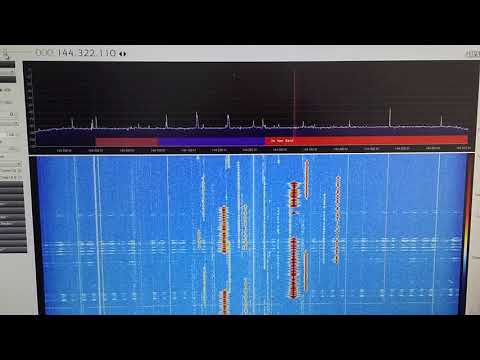
Over on his YouTube channel Adam 9A4QV has been testing his ADALM-PLUTO SDR in the 2M ham band at around 144 MHz. In one of his videos he shows a 2-tone test. A 2-tone test is used to determine how well an SDR can handle two strong narrowband signals at once, without causing intermodulation and imaging problems. The two tones in his video occur with real world signals on the 2M band when two amateur radio operators are transmitting strong signals at the same time.

The video shows that the Pluto SDR has some intermodulation problems occurring when the two strong signals transmit at once. No problems are noticed when only one signal transmits.

Problems like this with the PlutoSDR may be expected as it was never designed to be a high performance receiver, but rather a tool for learning and experimentation. But it is still possible to use it as a more general purpose receiver if you are aware of the limitations.

ADALM-PLUTO 2-tone test 144MHz

(Almost) Receiving HRPT with the ADALM-PLUTO and a WiFi Grid Antenna

Over on YouTube user Tysonpower has uploaded a video showing how he was (almost) able to receive the HRPT signal from NOAA18 with an ADALM-PLUTO, LNA4ALL and a WiFi grid antenna.

Most readers will be familiar with the low resolution 137 MHz APT weather satellite images transmitted by the NOAA weather satellites. But NOAA 15, 18, 19 and well as Metop-A and Feng Yun satellites also transmit an HRPT (High Resolution Picture Transmission) signal up in the 1.7 GHz region. These HRPT images are much nicer to look at with a high 1.1 km resolution. If you follow @usa_satcom on Twitter you can see some HRPT images that he uploads every now and then.

However HRPT is quite difficult to receive and decode because the bandwidth is about 3 MHz so something with more bandwidth than an RTL-SDR is required. The signal also needs a ~1 meter or larger dish antenna as it is very weak, and you also need a motorized pointing system to track the satellite with the dish as it passes over.

Despite the difficulty in his video Tysonpower showed that he was able to at least receive a weak signal using a non-optimal 2.4 GHz WiFi grid dish antenna, LNA4ALL and his ADALM-PLUTO. The signal is far too weak to actually decode, but it’s still pretty surprising to receive it at all. In the future Tysonpower hopes to be able to improve his system and actually get some image decodes going. Note that the video is in German, but there are English subtitles available.

[EN subs] Empfang von HRPT mit dem ADALM-PLUTO SDR - NOAA18

Tracking Wildlife with TDOA Direction Finding and RTL-SDR Dongles

At the North-West University in South Africa Masters student SW Krüger submitted his dissertation titled “An inexpensive hyperbolic positioning system for tracking wildlife using off-the-shelf hardware” back in May of this year. Recently it was found online and can be viewed here (large pdf warning).

In his thesis Krüger explains his experiments with using RTL-SDR dongles to set up a very low cost wildlife monitoring system using TDOA (Time Difference of Arrival) techniques, and very low power beacons on the animal tags. TDOA is a difrection finding technique which involves using multiple receivers spread out over a region and calculating the difference in time from when the signal arrives at each receiver. With this information the position of the transmitter can be determined. Typically to do this the system clock in the computing hardware and OS needs to be synchronized as perfectly as possible between receivers, otherwise timing difference will cause huge errors in the position. Krüger uses synchronization bursts from a beacon, but notes that a real-time clock or GPS module could also be used for accurate time keeping.

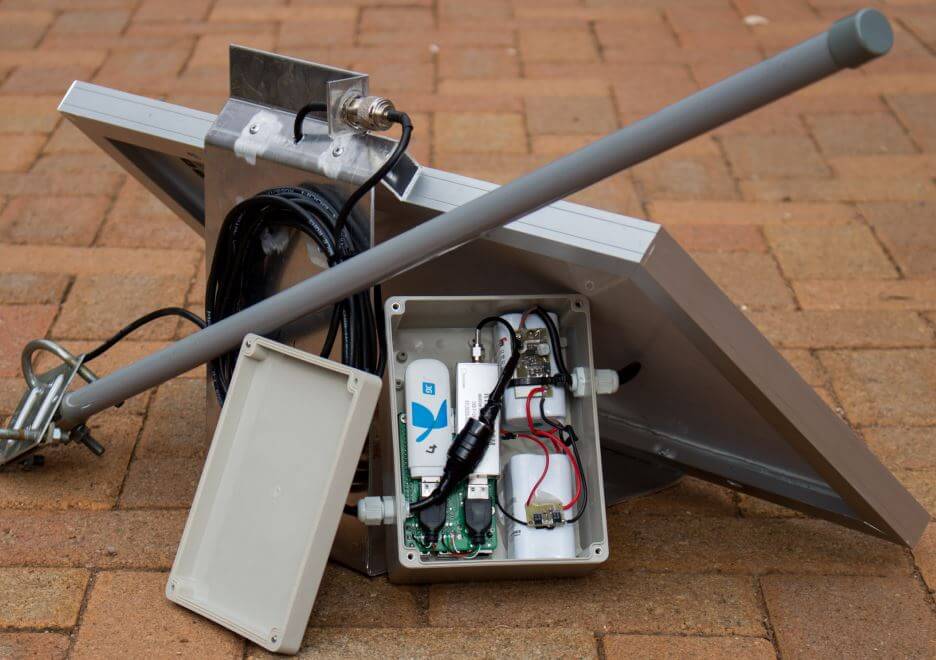
In his experiment he set up two RTL-SDR receivers spaced 9 km apart and was able to obtain an accuracy of about 3.5m, which he writes is similar to other wildlife positioning systems that use tags with much higher power consumption. The computing hardware used at the RX station is a Raspberry Pi 3 powered by a 20W solar panel and batteries. There is also a wireless 3G modem for communications. The DSP software produced for the project is all open source and available on GitHub.

The RX System with RTL-SDR, Raspberry Pi, Mobile Broadband Modem, Power Supply and Solar Panel.

dopplerscript: Getting Doppler Updates from GPredict into GNU Radio

Thanks to Dave for submitting news of his recent release of his Python script called dopplerscript. This is a tool that can help people automate the reception and decoding of the Meteor M2 weather satellite in Linux with GNU Radio by providing a tool for automatic Doppler correction. He writes:

gr-gpredict-doppler is an out-of-tree gnuradio block for getting doppler updates from gpredict into a flowgraph. I’ve written a small python script (based on pyephem) that replaces gpredict for generating  the doppler updates. This script allows one to automate scripting the  reception of Meteor M2 satellite transmissions while compensating for the doppler shift.

dopplerscript is a command-line tool to input satellite doppler shifts into a gnuradio flowgraph. The doppler.py script replaces gpredict as the source for doppler frequency updates in gr-gpredict-doppler, making it easy to script satellite reception.

As low earth orbit satellites fly very quickly overhead, the signal will be affected by the doppler effect, thus shifting the frequency as it moves towards and away from you. Tools like this can be used to predict and compensate for this effect and thus providing better signal processing. Meteor M2 is a Russian weather satellite in low earth orbit which transmits digital LRPT weather satellite images that can be received with an RTL-SDR or other SDR.

An Example LRPT Image Received with an RTL-SDR from the Meteor-2 M2.
An Example LRPT Image Received with an RTL-SDR from Meteor M2.

Akos’ ADS-B Performance Comparison of 19 Different RTL-SDR Dongles

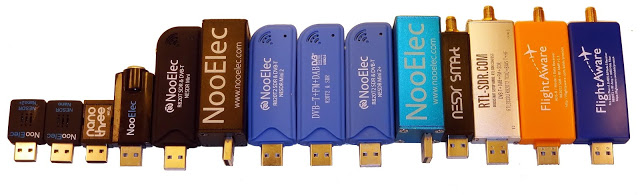
Over on his blog radioforeveryone.com author Akos has run a large comparative test of 19 different types and brands of RTL-SDR dongles on ADS-B reception. He takes multiple dongles from NooElecs Nano/Mini and SMArt range and our RTL-SDR Blog V3 unit and the FlightAware ADS-B optimized units. He also notes that E4000 based dongles such as the NooElec XTR are unable to receive ADS-B frequencies and excludes them from the test.

For his tests he used a Raspberry Pi 3 and compares two dongles at a time. The results are about as would be predicted. The tiny Nano dongles are usually the worst performers due to their trade off in size vs heat dissipation and internally generated noise. The standard sized dongles all perform about the same, but the dongles with heatsinking perform the best. Of course the FlightAware dongles still get the best ADS-B reception due to their significantly lower noise figure thanks to the built in ADS-B LNA.

One interesting finding is that Akos shows that heat does play a noticeable role in performance of these dongles at 1090 MHz. Akos noticed that the better heatsinking on the RTL-SDR Blog V3 or cooler days improved reception.

Some of the tested RTL-SDR dongles

LimeSDR Transmitting Voice and Data with SDRAngel

Over on the LimeSDR facebook group Marty Wittrock (KN0CK) has been experimenting with his LimeSDR and SDRAngel. SDRAngel is a general purpose SDR program similar to SDR#/HDSDR/SDR-Console etc, but with the key difference that it is designed to incorporate TX features as well. SDRAngel has releases available for Linux and Windows.

Marty writes that in early August SDRAngel programmer Edouard (F4EXB) resolved most of the issues with LimeSDR compatibility and now TX and RX in SDRAngel with the LimeSDR works great.

SDRANGEL/LIMESDR WINDOWS UPDATE – WORKING!: …For the first time in 18 months the LimeSDR has a working Windows transmit and receive application..! Check out the video for more, but for those that don’t use Linux, you can now experience full transmit and receive using the Win32 SDRAngel version 3.5.5 and Zadig 2.2 that loads the LimeSDR driver…Just load Zadig first as you normally would to select the LimeSDR (after you’ve initially installed it) and then launch SDRAngel…The application will allow you to operate ANYWHERE from 160m to 70cm using any demodulator and modulator you wish (AM, FM, SSB, CW, and more!). I tested it this evening from 40m to 10m to 2m tonight and it works EXCELLENT..!! Get in while the gettin’ is good – A full-up transceiver app now exists for the LimeSDR and this is just the beginning..! 73 de KN0CK

Posted by Marty Wittrock on Tuesday, 15 August 2017

LIMESDR/SDRANGEL UPDATE: Yours truly the mad scientist, playing with the LimeSDR on HF at 7.0 MHz here within the shack (no external antennas applied) TRANSMITTING NO DELAY ON HF LOWER SIDEBAND USING SDRANGEL AND THE LIMESDR..!! FINALLY, an app that supports receive and transmit for the LimeSDR is available free of charge and WORKS PERFECTLY..!! See it for yourself on the attached video…And I do have the recipe for this since it’s on Linux (Ubuntu 16.04) for now…A Windows 7/10 build IS planned…A RED LETTER DAY FOR THE LIMESDR..!! #LimeSDR #SDRAngel #HF 🙂 !!

Posted by Marty Wittrock on Saturday, 12 August 2017