Tagged: Elektro-L3

Elektro-L3 Arrives at 14.5°W and Begins Testing L-Band LRIT and HRIT

Earlier this month we posted about the Russian Elektro-L3 geostationary weather satellite drifting west from 76°E to 14.5°W. It is replacing Elektro-L2 and could bring unencrypted L-band LRIT and HRIT imagery back to Western Europe. Now tec_msat has written in again to let us know that Elektro-L3 has arrived. It is already transmitting X-band RDAS and testing LRIT and HRIT.

tec_msat notes that the satellite was only active on C-band for a couple of days. Then, on October 26, its RDAS, xRIT, and DCP (Data Collection Platform) downlinks all went up. Elektro-L2's DCP transmission at 1697 MHz was switched off at 06:30 UTC, and L3's DCP came up at 07:02 UTC. LRIT data was being received from about 09:42 UTC. GGAK (space weather data) is still being transmitted from Elektro-L2 for now.

This is the first xRIT from 14.5°W in years, so tec_msat warns that transmissions may be sporadic for a while. It's too early to judge signal strength, but it already looks stronger than L3 did at low elevation (under 15 degrees) in its old slot.

If you're in Western Europe, now is a good time to get your dish ready. SatDump is the best software for reception and decoding, and our Discovery Dish with L-band feed and an RTL-SDR Blog V3 is a great starting point for hardware.

Elektro-L3 LRIT Image Received from 14.5°W on October 26

Elektro-L3 Now Drifting West to 14.5°W: L-Band xRIT Could Return to Western Europe in October

Back in May, we posted about how Russia's Elektro-L3 geostationary weather satellite was expected to move from 76°E to 14.5°W, which would finally bring an unencrypted L-band LRIT/HRIT downlink over Western Europe. Thank you to RTL-SDR reader tec_msat for writing in and letting us know that the move now appears to be underway.

tec_msat writes that Elektro-L3 went quiet around September 10. Updated TLEs on September 13 then showed the satellite drifting west at roughly 1.7 degrees per day. Around September 20, its orbit was circularized, making it drift faster at around 3.1 degrees per day. At its current speed, it should reach 14.5°W around October 12. Based on Elektro-L5's commissioning timeline, test transmissions could begin within days of arrival.

Elektro-L5, launched in February 2026, has now been successfully commissioned at L3's old 76°E slot, which covers Asia, the Middle East, and parts of Russia and Australia. It has been transmitting GGAK, LRIT and HRIT, as well as X-band RDAS. With L5 taking over the eastern slot, L3 will replace the aging Elektro-L2 at 14.5°W. L2 never provided LRIT/HRIT from that position due to power supply issues, although the original Elektro-L1 did when it was stationed there.

Roscosmos noted in August, when announcing L5's commissioning, that L3 may be moved to 14.5°W. However, there has been no official announcement from Roscosmos that the relocation has started, so the drift observations currently come from amateur TLE tracking.

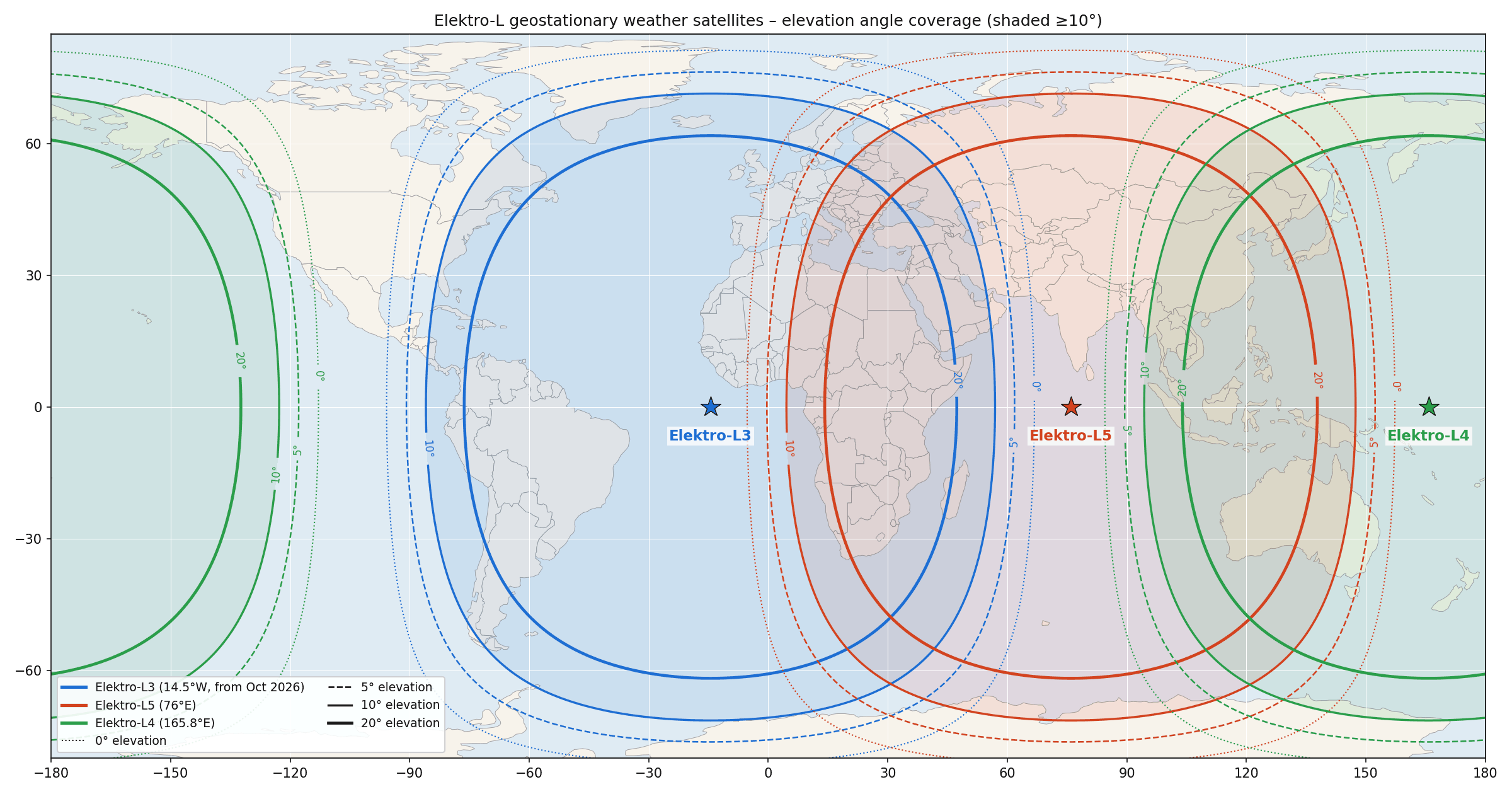
Once commissioned, L3 should once again make geostationary L-band weather imagery at 1691 MHz available to users in the UK, Ireland, Iceland, Portugal, Spain and western France. tec_msat also speculates that the signal may be stronger over Europe than it was from 76°E (potentially due to better elevation angles), making xRIT reception even easier.

If you're in the coverage area, now might be a good time to get your dish, feed and LNA ready. SatDump is the best software tool to use for reception and decode and our Discovery Dish with L-Band feed and RTL-SDR Blog V3 is a great starting point for hardware.
Expected Elektro L3/L4/L5 global coverage from mid-October 2026.

Receiving Elektro-L3 LRIT Weather Satellite Images with an 11-Turn Helix Antenna and No Dish

Typically, a satellite dish is used to receive Elektro L3. As an example, our 70cm diameter Discovery Dish with linear feed can do this easily, and achieve an SNR of about 5-6 dB. However, as Meti shows, it is possible to receive this satellite even without a dish, and as he shows, an SNR of 1.5 dB is sufficient for decoding a perfect image.

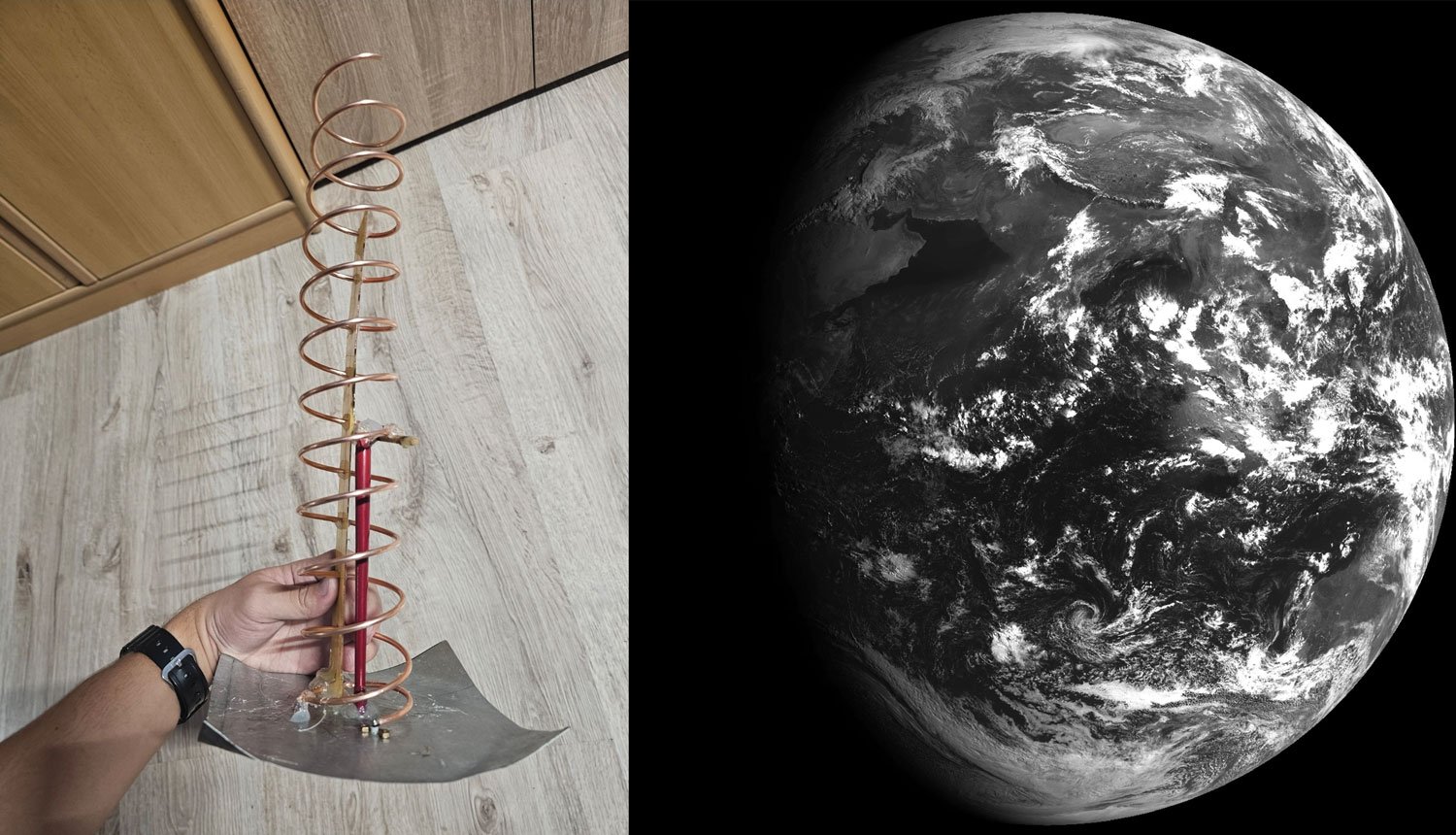
Meti's antenna is an 11-turn RHCP helix made of copper wire, with a 17 x 17cm ground plane. In his post, he also notes a few interesting findings, noting that the height of the antenna off the ground is critical, rotating the helix can help, interference from cell towers can cause issues, and bending the corners of the ground plane can help.

In the rest of the post, Meti also shows how well the helix antenna works at receiving weather satellite signals from polar orbiting L-Band satellites like Meteor M2-3.

Meti's 11-Turn RHCP Helix Antenna