Tagged: satellite

SignalsEverywhere: Investigating USGS Gaging Stations and their GOES Satellite Connection

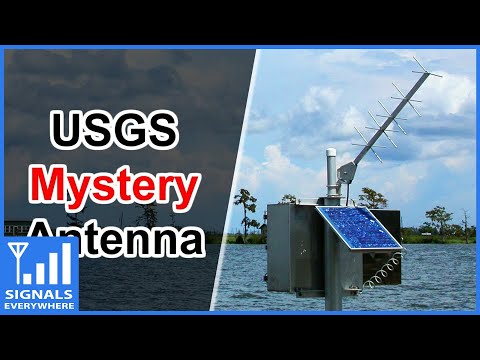
The United States Geological Service maintains over 8500 "Gaging stations" in bodies of water all over the country. Gaging stations are devices that are used to measure environmental data such as groundwater levels, discharge, water chemistry, and water temperature. What's interesting is that they all upload their data in real time to GOES satellites - the same satellites that we can use with an RTL-SDR to receive weather images of the entire earth. The data is then downlinked in the L-band to the USGS scientists via a protocol known as DCP (Data Collection Platform).

In the latest SignalsEverywhere video, Corrosive investigates how these stations work, and how we can receive the downlink at 1.68 GHz with a simple Inmarsat L-band antenna. While a fully functional decoder is not yet available, Corrosive notes that one called goes-dcs is currently being worked on.
USGS Gaging Station | Satellite Uplink to GOES and DCP Messages

Meteor M2 is Currently Experiencing Orientation Issues

Russian weather satellite Meteor M2 is a popular reception target for RTL-SDR radio enthusiasts, as it allows you to receive high resolution images of the Earth. However, currently it appears to be exhibiting orientation issues, causing off center and skewed images and sometimes poor/no reception. Russian blog "aboutspacejornal", writes that the orientation of the satellite can sometimes be restored presumably by a reset command from Earth, but shortly after goes back into uncontrolled rotation.

These sorts of off-axis images were commonly received from the older decommissioned Meteor-M1 satellite, which woke up from the dead in 2015. The resurrection was speculated to be from the batteries shorting out, allowing power to directly flow from the solar panels while in full sunlight. These days Meteor-M1 is no longer transmitting.

Meteor M2 proving the curvature of the earth due to it's orientation issues.
Meteor M2 proving the curvature of the earth due to it's orientation issues.  Image source aboutspacejornal.

Hopefully Meteor-M2 can be fixed, but if not, Meteor M2-2 is due to be launched on July 5 which should also have an LRPT signal that can be received easily with an RTL-SDR. Hopefully the launch is more successful than the November 2017 launch of Meteor M2-1 which unfortunately was a complete loss as it failed to separate from the rocket.

A LimeSDR Mini Based Es’Hail-2 DATV Ground Station Uplink

Daniel Estévez has posted on the LimeSDR Mini CrowdSupply blog about his ground-station build for the Es'Hail-2 satellite. Es'Hail-2 is the first geostationary satellite with amateur radio transponders on board. The LimeSDR Mini is a $159 RX/TX capable SDR with 10 MHz to 3.5 GHz frequency range.

The Es'Hail-2 satellite is positioned at 25.5°E which is over Africa. It's reception footprint covers Africa, Europe, the Middle East, India, eastern Brazil and the west half of Russia/Asia. There are two amateur transponders on the satellite. One is a narrow band linear transponder which uplinks from 2400.050 - 2400.300 MHz and downlinks from 10489.550 - 10489.800 MHz. Another is a wide band digital transponder for digital amateur TV (DATV) which uplinks from 2401.500 - 2409.500 MHz and downlinks from 10491.000 - 10499.000 MHz.

Daniel's ground station uses a LimeSDR Mini running on a Beaglebone Black. A 2.4 GHz WiFi parabolic grid antenna is used to transmit to the satellites digital amateur TV uplink. In order to generate enough power for the uplink transmission a GALI-84 amplifier chip is cascaded with a 100W power amplifier. All the electronics are enclosed in a watertight box and placed outside.

A LimeSDR Mini Based Es'Hail-2 DATV Uplink Ground Station

Decoding Es’Hail-2 DVB-S2 Realtime in Linux with LeanDVB

Last week we posted about M Khanfar's YouTube video that showed how to decode Es'Hail-2/QO-100 DVB-S2 on Ubuntu with the LeanDVB decoder. However, the method he showed was not in real time as it involved recording an IQ file in GQRX first, then decoding that IQ file. Similarly we also posted last week about a Windows based real time decoder.

M Khanfar recently wrote in again and wanted to show that real time decoding is possible with LeanDVB. The method is to simply pipe the output of the rtl_sdr command line decoder in LeanDVB, and then into VLC. He notes that his PC isn't actually fast enough to decode in real time without lag, but a modern i5 CPU would work well. The actual terminal command is shown in his YouTube video description.

This is Realtime live DVB-S2 Decoding done , without need to record .RAW file , its live and easy method by one click ! In this video i decoding 2MS symbol rate from wideband transponder of QO-100 beacon , you can decoding 1MS , 0.5MS , 333KS , 125KS symbol rate ! The lower Symbol, the faster speed for decoding! , the Amateurs operators on QO-100 Uplink DATV DVB-S2 at 0.5 , 333 , 125Ks , so its easy to Live Decoding Now ! With very low SNR ! , so the normal SDR can coverage wideband beacon of 2Ms symbol and all Ham uplink ! , if you have an SDR that can coverage 27.5 mb of bandwidth, so you can easy decoding Live a standard commercial satellite channels! But it need a high speed Pc .

QO-100 Realtime Live DVB-S2 Decoding

Receiving Es’Hail-2 DVB-S2 on Ubuntu With LeanDVB

Yesterday we posted about a real time Windows demodulator for receiving amateur TV DVB-S/S2 on Es'Hail-2/QO-100. Recently another YouTube user "M Khanfar" also submitted a video tutorial showing how to decode Es'Hail-2 DVB-S2 on Ubuntu with an RTL-SDR and the LeanDVB decoder.

Khanfar notes that although the LeanDVB decoding method is not real time, his tests show that the LeanDVB method is able to work with a much lower SNR signal compared to the Windows demodulator. The process is to simply capture an IQ file with GQRX, then run LeanDVB on the command line with the recorded IQ file. It will create a TS file that can be played in any media player.

His receiving setup consists of an RTL-SDR, 100cm dish, modified LNB and a home made bias tee that can switch his LNB between horizontal and vertical polarization.

QO-100 DVB-S2 Decoding

Windows Realtime DVB-S Demodulator for Es’Hail-2 & Amateur TV Available

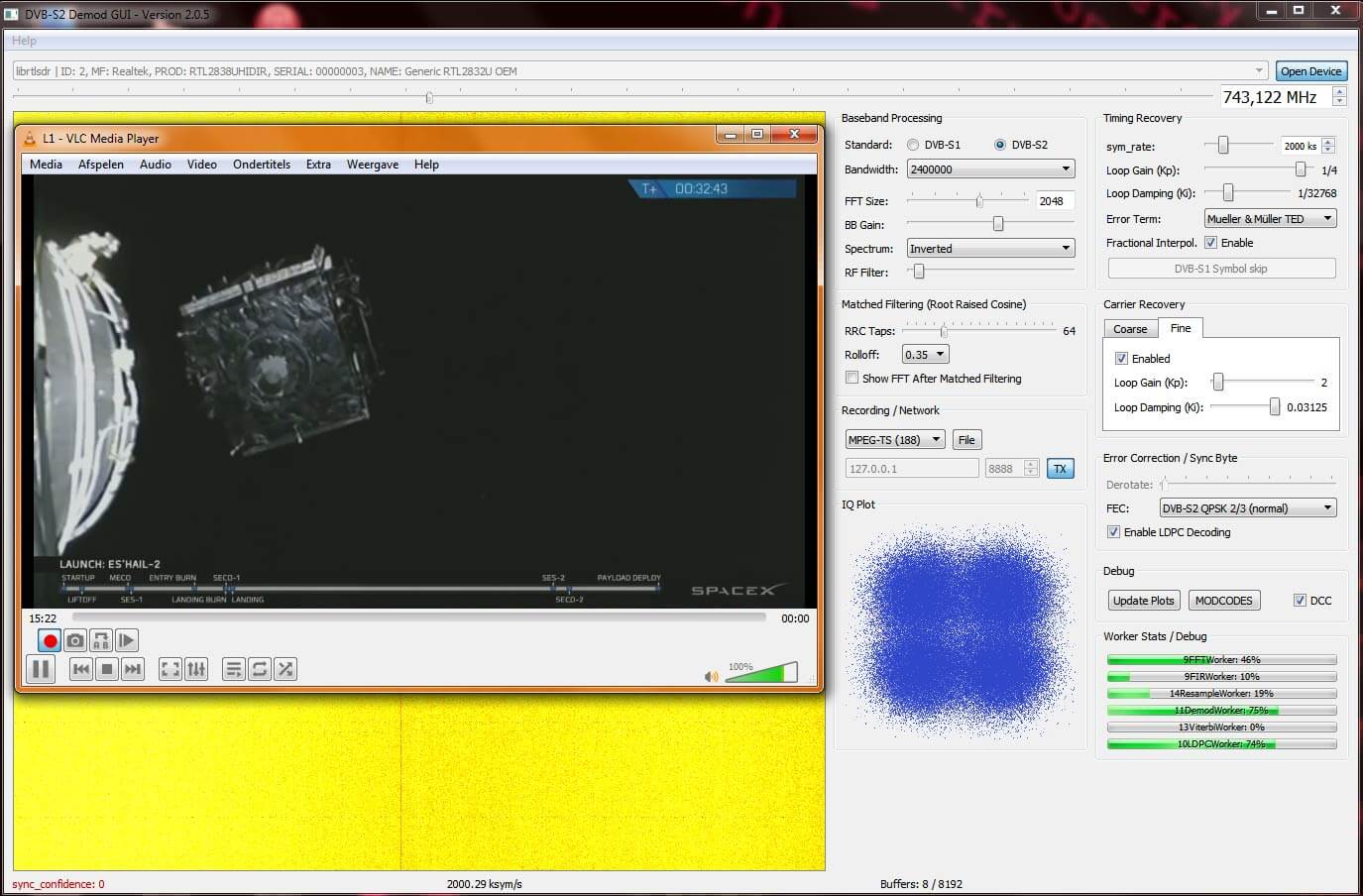
Thank you to Happysat for writing in and noting that over on the Amsat-DL forums user Markro92 has uploaded a realtime Windows DVB-S demodulator with GUI. The demodulator works with the RTL-SDR, HackRF, SDRplay and PlutoSDR support is due to be added soon. Happysat notes the following: 

It can demodulate DVB-S and S2 signals with very low symbolrate on Es Hail-2 geosat on 25,9 East from the Wideband Transponder. So you do not need a modified lnb or modified satelitte stb :) Of course you can also see the amateur tv streams which people uplink theirself.

To see if there is any stream active one can visit the wideband WebSDR and above the stream the info is displayed which parameters in use (symbol rate and mode dvbs(2)) so you can adjust in the Demodulator program. Stream + Chat: https://eshail.batc.org.uk/wb/ .

The latest version of the software will always be always available at http://v.1337team.tk/dvb-s_gui_amsat.zip.

Happysat Decoding a DVB-S2 stream from Es-Hail2 with an RTL-SDR V3.

Weather Satellite Images from Geostationary COMS-1 Received

COMS-1 Geostationary Satellite Footprint
COMS-1 Geostationary Satellite Footprint https://www.wmo-sat.info/oscar/Satellites/view/33

COMS-1 is a geostationary weather satellited operated by the Korean Meteorological Agency (KMA) which was launched back in 2010. It is similar to NOAA GOES satellites as it is also geostationary orbit (@128.2°E - footprint covers all of Asia + AUS/NZ), and so is far away enough to image the entire disk of the Earth at once. Unfortunately, unlike the GOES satellites which have in the past few years become relatively easy for hobbyists to decode, the COMS-1 LRIT and HRIT downlink data is encrypted by KMA. KMA only appear to provide decryption keys to governments, research institutes and large organizations upon request.

However, recently Australian @sam210723 was able to successfully create code to decrypt the key message file and obtain the images. From a previous Twitter post of his, it appears that the encryption keys from the KMA example code are actually valid and can be used without needing to apply for a key.

Sam notes that he'll soon release a full blog post on his results, but for now he has an older post from last year that explains a bit about the satellite and decryption of the LRIT Key. His code is available on GitHub, and in a recent Twitter post he shows some example images that he's been able to receive using an Airspy SDR.

HackSpace Magazine Discusses SatNOGS, Cubesats and More

HackSpace is a monthly magazine dedicated to modern maker projects. This month issue 18 was released and it focuses on space based projects. The HackSpace Magazine is available for free online in PDF form, and physical copies can also be purchased.  There are several interesting articles but one in particular shows us how to set up a SatNOGS ground station with a Raspberry Pi 3, RTL-SDR and a satellite antenna such as a turnstile. 

A problem with low cost satellites like cubesats is that it is difficult to monitor them as data can only be collected when they are passing over a ground station. So in areas with no ground stations data is simply lost. SatNOGS is an open source project that aims to make it easy for volunteers to build and run RF ground stations that automatically monitor satellite data, and upload that data to the internet for public access. SatNOGS ground stations typically use RTL-SDR dongles as the radio.

A related article in the magazine also discusses cubesats, giving an overview of some previous cubesat launches and what sort of payloads are available. A third article under the space topic discusses the Libre Space Foundation which is the team behind the SatNOGS and various other space based projects that aim to democratize space. Readers may also be interested in the articles showing how to build an ISS countdown timer and how to build a Slim Jim antenna.

HackSpace Magazine SatNOGS Article
HackSpace Magazine SatNOGS Article (Excerpt)