Tagged: sdrplay

A Review of the SDRPlay Software Defined Radio

In the May 2015 issue of The Spectrum Monitor magazine, the SDRPlay was reviewed in an article by Thomas. Now the article has been released for free over on the swling.com blog. The SDRPlay is a $149 USD software defined radio with a tuning range of 100 kHz – 380 MHz and 430 MHz – 2 GHz, a 12-bit ADC, and up to 8 MHz of bandwidth. We consider it as a decent upgrade to those wishing for something better than the RTL-SDR and a good competitor to the Airspy SDR.

In the review Thomas unboxes the unit, installs the software and reviews the HF DX performance comparing it to the more expensive Elad-FDM S2. While the performance isn’t as good as the Elad, Thomas writes that for the price it performs very impressively. In his conclusion he writes:

[The] SDRplay RSP really impressed me from the beginning with its low noise floor, variable IF bandwidth options, and relative ease of installation. Since the RSP only requires one USB cable for both data and power, it’s also an ideal portable SDR.

SDR Play Radio Spectrum Processor
The SDR Play Radio Spectrum Processor

SDRPlay Price Reduced to $149 USD

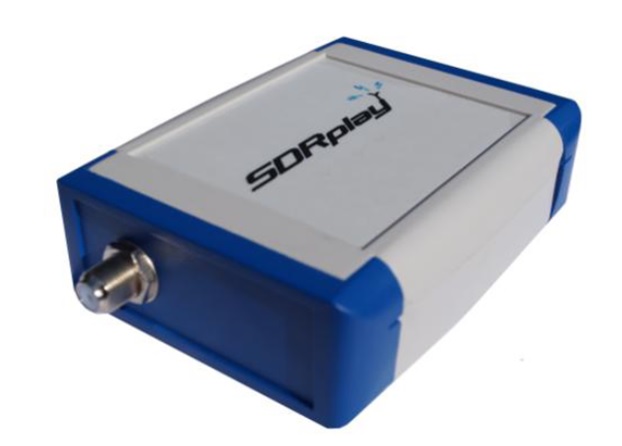
The Radio Spectrum Processor (RSP) by SDRPlay is a receive only software defined radio with a 100 kHz to 2 GHz range (with a small gap at 380 MHz to 430 MHz), a 12-bit analogue to digital converter (ADC) (~10.4 ENOB), 8 MHz bandwidth and a bank of several switched front end filters.

Previously the SDRPlay RSP was priced at $299 USD, however they have just halved this price down to $149 USD plus tax and shipping. At this price point we think the SDRPlay is a very good competitor to the Airspy SDR which seems to be the more popular option priced at $199 USD, especially if you are interested in listening to the HF bands without the need for an upconverter.

Recently we posted about some SDRPlay reviews which are all favourable.

The Radio Spectrum Processor (RSP) by SDRplay.

Highlighting some SDRPlay Reviews

Update: Note that we also now have our own comprehensive review available here which compares the Airspy, SDRplay RSP and HackRF.

The Radio Spectrum Processor (RSP) by SDRplay is a receive only software defined radio with a 100 kHz to 2 GHz range (with a small gap at 380 MHz to 430 MHz), a 12-bit analogue to digital converter (ADC) (~10.4 ENOB), 8 MHz bandwidth and a bank of several switched front end filters. It currently costs $299 USD and with these specs and price range we consider the RSP to be a competitor to the Airpsy and Funcube Dongle software defined radio offerings.

Recently several reviews of the SDRplay RSP have been written online and in magazines. The first review comes from the pages of the UK based Radio User magazine (pdf warning) which goes through the specs, design, install and operation of the device. A more recent review shows an unboxing and there’s also this review submitted to the SDRplay team which demonstrates some FM dxing results. There are also several more reviews collected by the SDRplay team linked on the SDRplay website at http://www.sdrplay.com/reviews.htm.

We also note that we recently posted about some in depth measurements that Leif (programmer of Linrad) recently made to multiple SDR’s, including the SDRplay.

The Radio Spectrum Processor (RSP) by SDRplay.

Comparison of several SDRs on degradation from nearby strong signals at broadcast FM frequencies

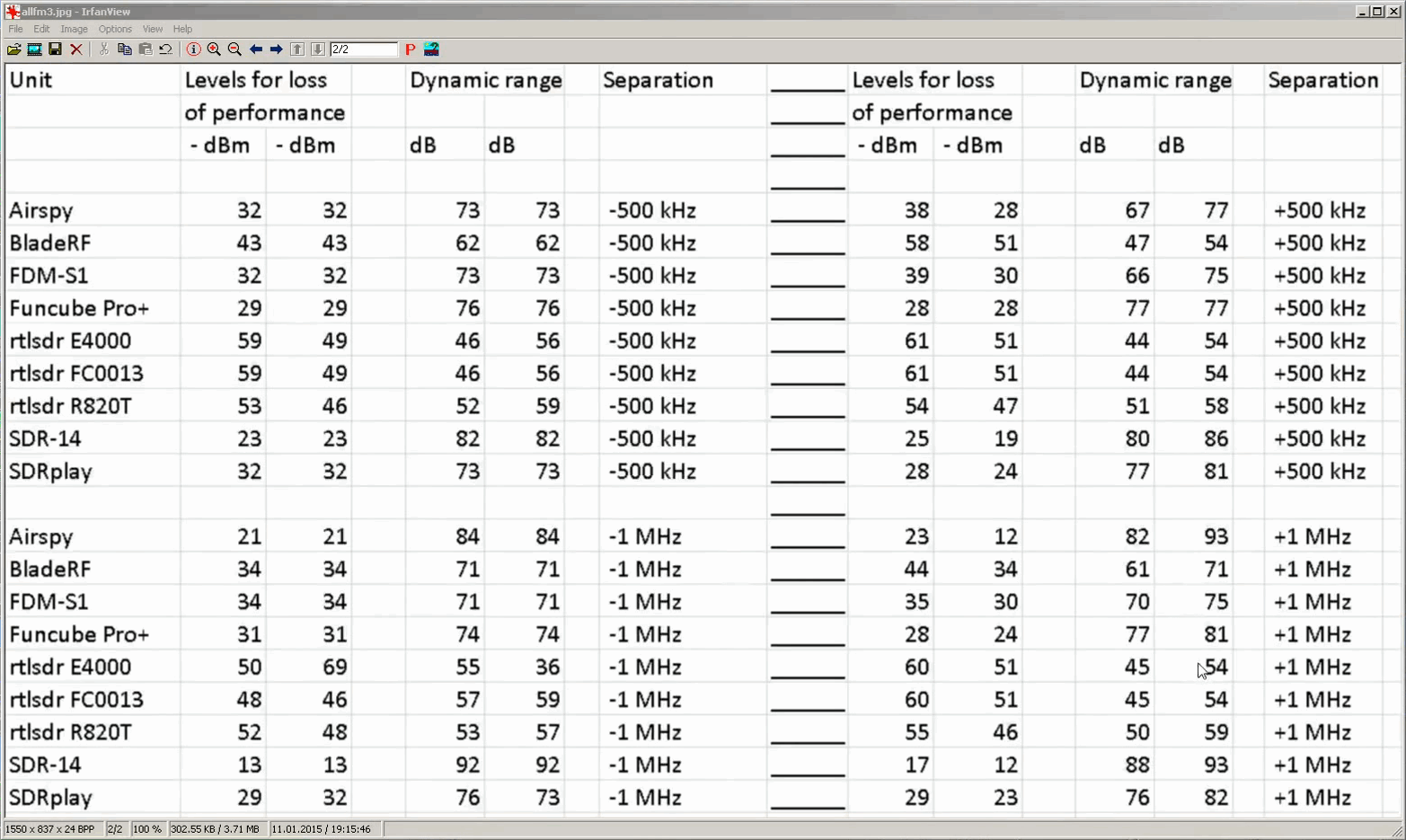
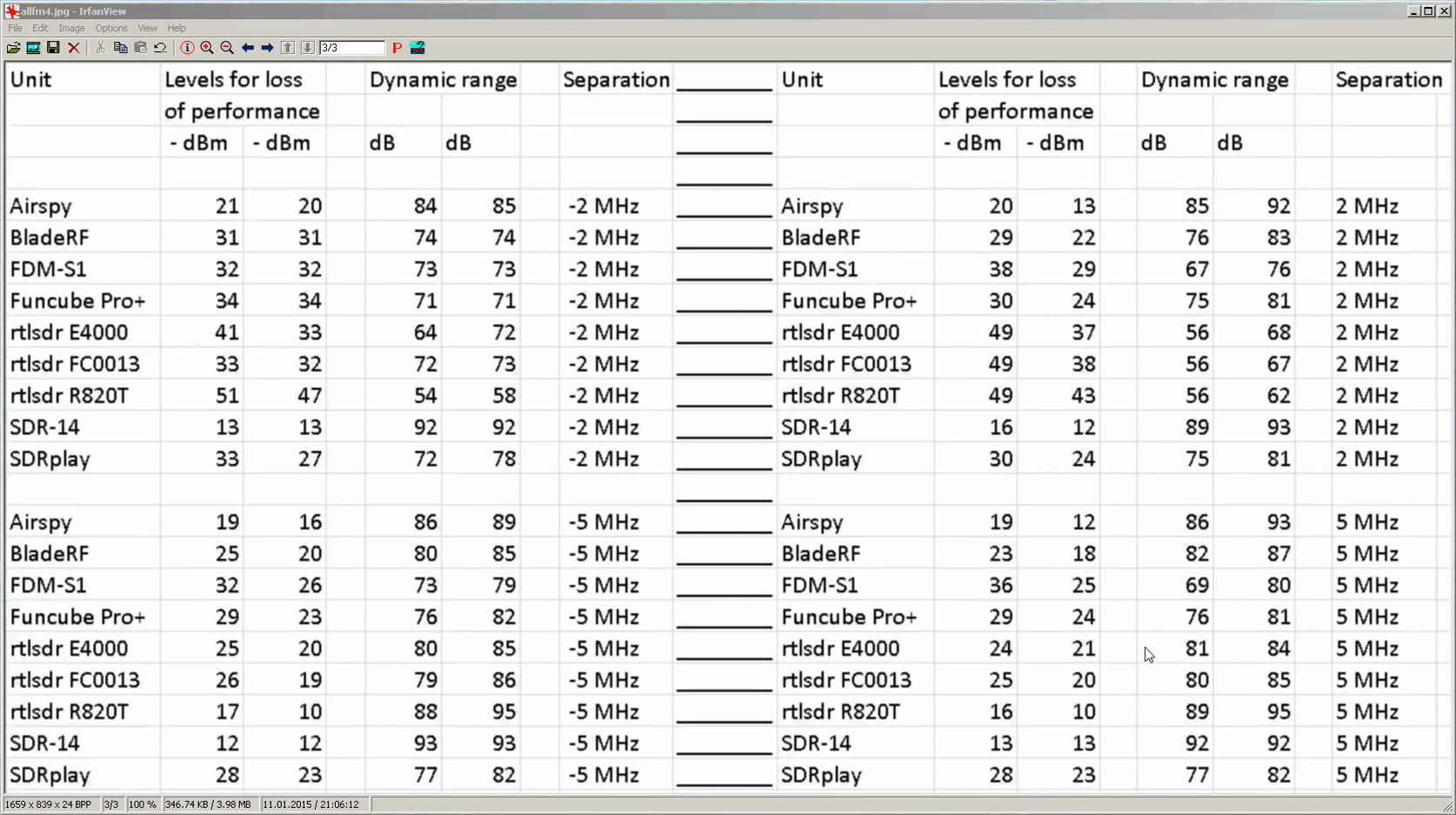
The programmer of Linrad (aka Leif sm5bsz) has uploaded a video to YouTube that compares several software defined radios on dynamic range and compression performance in the presence of strong nearby signals. In the video Leif tests the Airspy, BladeRF with B200, FDM-S1, Funcube Pro+, rtlsdr/E4000, rtlsdr/FC0013, rtlsdr/R820T, SDR-14 and SDRplay.

The main test works by tuning to a broadcast band FM frequency and then injecting a strong carrier signal at distances of 500 kHz, 1 MHz, 2 MHz and 5 MHz from the center frequency. The carrier signal strength is slowly increased until the SDR shows signs of complete degradation of reception of the FM signal. Better SDRs will tolerate stronger nearby signals without degradation.

The results are summarized at 34:20, 1:21:38 and 1:48:30. We have also taken screencaps of the results at 1:21:38 and 1:48:30 and they are shown below. The first column is when a higher gain is used, and the second column is when a lower but still barely copyable gain level is used. In the Levels for loss of performance columns smaller numbers are better and in the Dynamic range columns larger numbers are better. Finally, at the end of the video starting at 1:45:55 Leif also tests the spur performance of the SDRs.

Results at 500 kHz and 1 MHz Seperation
results_3
Results at 2 MHz and 5 MHz Seperation
SDR on 88-108 FM part1