Category: Airband

Characterizing Yagi Antenna Directionality via ADS-B Reception

Over on his blog Alex Krotz has been investigating whether adding more passive director elements actually affects the directionality of his home made Yagi-Uda antenna. Instead of using modelling software, Alex wanted a more accurate result that took into account all the imperfections of his antenna.

His idea was to receive ADS-B signals with his Yagi and a dipole antenna, then compare the data received in order to determine in which directions the Yagi receives better than the dipole. To do this he first creates a standard 2D map of plane tracks collected over a 24hr period for both the dipole and Yagi. A gaussian blur is applied to the two maps in order to fill in blank space and the data is normalized. Then he simply subtracts the dipole plot from the Yagi-Uda plot. The resulting difference plot reveals a mapping of where the Yagi receives better or worse compared to the dipole in a 2D plane.
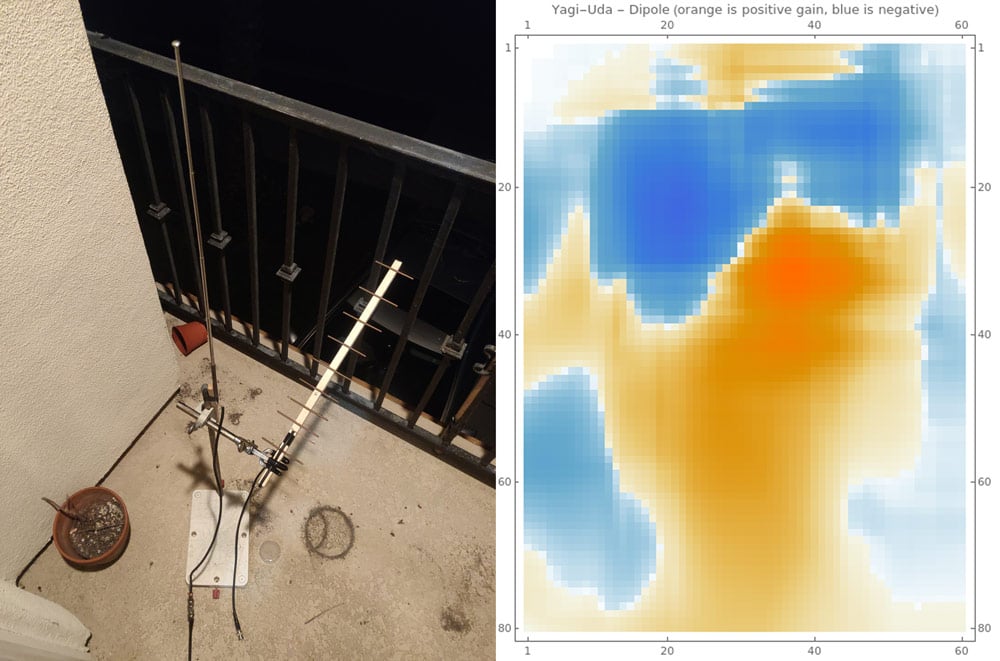
Directivity of the Yagi revealed by comparing against a dipole

Tech Minds: Testing the OpenEar DMR TETRA ADSB POCSAG Decoder for RTL-SDR

Back in March we posted about the release of OpenEar, a standalone TETRA decoder for the RTL-SDR. Since then OpenEar has undergone massive developments, not only improving upon the TETRA decoder, but adding DMR, ADS-B and POCSAG decoders as well as a waterfall display.

Recently Tech Minds reviewed this software on his YouTube channel. In the video he shows how to download the software, install the rtlsdr.dll file, and run and use the software. He then demonstrates reception of an amateur radio DMR repeater, reception of POCSAG pager messages and finally reception of ADS-B aircraft messages.

OpenEar Digital Decoder - DMR TETRA P25 ADSB POCSAG RTL-SDR

Virtual Plane Spotting Livestream by Piping ADS-B Data into Flight Simulator

Over on YouTube we've recently discovered a live stream by channel Information Zulu that has created a virtual live 24hr view of LAX airport air traffic by piping ADS-B data into a flight simulator game. The stream also combines this with live air traffic audio and arrivals and departures information. Other videos on his channel show highlights like go arounds.

We're not sure what he's using to pipe ADS-B data into the simulator or exactly what simulator this is, but in the video description he notes that he uses a Pi 4, RTL-SDR blog V3 with ADS-B LNA, and an AirNav antenna to receive the ADS-B data. 

This reminds us of the Android ADSB Flight Tracker app which also has a 3D view, and the post about using ADS-B data to simulate what aircraft instruments would show on the real aircraft.

Using ADS-B Exchange to Track Police and Military Aircraft Monitoring the George Floyd Protests

During the recent George Floyd BLM protests police and military aircraft have been playing a large part in the surveillance of protestors. All these aircraft are required to transmit ADS-B which of course can be monitored with an RTL-SDR or other SDR. Many volunteers around the world use RTL-SDRs to upload ADS-B data to an online aggregation service, so flight data from all over the world can be accessed in one place. However, most ADS-B aggregation services like FlightAware and FlightRadar24 censor police and military aircraft from the raw ADS-B data received from the RTL-SDRs. ADS-B Exchange is the only service that has a policy to not censor any aircraft.

Buzzfeed recently ran an interesting article that used ADS-B Exchange to highlight the flight paths of various surveillance aircraft used during the protests, as well as the aircraft types used and who they are registered to. Most interestingly they saw that two military Black Hawk helicopters and a CBP Predator drone was used in Minnesota, and two military Lakota helicopters were using in Washington, DC.

As mentioned in a previous post, ADS-B Exchange recently updated their interface and backend, and they now run tar1090, which is a fully featured ADS-B mapping platform that can display the historical tracks of any tracked aircraft.

We also note that on Twitter John Wiseman @lemonodor also runs several "advisory circular bots" that make use of ADS-B Exchange data to automatically tweet a notification when aircraft are detected as having a circular flight path.

Police helicopter historical tracks over Minneapolis via adsb-exchange.com
Police helicopter historical tracks over Minneapolis via adsbexchange.com

UFO Tracking Network using RTL-SDRs to Rule out False Positives from Commercial Aircraft

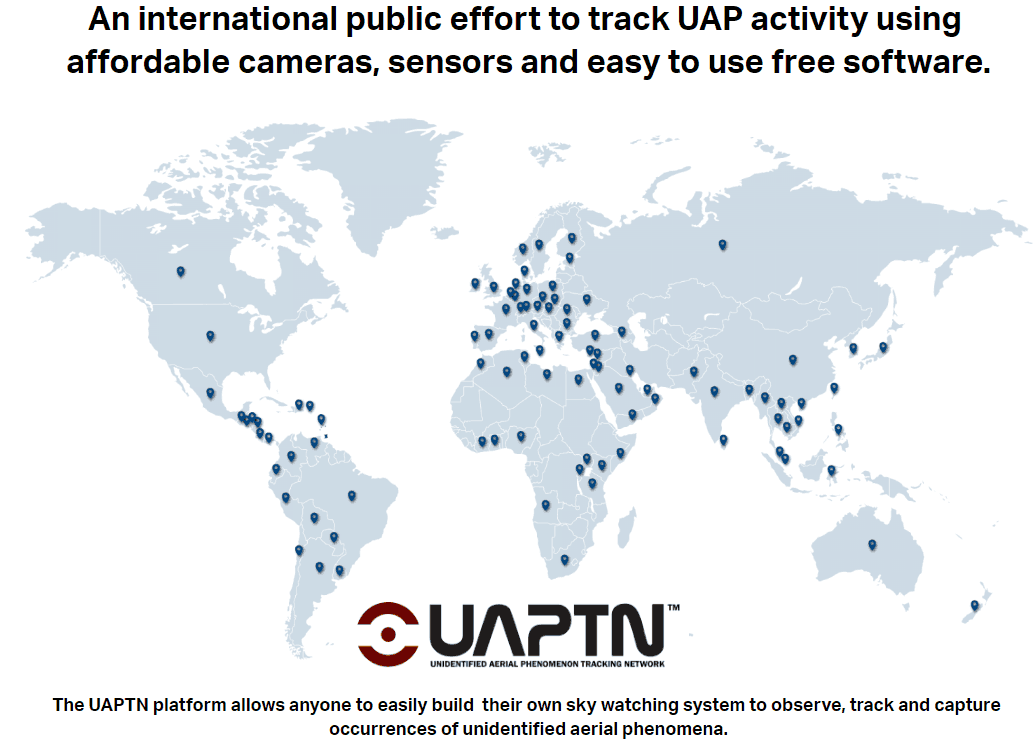
The Unidentified Aerial Phenomenon Tracking Network (UAPTN) is an effort to set up crowd sourced Raspberry Pi powered cameras all over the world in order to record videos of "unidentified aerial phenomena" AKA UFOs. In order to rule out false positives from known aircraft, they are recommending that contributors install a FlightAware RTL-SDR in their system for aircraft tracking. 

For this purpose doing your own ADS-B flight tracking would be required as most commercial flight tracking sites censor military and private jets. The only site that does not censor data is ADS-B Exchange. However, of course military aircraft conducting operations are always able to turn ADS-B off if required for the mission which is what the UAP network will probably detect the most. 

If UFO tracking does not interest you, then you might instead be interested in creating a RTL-SDR based GhostBox to talk to spirits!

The Spectrum Monitor: The ABCs of ADS-B and Airband Reception using Software Defined Radio

Thank you to Mario Filippi (N2HUN, WQWL238) for submitting news about his latest article that has been published in the March 2020 edition of The Spectrum Monitor magazine. The article is titled "The ABCs of ADS-B and Airband Reception using Software Defined Radio", with the description reading:

Ever wonder about all the planes you see in the sky overhead where you live? What flight is that; where is it going; how high and how fast is it? All of these planes transmit on one frequency: 1090 MHz and you can monitor them all as Mario shows us. He tells us what receiver to use, which antenna (hint: you can build a better ADS-B antenna than you can buy), which software to use and how to assemble your own desktop virtual radar screen.

The article isn't free to access as it's published in the Spectrum Monitor magazine, however the magazine only costs $3 and contains a number of other airband related articles too.

The Spectrum Monitor: 2020 Aviation Edition

ADSBExchange now using tar1090: Historical Flight Tracks, Military Aircraft Filters and more

ADSBExchange is an aircraft tracking website service which aggregates ADS-B data from contributors running RTL-SDR's or similar receivers worldwide.

However, unlike other flight tracking sites such as flightaware and flightradar24, ADSBExchange sets themselves apart by proudly refusing to censor the tracking of military and private jets that have requested privacy. One area where this refusal to self-censor helps is with the "Dictator Alert" service. This is a service that automatically tracks the movements of private aircraft owned by authoritarian regimes via the ADS-B data collected and shared by ADSBExchange. 

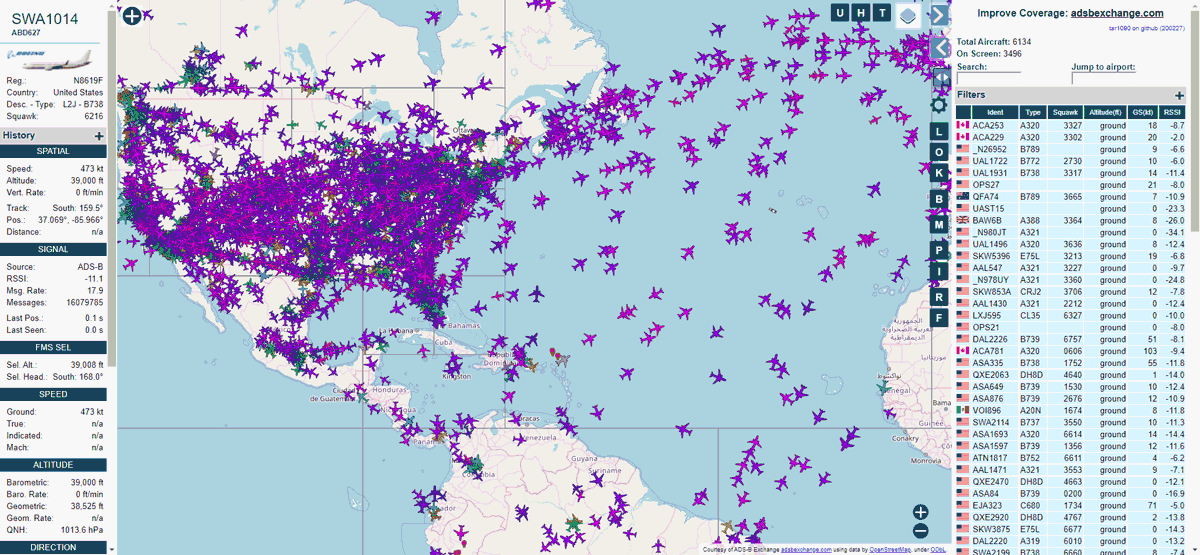
Recently ADSBExchange upgraded their web interface moving from the old Virtual Radar Server system to tar1090 which is a more fully featured open source display for dump1090. This new interface has some great features, like the ability to view the complete flight track history of any aircraft on a particular day, the ability to display only military aircraft and the ability to filter by altitude and aircraft type. 

ADSBExchange.com new tar1090 interface
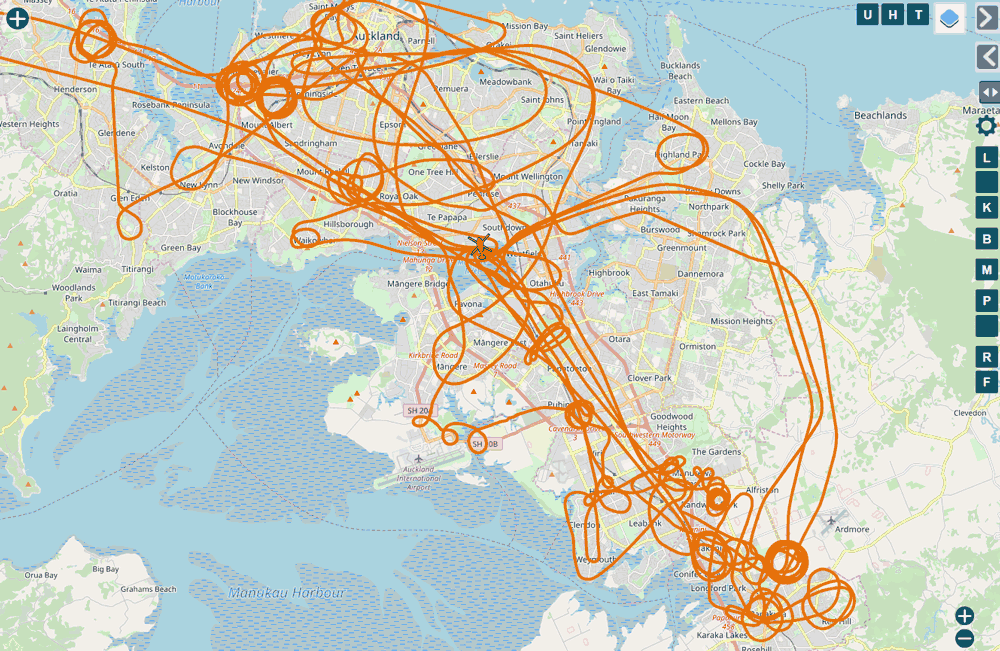
Viewing the tracks of 1-day of police helicopter activity in the new ADSBExchange tar1090 interface.
Viewing the historic tracks of 1-day of police helicopter activity in the new ADSBExchange tar1090 interface.

New 978 MHz UAT Specialty RTL-SDR and Antenna and Dual 1090 & VHF Antenna from RadarBox

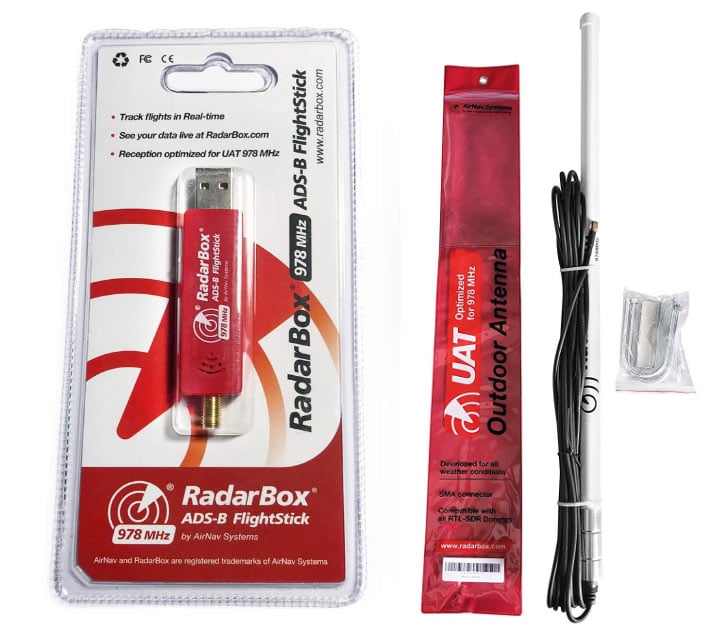
Over on Amazon we've recently seen the release of a 978 MHz UAT specialty RTL-SDR and 978 MHz tuned antenna by the flight tracking service known as AirNav RadarBox. The RTL-SDR appears to be similar to their 1090 MHz RTL-SDR version, which contains a SAW filter and LNA onboard the RTL-SDR. Due to the built in filter, this dongle will only work at the 978 MHz frequency. Like the 1090 MHz version, the dongle itself is priced at only US$14.95, and the antenna at US$49.95.

Universal Access Transceiver (UAT) is an alternative to ADS-B that is available only in the USA. It is typically used by smaller aircraft, transmits at 978 MHz, and apart from it's tracking system it has some additional advantages for pilots over 1090 MHz ADS-B, like the ability to receive alerts, weather data and radar plots. With an RTL-SDR and appropriate software these data services can also be received.

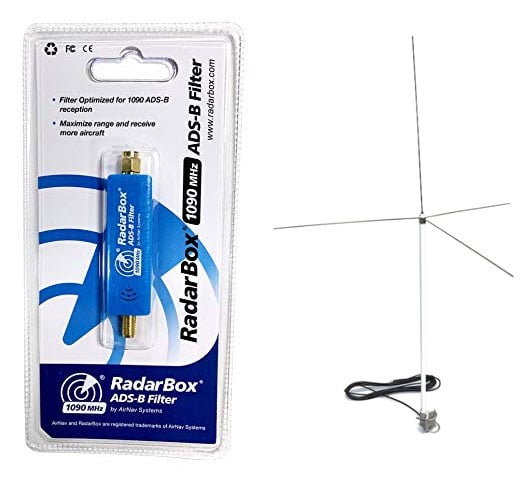
In addition they have also released some other interesting products including a 1090 MHz ADS-B with 118-136 MHz VHF airband antenna stacked on top of the ADS-B element for US$49.95, and an external ADS-B 1090 MHz filter for only US$14.95.

As an alternative to an RTL-SDR UAT receiver, we note that the Stratux has a hardware radio based UAT receiver available which has significantly lower power consumption. Although the receiver itself appears to be currently out of stock.

We note that we also currently have our 1090 MHz AirNav Radarbox Antenna + ADS-B optimized RTL-SDR set on sale for only US$39.95 + shipping, which is cheaper than you can find it elsewhere. Visit our store for ordering information.

The AirNav RadarBox 978 MHz UAT Optimized RTL-SDR and Antenna.
New RadarBox 1090 MHz Filter and 1090 MHz & VHF Antenna single antenna.