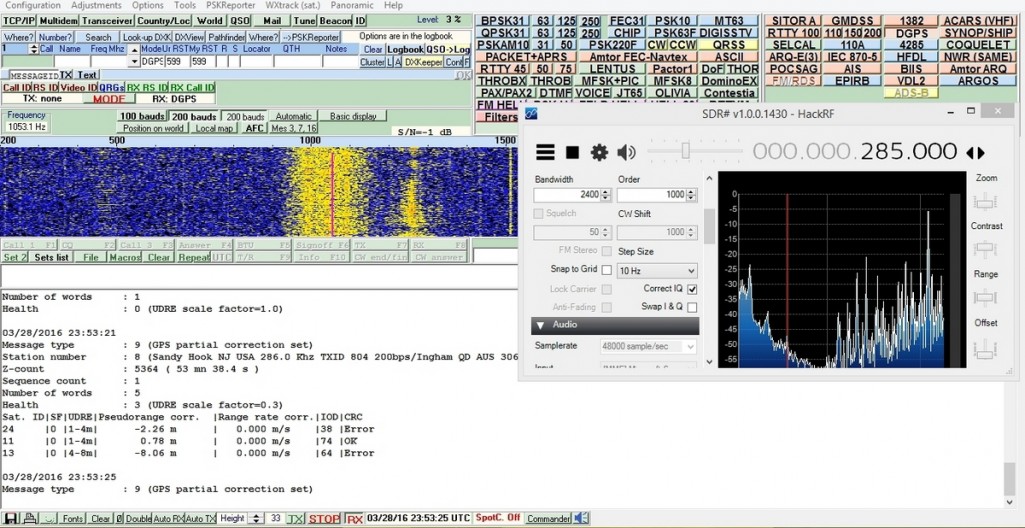
Differential GPS (DGPS) are signals that exist between 285 – 325 kHz and are used to enhance the accuracy of GPS receivers. The system can improve GPS accuracy from 15m down to 10cm in some cases. It works using a network of ground stations at a very accurate known location that continuously measure the GPS error they receive. They then broadcast this error to DGPS capable receivers. The receiver can then use this error knowledge to correct their own readings.
Over on his blog András Retzler has created a post that discusses his research work on creating a fast networked wideband HF receiver. András is the creator of the web based OpenwebRX software, which allows RTL-SDR and some other SDR’s to efficiently broadcast their SDR data over a network and onto the internet. Some live SDR’s can be found at the OpenWebRX directory at sdr.hu.
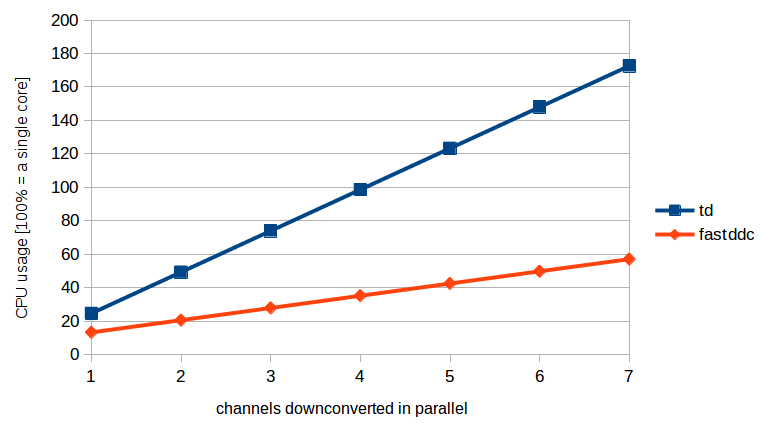
The problem with the current implementation, András writes, is that while OpenWebRX works well with the RTL-SDR’s 2.4 MSPS sampling rate, it can not work so well with very high sampling rates, such as 60MSPS due to excessive computational requirements when several channels need to be monitored. András’ solution is to use his Fast Digital Down Conversion (FastDDC) algorithm which is significantly more CPU efficient. András writes that the FastDDC algorithm improves computation by up to 300% in some cases, can speed up calculations on low powered computers like the Raspberry Pi 2 and can be implemented on a GPGPU for even higher performance. He is still working to implement the algorithm in OpenWebRX.
John Seamons has forked OpenWebRX, and sells his own hardware with it. The web interface is clearly the selling point of the device. After getting a lot of help from me, most of which was inevitable for his success, now John and ValentF(x) are leaving me with nothing, except a ‘Thank you!’. John has told me that OpenWebRX is a large part of his project, and he also claimed that my work has reduced the time-to-market of his product by maybe a year or so.
Why I’m standing up here is that forking open source software (which means changing the code in a way that is incompatible with the original version, and taking development in another direction), and funding it through Kickstarter is a very unusual way of getting things done. I acknowledge that John has very much work in his board and the accompanying software, however, he treated me and my project in an unethical manner.
In the Kickstarter comments section, the KiwiSDR creators reply back with their side. It is hard to say who is in the right in a situation like this. While what KiwiSDR have done is legal according to the licence, the ethics of doing so are questionable. We hope that both parties can successfully come to an agreement in the end.
If you want to directly support András and his work on OpenWebRX and other projects like FastDDC, then please consider donating to him at http://blog.sdr.hu/support. If you are a KiwiSDR backer, donating to Andras may be one way to right the situation if a deal cannot be reached.
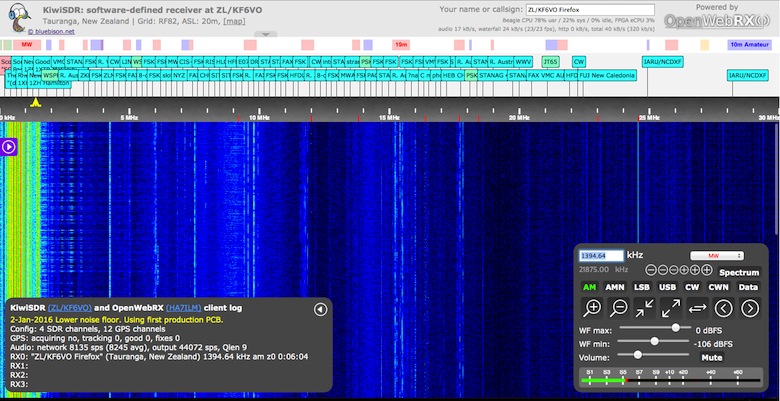
Back on February 8 we posted about the up and coming KiwiSDR, a software defined radio with 30 MHz of bandwidth and a tuning range that covers 0 – 30 MHz (VLF to HF). It is intended to be a low cost web based SDR that can be accessed from all over the world via a browser interface.
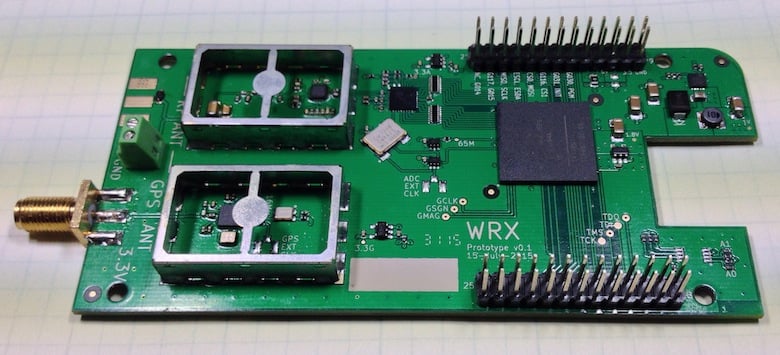
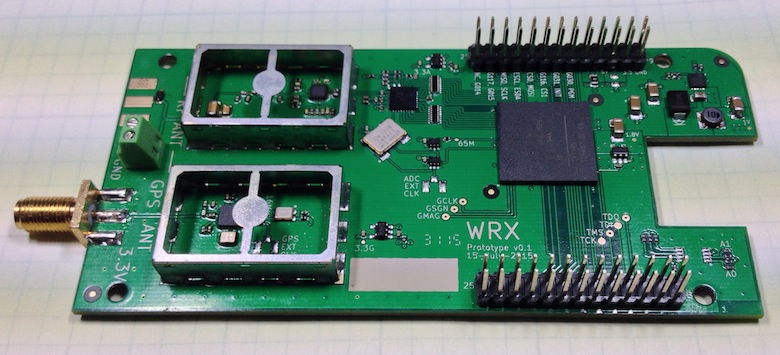
The KiwiSDR is designed as a cape for the BeagleBone Black mini embedded computer, and uses a LTC 14-bit 65 MHz ADC and Xilinx Artix-7 A35 FPGA. It also has an integrated SDR based GPS receiver which is used to automatically compensate for any frequency drift from the main 66.6 MHz oscillator. It runs on the OpenwebRX web based software, which many RTL-SDR users have already been using to stream live radio to the web.
Today the KiwiSDR started its crowd funding campaign on Kickstarter. A full KiwiSDR can be purchased for $199 USD, or for $299 including an enclosure, BeagleBone computer and GPS antenna. The fundraising goal is for $50,000 USD and if successful they estimate delivery in October 2016. The creators of the KiwiSDR write:
Sure, the world doesn’t really need another SDR. But we haven’t found one with this set of features. In cost and performance, KiwiSDR fits between RTL-SDR USB dongle-style, or fixed DDC chip devices ($20 – $400, 8-12 bit ADC, limited bandwidth), and full 16-bit SDRs ($700 – $3500) while offering better wide-band, web-enabled capabilities than the more expensive SDRs.
Our main motivation is to enable new applications which utilize a significant number of programmable, web-accessible SDRs world-wide. Direction finding remains one of the great under-solved problems of shortwave listening, particularly for utility stations. Given the GPS timing available on the KiwiSDR, could time-of-arrival techniques between cooperating SDRs be used? We’d sure like to find out.
Also, we’d like to see data decoders built directly into the web interface of KiwiSDR. There are many standalone programs that demodulate and decode data signals from SDRs. But these are computer- and OS-specific and often require a complicated interface to the data stream from the SDR. For example, we have a prototype of a WSPR decoder that is integrated into the KiwiSDR interface.
There are currently three KiwiSDR servers running publicly at the moment, and they can be accessed at:
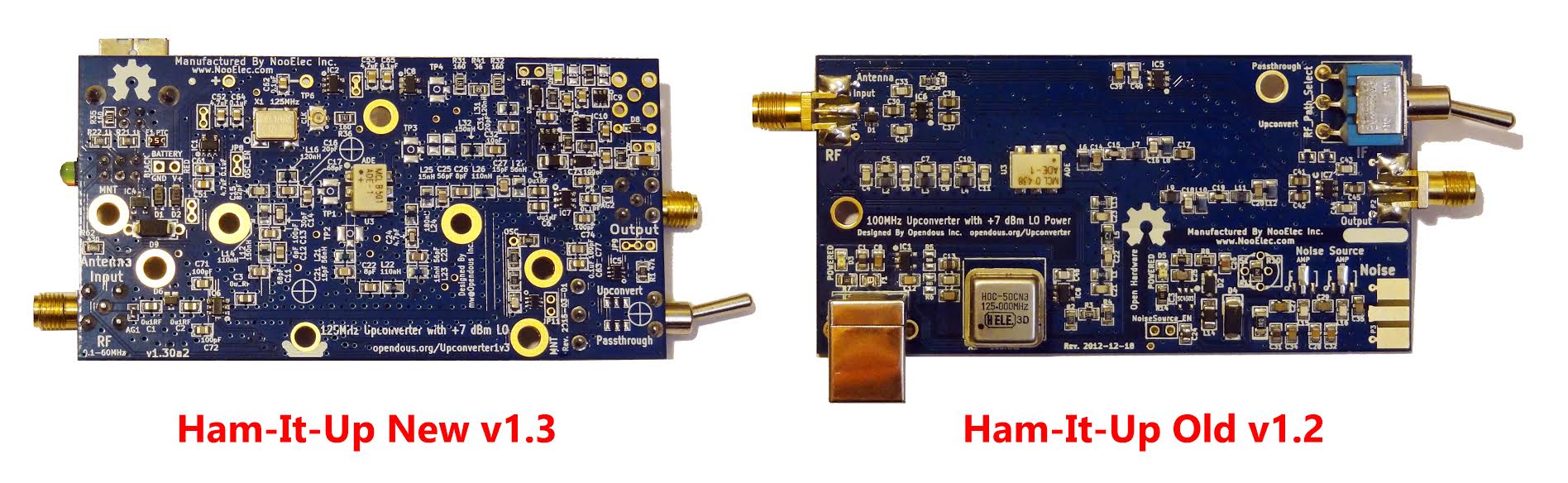
An upconverter allows you to receive HF frequencies (0-30 MHz) with an RTL-SDR which has a lower frequency limit of 24 MHz. The ham-it-up upconverter was one of the first upconverters to go on the market that targeted users of the popular RTL-SDR dongle. Over the years the ham-it-up has slowly been revised and now it is up at version 1.3. The biggest changes in the latest version are a revised design that uses the ADE-1 in reverse (better VLF operation), a presoldered oscillator and it also now includes the previously optional noise source by default.
In his review Akos compares the ham-it-up v1.3 to the older v1.2 model. His results show that the revised design seems to have better immunity to noise and better FM broadcast filtering. He also tests out the new battery power via connection and shows that using battery power is less noisy.
Previously we posted a review comparing the ham-it-up v1.0, SpyVerter and Nobu’s Japanese upconverter. Although the ham-it-up v1.3 is much improved and we have not tested it, we still believe the SpyVerter is the better upconverter choice at the moment due to its better architectural design and included metal case, though Akos does point out that the ham-it-up is currently about $15 USD cheaper and has a passthrough switch.
Ham-it-up v1.3 vs ham-it-up v1.2
In his second post Akos reviews the Balun 1:9 which is a $10 balun that is designed for attaching a long wire antenna to the ham-it-up. The goal of the balun 1:9 is to transform the high impedance long wire antenna down to around 50/75 Ohms for the receiver. In Akos’ results he writes that he mostly see’s identical or better performance with the balun connected.
The Nooelec balun 1:9
To add to Akos’ review, we want to note that we think that there might be some confusion over baluns and ununs. We wonder if a 9:1 unun (instead of a balun) should be used for a long wire antenna, since a long wire is an unbalanced antenna. We think a balun should be used for a balanced antenna such as a dipole. In his review Akos also found that connecting two longwire antennas to the spring terminals improved reception. This may have possibly been because adding two longwires essentially created a balanced dipole antenna. To implement a longwire antenna unun with a balun, we think that the second terminal and coax shield should be connected to a good ground source like a cold water pipe. If you have knowledge on this topic please comment to confirm or expand on our theory.
The KiwiSDR is an up and coming VLF/LF/MF/HF capable SDR that has a large 30 MHz of instantaneous bandwidth and coverage from 10 kHz to 30 MHz. It is designed to be low cost and used as an online internet based SDR in a similar way to how WebSDR is used, however KiwiSDR is designed to be used with the OpenWebRX software from András Retzler, HA7ILM. It uses a LTC 14-bit 65 MHz ADC and Xilinx Artix-7 A35 FPGA, and also has an integrated SDR based GPS receiver which is used to automatically compensate for any frequency drift from the main 66.6 MHz oscillator. The features of the KiwiSDR include:
100% Open Source / Open Hardware.
Includes VLF-HF active antenna and associated power injector PCBs.
Browser-based interface allowing multiple simultaneous user web connections (currently 4).
Each connection tunes an independent receiver channel over the entire spectrum.
Waterfall tunes independently of audio and includes zooming and panning.
Multi-channel, parallel DDC design using bit-width optimized CIC filters.
Good performance at VLF/LF since I personally spend time monitoring those frequencies.
Automatic frequency calibration via received GPS timing.
Easy hardware and software setup. Browser-based configuration interface.
The KiwiSDR is currently in beta testing and has released two OpenWebRX beta test sites which can be used at:
Recently Tim Havens (NW0W) wrote in to use to let us know about his work in connecting the Airspy and Spyverter to a very accurate GPS disciplined oscillator (GPSDO). Usually the drift on the Airspy and Spyverter is completely negligible, however Tim uses them together with his Yaesu FTDX-5000 for monitoring CW signals. He wanted to be able to click on a CW signal and have his FTDX-5000 tune to the signal perfectly every time, so even very small oscillator drift offsets could affect his tuning.
To get a high accuracy clock signal from a device such as a GPSDO can be used for both the Airspy and Spyverter. Tim was able to find a very nice GPSDO from Leo Bodnar that comes with two clock separate outputs that can be configured to output any frequency between 450 Hz and 800 MHz.
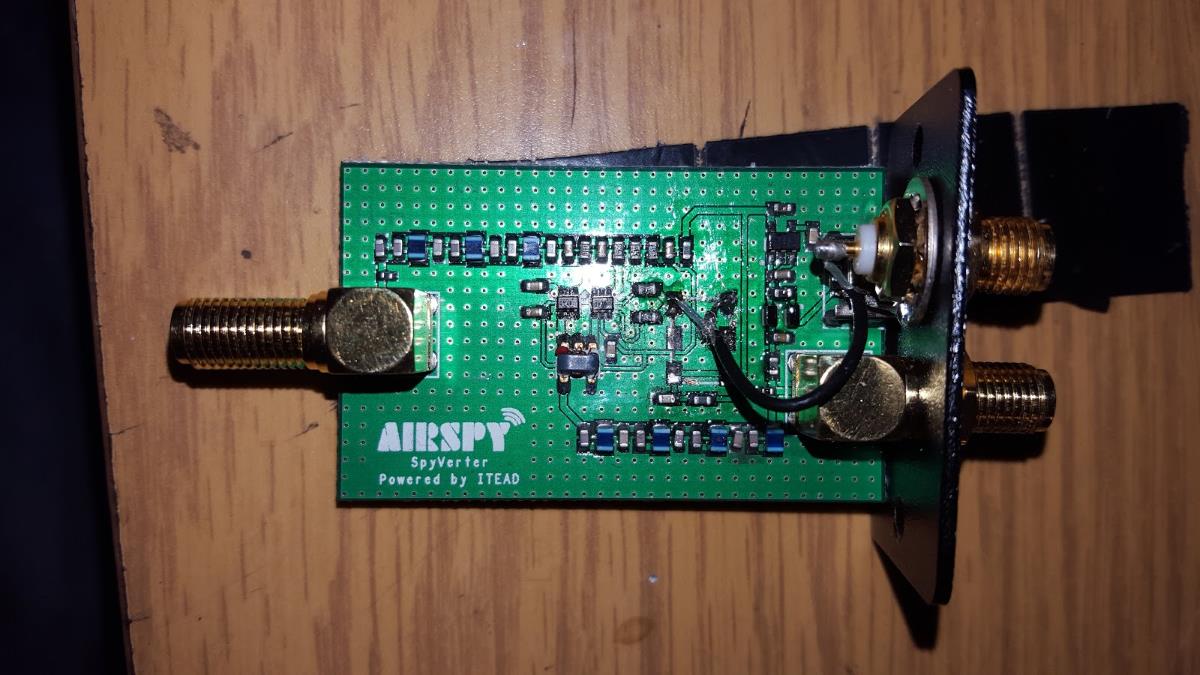
The Airspy already contains an external clock input for 10 MHz, however the present version of the Spyverter contains no such external input. To get around this Tim carefully removed the oscillator on the Spyverter and then added a second SMA connector to connect to the GPSDO.
His final setup consists of the Leo Bodnar GPSDO outputting a 10 MHz and 120 MHz GPS disciplined clock signal that feeds the Airspy and Spyverter respectively. With this Tim found that he needed no initial offset and zero drift was noticed over two days of testing.
Finally Tim also writes that this Leo Bodnar GPSDO could just as easily be used to create a 28.8 MHz clock signal for an RTL-SDR, or any other SDR or upconverter that needs it.
Over on his blog Andrew has posted a good writeup where he determines the QRM (interference) effects of a PLT (power line transmission) device. PLTs are also known as ethernet/internet over powerline devices and they are devices that plug into an electricity socket and use household electricity wires to create a computer network, thus eliminating the need for ethernet cables or WiFi. However, many hams and radio hobbyists hate these devices because they believe that they can cause significant amount of radio interference, especially on HF.
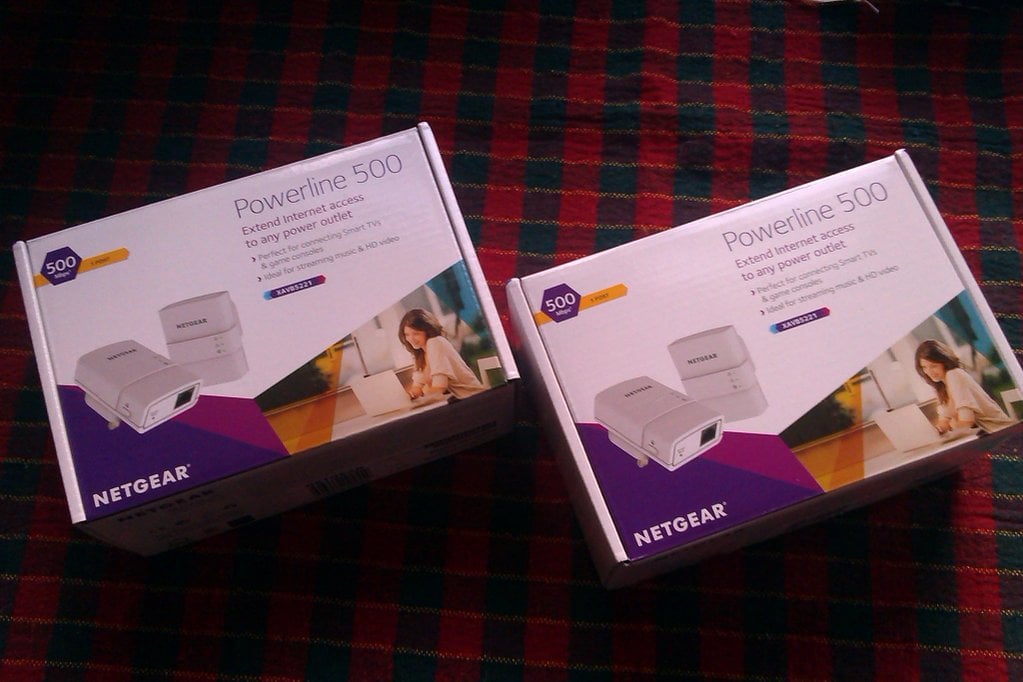
In his investigation Andrew bought a pair of Netgear Powerline 500 PLTs. He then plugged the PLTs in and started streaming a movie over the powerline network connection to cause maximum radiation. Then using his Funcube dongle and SDR# he investigated ham bands to see if these devices brought any noise.
In his results Andrew writes that he barely saw any interference caused by these devices. Some interference was noticed at 17 meters and 12 meters, but he notes that the amateur portion was left relatively unaffected. Many hams believe these devices can completely wipe out HF, but it seems that this is untrue, at least for this particular PLT model.
Radio transmissions between 0 - 30 MHz can travel all the way around the world. At these frequencies many interesting signals such as international shortwave radio, ham radio communications and several military transmissions exist.
The RTL-SDR's lowest tunable frequency is 24 MHz, and so it can only receive a small portion of the interesting transmissions that occur between 0 - 30 MHz. In order to listen to frequencies below 24 MHz an upconverter is required (either that or perform the direct sampling mod). An upconverter works simply by shifting these lower frequencies up to a higher frequency that the RTL-SDR can receive. For example, a 5 MHz signal might be upconverted to 105 MHz.
To date, most decent upconverters (such as the popular ham-it-up upconverter) have been based on the double balanced mixer architecture implemented by the ADE-1 mixer chip from Minicircuits. The SpyVerter on the other hand is based on a different type of architecture which is inspired by the H-mode mixer design that was used in the unreleased HF7070 communications receiver. The expected major advantage that this design has over a ADE-1 based design is better IIP3 performance. This essentially means that strong signals will not cause overloading issues in the SpyVerter, meaning less noise and spurious images.
Another advantage of the SpyVerter is its use of a 120 MHz low phase noise/low jitter clock, meaning less reciprocal mixing and thus greater SNR and a lower noise floor. A low phase noise clock is essential for getting good performance when receiving the very narrowband signals that are typically found between 0 - 30 MHz. The other upconverters do not specify their phase noise performance as far as we can tell.
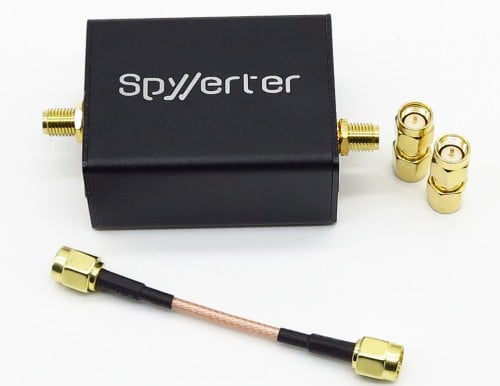
The SpyVerter comes in a metal box, with three SMA adapters. A metal box is great because it helps keep strong interfering signals from entering the signal path, as well as stabilizing the internal temperature, keeping frequency drift to a minimum. Most upconverters only come with a metal box as a paid add on, but the SpyVerter comes in one by default.
Although the SpyVerter is designed to be used with the Airspy, it is fully compatible with the RTL-SDR as well. The SpyVerter can be powered via a USB cable, or via 5V bias tee (and this is compatible with the bias tee used on the RTL-SDR Blog units sold by us).