Category: HF

Using a direct sampling enabled Airspy as a Panadapter for a Yaesu FTDX-5000

Tim Havens is an avid CW operator on the ham bands and primarily uses his Yaesu FTDX-5000 transceiver for this purpose. At the same time he also uses a software defined radio coupled with an upconverter as a panadapter by connecting the SDR to the 9 MHz IF output of the Yaesu.

However a problem Tim encountered was that the frequency drift of any SDR he tried was too large, even with a TCXO based software defined radio (like a modded RTL-SDR or the Airspy), and that it was a constant hassle to recalibrate. Furthermore, he noticed that the upconverters he used introduced their own drift which just added to the overall frequency drift.

To get around this Tim decided to use the Airspy in a special configuration. First he used the external clock input of the Airspy to connect to his Jackson Labs “Fury” GPSDO. This device uses GPS satellites to generate a very accurate 10 MHz clock, with almost zero drift. Secondly, to get around the need for an upconverter with it’s own frequency drift he used the ADC1 direct sampling input ports on the Airspy to connect to the 9MHz IF output of his FTDX-5000 through an extra band pass filter and LNA.

Tim writes that he will soon update his post with more images and a video.

Airspy with external GPS clock and ADC1 output connected.

Optimizing Reception of VLF frequencies on an RTL-SDR Dongle

Over on his web site, Martin (G8JNJ) has uploaded a new article discussing how to optimize reception of VLF (<10 kHz) signals on a direct sampling modified RTL-SDR. He writes that the main problem with the RTL-SDR receiving VLF frequencies is that there is significant overloading caused by broadcast stations operating on the LF and MF bands.

So in order to optimize VLF reception, Martin built an external frequency equalisation network which has the following components and functions:

  • 2MHz Low pass Filter – to minimise alias signals originating at 30MHz
  • 20dB Variable attenuator – to set the overall signal level fed into the dongle
  • Switched LF roll-off – to optimise the performance at frequencies around 10KHz in the presence of strong lightning surges
  • -10dB notch at 198KHz – to reduce level of BBC R4 broadcast station in the LF band
  • -10dB notch at 800KHz – to reduce level of local broadcast stations in the MF band

His screenshot results show that his filters work well and significantly reduce the effect of lightning pulse noise at 9 kHz. With the filters in place and properly optimized with the attenuator and various switches, he is able to receive Russian Alpha navigation signals at frequencies around 12 and 14 kHz and the 300 to 500 kHz aeronautical and maritime navigation bands.

G8JNJ's LF Band Equalizer Circuit
G8JNJ’s LF Band Equalizer Circuit

Measuring the input impedance of the RTL2832U direct sampling input pins

The direct sampling mod allows you to listen to the HF frequencies between 0 – 14 MHz on an RTL-SDR by simply connecting an antenna directly to the ADC pins on the RTL2832U chip. Until recently the impedance of these pins was unknown, but most people assumed that it was about 300 Ohms.

Now Martin (G8JNJ) has recently updated his webpage with some interesting results that he and another experimenter (Robert Symanek) obtained regarding the input imedpance. Robert found that using a Minicircuits T16-6T-KK81 transformer with 50 Ohms on the primary and 800 Ohms on the secondary gave a 16dB to 19dB higher signal than a simpler 200 Ohm transformer.

This inspired Martin to do a proper measurement of the input impedance. Martin’s measurements found that the differential input impedance of the RTL2832U is approximately 3,330 Ohms when the input is enabled, and this would require a 66:1 transformer. However, Martin writes that a wideband transformer like this probably does not exist, but that the T16-6T-KK81 with terminating resistors added is probably a good choice.

Martin's Direct Sampling + Diplexer Mod
Martin’s Direct Sampling + Diplexer Mod

Several PDF Files Related to RTL-SDR’s and HF/MW Reception

Recently RTL-SDR.com reader Dr. Phil wrote in to let us know about some PDF notes that he has created about the RTL-SDR dongle. There is some good information in his documents and the notes mainly focus on using the RTL-SDR with the direct sampling mod to receive HF.

His other documents also explain concepts such as imaging, interference and gain, how to reduce interference, input impedance of the Q sampling pads, intermediate frequency, and sample rate. In addition he has also uploaded some documents where he has calculated for various AM, FM and SW stations at what frequencies images will show up. His final document also discusses the Mirics SDR chipsets which are used in the SDRPlay.

He writes that any corrections are welcome. Dr. Phil’s main website can be found at http://home.comcast.net/~phils_radio_designs/.

Pocket HF SDR: http://home.comcast.net/%7Ephils_radio_designs/Pocket_SDR.pdf

Pocket HF SDR Cookbook: http://home.comcast.net/%7Ephils_radio_designs/SDR_Cookbook.pdf

RTL2832U: http://home.comcast.net/%7Ephils_radio_designs/RTL2832U.pdf

HF Direct Sampling: http://home.comcast.net/%7Ephils_radio_designs/Direct_Sample.pdf

AM Images: http://home.comcast.net/%7Ephils_radio_designs/AM_Images.pdf

FM Images: http://home.comcast.net/%7Ephils_radio_designs/FM_Images.pdf

SW Images: http://home.comcast.net/%7Ephils_radio_designs/SW_Images.pdf

Generic RTL: http://home.comcast.net/%7Ephils_radio_designs/GenericRTL.pdf

Mirics Chipset: http://home.comcast.net/%7Ephils_radio_designs/Mirics.pdf

A photo of the direct sampling mod with a wire antenna.


Building a 520 kHz High Pass Filter for the RTL-SDR

Over on YouTube user kugellagers has uploaded a video showing how he designs and builds a 520 kHz high pass filter for his RTL-SDR dongle + upconverter. In the video he explains how to design the filter with the free Elsie software which is an electrical filter design and analysis program. He then shows how he builds and selects the filter inductors and capacitors and how he assembles the components on a PCB. Finally he demonstrates how his 520 kHz high pass filter is useful for filtering out atmospheric noise from lightning strikes.

Previously we posted about kugellagers’s other video in which he demonstrates his FM bandstop filter and 1.8 MHz high pass filter.

520 kHz High Pass Filter Construction

A Review of the TitanSDR Pro

Over on the swling.com blog, Thomas has uploaded a review of the TitanSDR Pro that was published in the May 2015 version of The Spectrum Monitor online magazine. Although the TitanSDR pro software defined radio is an expensive (1,380 EUR for the basic / 1,970 EUR for the PRO), it may be of interest to those looking to go further into the short wave listening hobby. The TitanSDR is a high performance 9 kHz to 32 MHz receiver with 16 built in preselectors and a bandwidth up to 2.1875 MHz. It’s main markets appear to be government intelligence and military, but it also finds good use in general short wave listening.

Thomas reviews the TitanSDR positively, liking its easy to use software and its superb sensitivity, but noting that it’s high price may be a bit off putting.

Also, in the current June version of The Spectrum Monitor magazine Thomas also reviews the SDRPlay, a $149 USD HF capable radio, also giving it a favourable review.

The TitanSDR Pro
The TitanSDR Pro

Review of Nobu’s HF Upconverter, Galvanic Isolator and 14 MHz Low Pass Filter

Back in April we posted about some new products made by Japanese RTL-SDR experimenter and product manufacturer Nobu. Nobu’s new products were a 1:1 galvanic isolator and a low pass filter. The galvanic isolator isolates the antenna from the RTL-SDR and PC, significantly reducing noise. The low pass filter is useful when used with direct sampling modified RTL-SDRs to filter out any strong interfering signals that are above 14 MHz.

Recently Nobu sent us at RTL-SDR.com some samples of his products. He sent us one of his HF upconverters, a galvanic isolator and a low pass filter.

NobuProducts
Nobu’s RTL-SDR Products: HF Upconverter, Galvanic Isolator, Low Pass Filter. Placed next to an RTL-SDR for size comparison.

Continue reading

An interesting RTL-SDR direct sampling modification

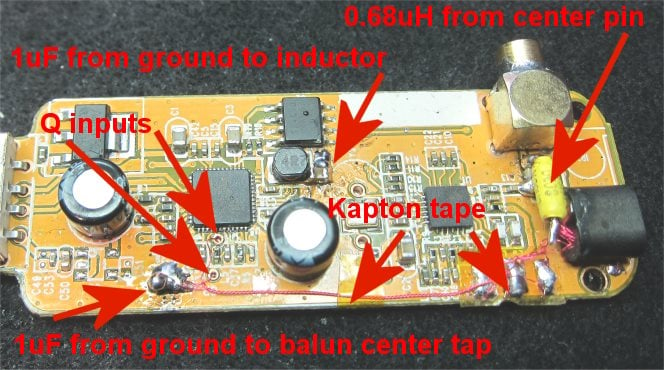
Over on the Reddit RTL-SDR discussion board user pksato has posted an image of his direct sampling modified RTL-SDR dongle. His mod includes a simple common base amplifier with 9dB gain, an impedance transformer with calculated output impedance of 50 Ohms and a 5V power filter.

The direct sampling mod allows you to modify your RTL-SDR to receive HF frequencies, without the need for an upconverter. It requires a hardware mod that can be as simple as soldering a wire to one of the RTL2832U pins, but for improved results you will need filters, impedance transformers and amplifiers. There is more information about direct sampling here.

More information and images about pskato’s mod can be found on the Reddit thread.

We also note that amateur radio hobbyist KN0CK (aka Marty Wittrock) sells direct sampling modified dongles that are modified in a similar way to pskato’s mod (circuit placed on top of the RTL-SDR PCB). His products can be found at http://www.kn0ck.com/HF_SDR/.

Direct Sampling Modified RTL-SDR.
Direct sampling mod with amplifier circuit schematic by pskato.