Over on YouTube user BSoD Badgers has uploaded a video showing his reception of FreeDV digital speech at 14 MHz. He uses SDR# combined with the FreeDV software to decode the signal.
FreeDV is a open source software application that allows digital speech to be sent at HF frequencies in a 1.25 kHz wide signal. The same software can be used on the receiving end to decode the signal into speech.
By using an upconverter, direct sampling mod, or experimental software driver the RTL-SDR can be used for HF reception. However, a problem with HF reception and the RTL2832U chip is that it uses a switching power supply in its design. This switching power supply causes significant amounts of noise spurs to appear in the HF spectrum.
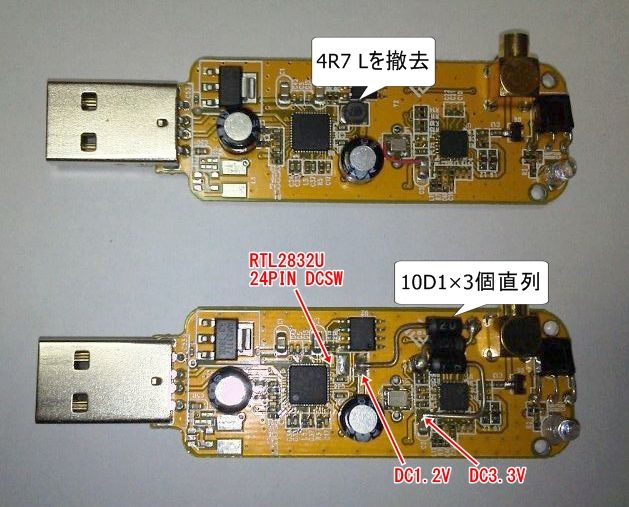
Japanese RTL-SDR experimented ttrftech has recently posted about a modification to the RTL-SDR which he performed (note in Japanese, use Google translate to read). The purpose of the switching power supply in the RTL2832U is to step 3.3v down to 1.2v. In his modification, ttrftech disconnected the switching power supply and instead stepped 3.3v down to 1.2v by using three diodes. This works as each diode has a voltage drop across it of 0.7v.
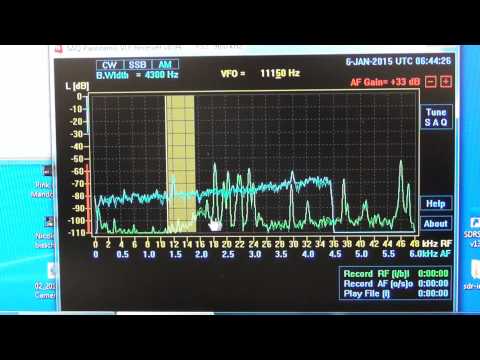
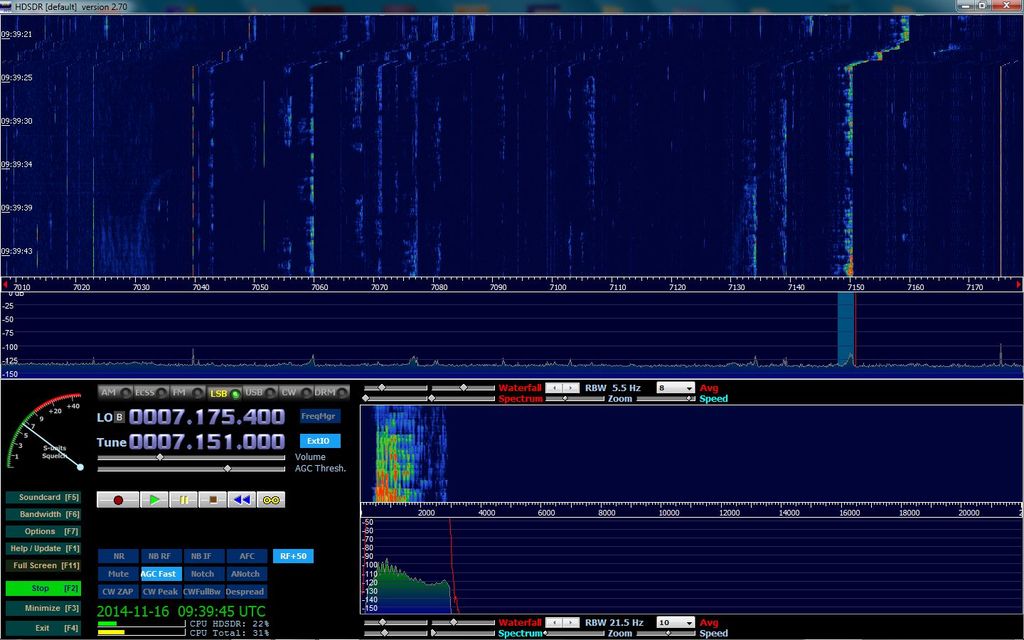
His results show that there is a significant reduction in noise spurs at HF frequencies.
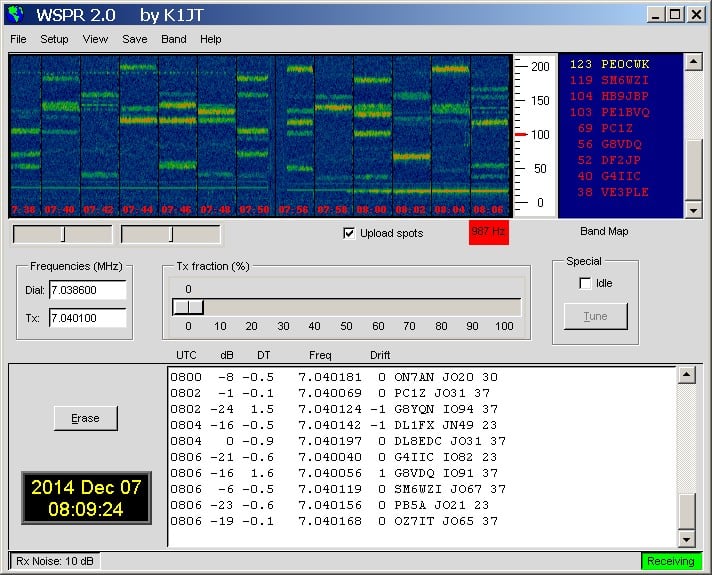
Switching power supply replaced by three diodes.Unmodded reception at 7 MHzModded reception at 7 MHz
Over on YouTube user BSoD Badgers has uploaded a video showing reception of Hellschreiber on HF at 20m. To receive the HF frequencies he used a ham-it-up upconverter. He used SDR# to receive the signal and the Fldigi decoding software to decode the signal.
Hellschreiber is a fax-like communications mode used by amateur radio hobbyists.
Over on YouTube user Java’s Toys has uploaded a video showing a demo of his reception of a BPSK63 signal using his RTL-SDR and the Ham-it-up upconverter. BPSK63 is a text based digital communications mode used by ham radio enthusiasts to make contacts. It is twice as fast compared to the more commonly used BPSK31 mode.
Java’s toys used HDSDR together with Fldigi to receive and decode the signal.
Over on YouTube user w2aew has uploaded a video tutorial explaining how filtering in an upconverter works. In a previous video w2aew explained how a simple upconverter for the RTL-SDR worked and noted that for best performance the upconverter needs three filters, one preselector at the input, one after the local oscillator and one after the mixing stage.
In this video w2aew takes a Nooelec Ham-it-up upconverter which has the three filters mentioned above implemented and scopes the output after each filter to show their effect on an input signal.
#175: Filter functions in an HF Upconverter used with RTL-SDR Dongle Receiver
A new UK designed and manufactured upconverter that goes by the name SDR(X) has recently become available for purchase. This upconverter connects to a RTL-SDR dongle and allows it to receive from 100 kHz up till 1850 MHz. Some of its features include:
Four user selectable HF pre-filters (0-2, 2-6, 6-11 and 11 to 30MHz) or single 0-30MHz pre-filter.
Band pass filter after mixer and band pass filter after Oscillator
User selectable MMIC 18db amplifier external to RTL chip set (lower noise level, than RTL chip and compensates for pre-filters).
User selectable HF and VHF/UHF mode (HF 0-30MHz, VHF/UHF mode 24MHz to 1850MHz).
Microchip PIC controller for above.
Diode protection on RF input.
The board comes as a prebuilt kit which is currently selling for 79.95 GBP which includes an RTL-SDR dongle. The device also comes with complete documentation. The SDR(X) can be purchased from 6v6.co.uk.
Over on YouTube user w2aew has uploaded a tutorial video that clearly explains the theory behind upconverters. Upconverters are commonly used with the RTL-SDR to receive the HF (0 – 30 MHz) bands. In the video he shows how to make a simple homemade double-balanced diode ring mixer for the RTL-SDR and shows its performance in HDSDR.
#174: Using a mixer to listen to HF, shortwave, ham, etc. on RTL-SDR dongle
The second plugin is a Digital Code Squelch (DCS) decoder plugin. The plugin will display the DCS codes that are transmitted with the signal and will display all possible compatible codes. DCS is a squelching system similar to CTCSS which allows for radio user sharing by ensuring that radio users are not bothered by communications not intended for them. The DCS Decoder plugin can be downloaded from http://www.rtl-sdr.ru/page/novyj-plagin-dcs-decoder (note page in Russian).
Digital Code Squelch (DCS) Decoder Plugin for SDR#