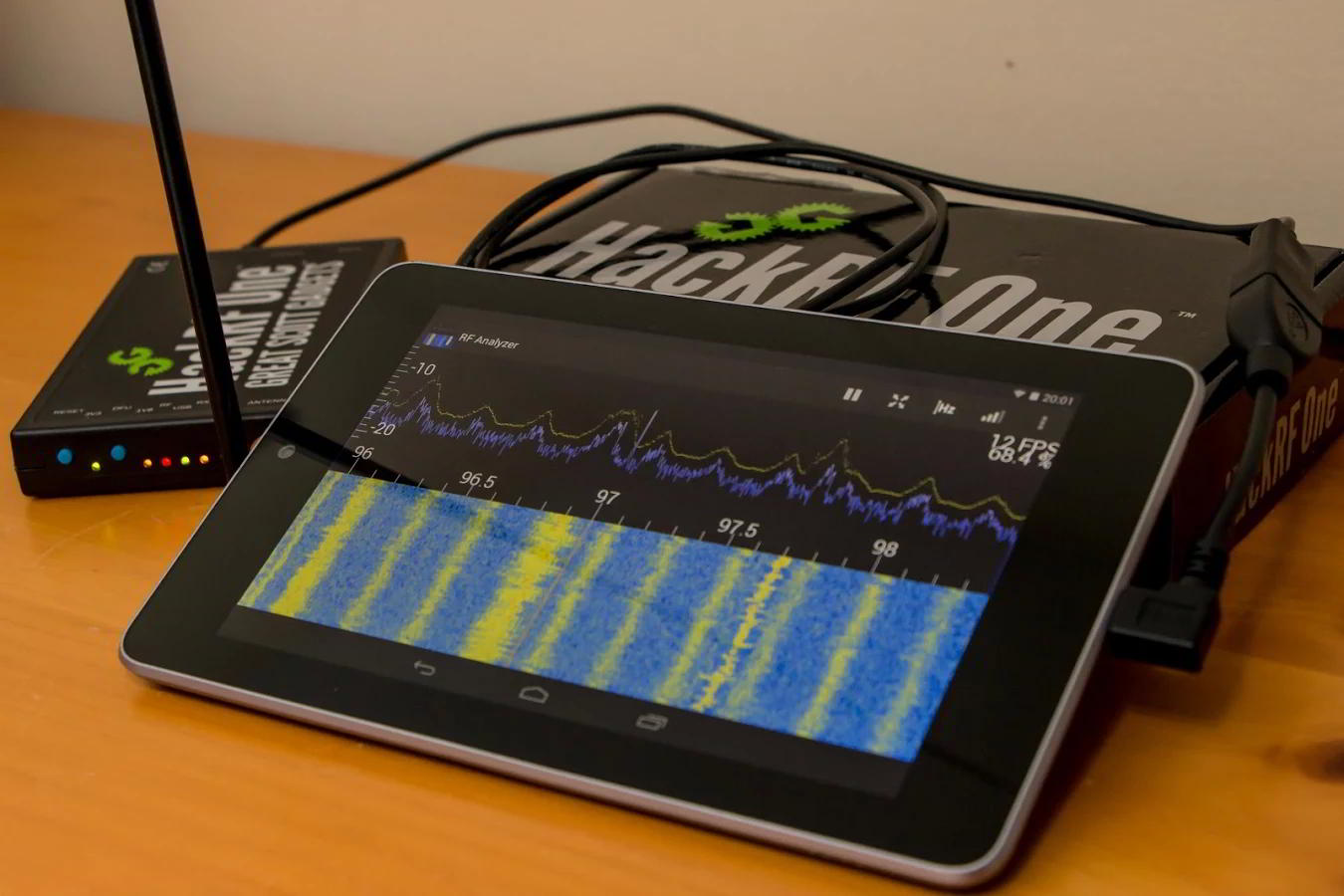
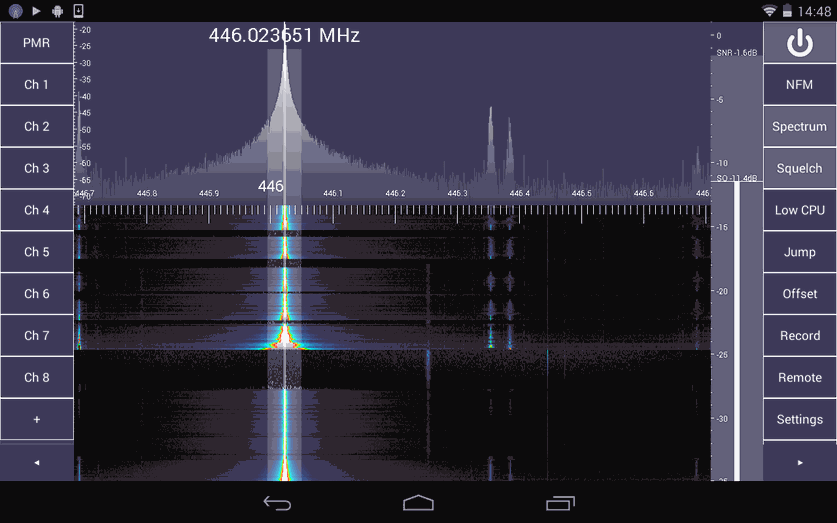
The app is fully open source and the code and APK can be downloaded for free from its Git repository. Alternatively, the app can be downloaded from the Google Play store at a small cost of $0.99 USD.
To use the app you’ll need a USB OTG cable to connect your HackRF or RTL-SDR to your Android phone. More information on the app can be found on the authors blog.
An alternative Android app to RFAnalyzer is SDR Touch.
RF Analyzer Android App for the HackRF and RTL-SDR
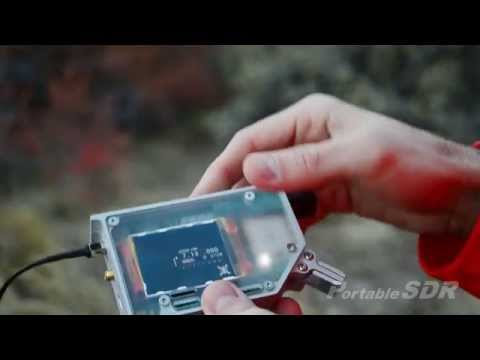
The popular Hackaday blog is having a contest where contestants submit homemade prototypes of opensource devices they have created. The prize is a trip to space and the winner will be awarded to the best example of an open, connected device. The finalists were recently announced and a device called the PortableSDR is one of them.
The PortableSDR is a portable rugged standalone software defined radio transceiver with a 0 to 30 MHz tuning range (also 144 MHz). A standalone SDR means that no computer is required to use the radio, and can work in a similar way to a standard handheld hardware radio. Its advantages come from its SDR design, which allow it to have a wide tuning range, be able to easily decode most protocols and to also work as an antenna analyzer or vector network analyzer.
Some people have been calling this radio a Baofeng UV-5R killer, which is very high praise as the Baofeng is one of the most popular low cost hardware radios out there.
Over on YouTube user mm6dos has uploaded a video showing a new driver he helped develop for the R820T tuner which is used in the most commonly purchased RTL-SDR dongles. He writes:
A short demonstration of a new non-gpl RTL2832U / R820T driver specifically written for SDR#. The R820T tuner actually contains a configurable IF filter and 3 separate gain stages. Unfortunately Osmocom’s implementation has fixed this filter and one of the gain stages. Aliasing and overloading is significantly reduced using this driver.
Currently we don’t have a source for the download of this driver, but we assume that it will be released soon. The videos below show the driver in action, with the first video showing the IF filter adjustments and the second video showing the software decimation feature.
SDR Touch, the popular Android based software defined radio software for the RTL-SDR has been updated to version 2.0. This new version is a complete rewrite with many optimizations listed below.
100% rewritten from scratch
Improved reception sensitivity and quality
Optimized engine
GUI overhaul (Landscape mode, more flexible)
16 bit audio
FIR filtering
The author also writes that the rewrite allows for new features coming out in the future such as adjustable bandwidth, FFT size, plugins and a separate GUI for in-car use. SDR Touch is available from the Android Play store.
Over on the Osmocom mailing list, Oliver Jowett an RTL-SDR experimenter has posted about his new experimental driver for the R820T RTL-SDR which extends the tunable range down to around 13 and up to 1864 MHz (previously 24 – 1766 MHz). Oliver writes
You can get these changes from https://github.com/mutability/rtl-sdr/ (you’ll need to build from source yourself). There should be no application changes needed, just tune as normal. (gqrx needs the “no limits” option turned on) These changes work by limiting the tuner to a range of frequencies that it can reliably tune to, then allowing tuning beyond those bounds by making the 2832’s downconverter do the final bit of tuning. This can add up to 14.4MHz to each end of the range. Also, the tuner is switched to low-side mixing at the top of the range which gives a bit more range there. The practical range is limited by the width of the IF filter and aliasing effects at the extreme edges of the downconverter’s range. I’ve been able to pick up broadcast AM and amateur CW/SSB down to around 15.5MHz without too much trouble. I’d be interested to know how this works for others. Also.. these changes are likely to have broken offset tuning, direct sampling mods, and tuners other than the R820T, as it touches all those areas but I only have an unmodified R820T to test against. If you have different hardware and are willing to spend some time testing then please let me know. I expect that the range of the other tuners can be extended in the same way with not much trouble.
Over on the Reddit RTL-SDR discussion board there has been talk about this patch. Most users are reporting that it works well down to around 15 MHz, but some people are reporting that they have been able to receive signals down to around 4 MHz. Testers also report that this modified driver works much better than the no-hardware direct sampling mod patch released a few months ago.
Micheal Ossmann, creator of the HackRF is starting an online video course on the topic of software defined radio (SDR). His course will cover GNU Radio and will help you to learn the fundamentals of digital signal processing. The first video has been released and in this video Micheal shows how to set up a broadcast FM receiver in GNU Radio.
To do the exercises in the course you will need a HackRF or other similar SDR radio. Most exercises involving reception only should be compatible with the RTL-SDR with some small modifications relating to things like the changing sample rate.
FlightAware is an online service providing real time flight tracking. The flights are primarily tracked by volunteers who run ADS-B decoding hardware which is networked through the internet to the FlightAware servers.
Now FlightAware have written in to RTL-SDR.com to let us know about their new PiAware software which enables a Raspberry Pi running dump1090 to contribute data to the FlightAware network. Dump1090 is a popular RTL-SDR compatible ADS-B decoder program for Linux systems.
A major perk for running their software and contributing data is that FlightAware will buy you a licensed copy of PlanePlotter.
The press release provided is quoted below.
If you are running an inexpensive Raspberry Pi ADS-B receiver with dump1090 then you can install the PiAware Package from FlightAware to freely view nearby flight traffic and transmit this data to FlightAware’s tracking network. Most aircraft within Europe by 2017 and USA by 2020 will be required to have ADS-B transmitters onboard.
FlightAware’s user-hosted worldwide ADS-B receiver network tracks about 90,000 unique aircraft per day and feeds this live data into the FlightAware website in combination with other public/private flight tracking data sources. FlightAware has over 500 user-hosted ADS-B sites online across 60 countries, with top contributors tracking over 10,000 aircraft per day. To see how ADS-B data is put to use, check out the FlightAware Live Map.
The PiAware installation process takes only a few minutes. If you don’t have PlanePlotter, you can download it and then send FlightAware your installation’s serial number and we’ll buy you a license. FlightAware will also give users a free Enterprise Account ($90/month value) in return for installing PiAware.