Category: Radio Astronomy

Imaging the Milky Way in Neutral Hydrogen with an RTL-SDR

Over on Facebook Job Geheniau has recently been sharing how he's taken an image of our galaxy (the Milky Way) with a radio telescope consisting of a 1.5 meter dish, RTL-SDR and a few filters and LNAs. In the past we've posted several times about others observing the Hydrogen line with an RTL-SDR, and we have a tutorial here showing how to observe it on a budget.

In this case, Job went a step further than just a single measurement. He used a used a motorized dish and RTL-SDR to scan the entire Milky Way over one month, resulting in a full radio image of the galaxy. As his posts and pdf document are on Facebook and not visible to those without Facebook accounts, we asked for permission to reproduce some of them here for all to see. We have also mirrored his PDF file here, which contains more information about his radio telescope, results and setup.

To make a very long story short. After a month of angel patience (and that says something to me) I managed to take a 'picture' of our entire galaxy (galaxy) in neutral hydrogen! I attach some pictures. If you are more interested, please come after this and PDF with explanation. It was a hell of a job I can tell you. But here's the ' picture s' of the house (230 million light years wide) in which we live and in which we all have a big mouth......
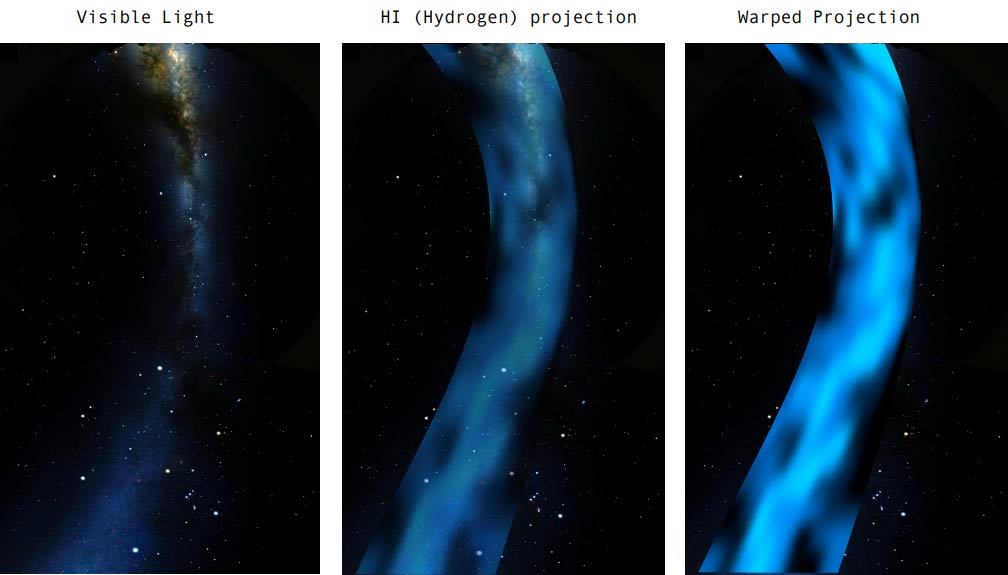
Hydrogen Line Image of the Milky Way produced by Job Geheniau

For the Scientists among us... a beautiful plot of the Milky Way Graphically explained in neutral hydrogen....... In short, summarized... if you look up on a beautiful summer evening you will see a beautiful galaxy, this is graphically the same but then on a different frequency than the eye can perceive. own dates of course.....
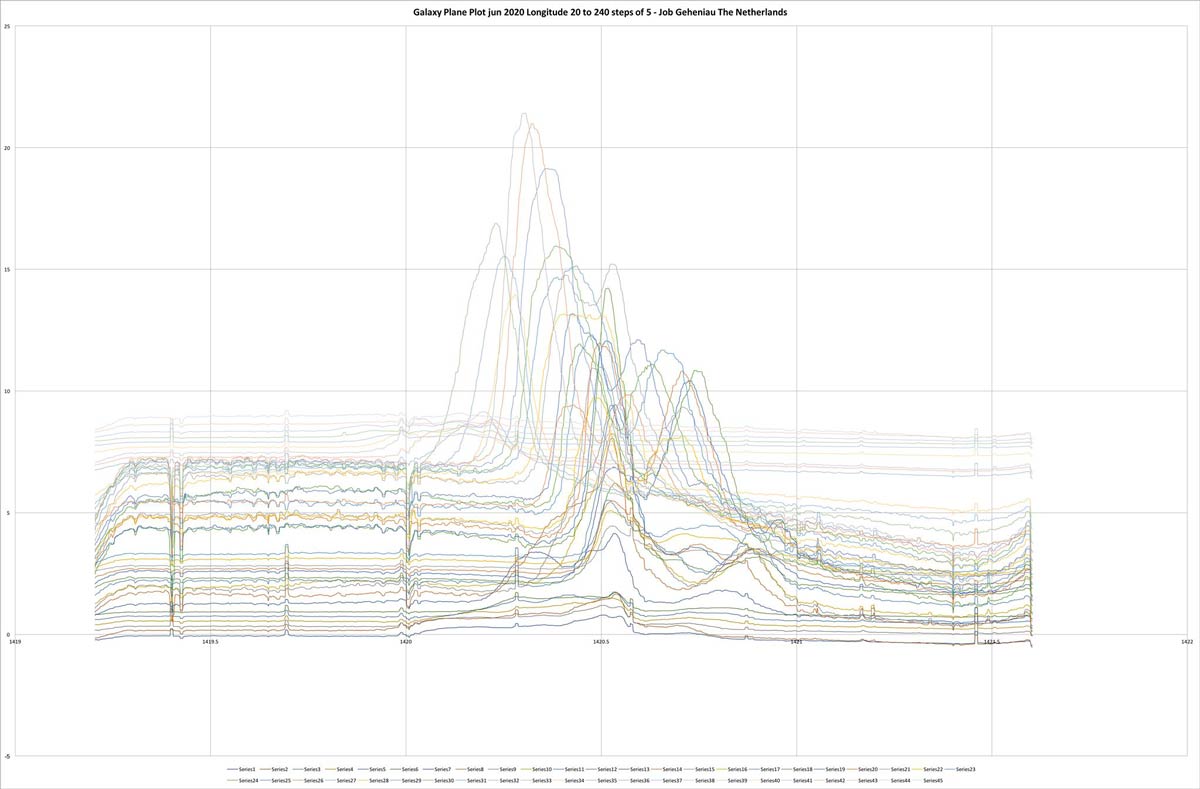
A composite of Hydrogen Line readings at different points of the Milky Way
A composite of Hydrogen Line readings at different points of the Milky Way produced by Job Geheniau
An image of the Galactic Plane (longitude 20 to 240 steps of 5 degrees and latitude 0)

His setup consists of a 1.5m dish, extended to 1.9m with some mesh. A 1420 MHz tuned feed, Mini Circuits ZX6-P33ULN LNA, Bandpass Filter, NooElec SAWBird LNA, Bias-T, RTL-SDR V3, PST Rotator Dish Software, VIRGO software, SDR#, Cartes due Ciel sky chart and a home made netfilter.

He uses a modified version of the VIRGO software to read sky coordinates from a text file, and this points the telescope at each predefined coordinate. He then uses VIRGO to record data for 180 seconds before moving on to the next coordinate. The data is then plotted in Excel, and the highest peak is taken at each coordinate and put back into an 8x21 matrix in excel. Conditional formatting is then used to generate a color gradient resulting in a rough map. Then a Gaussian blur is applied, and it is projected over the Galaxy, resulting in the images above.
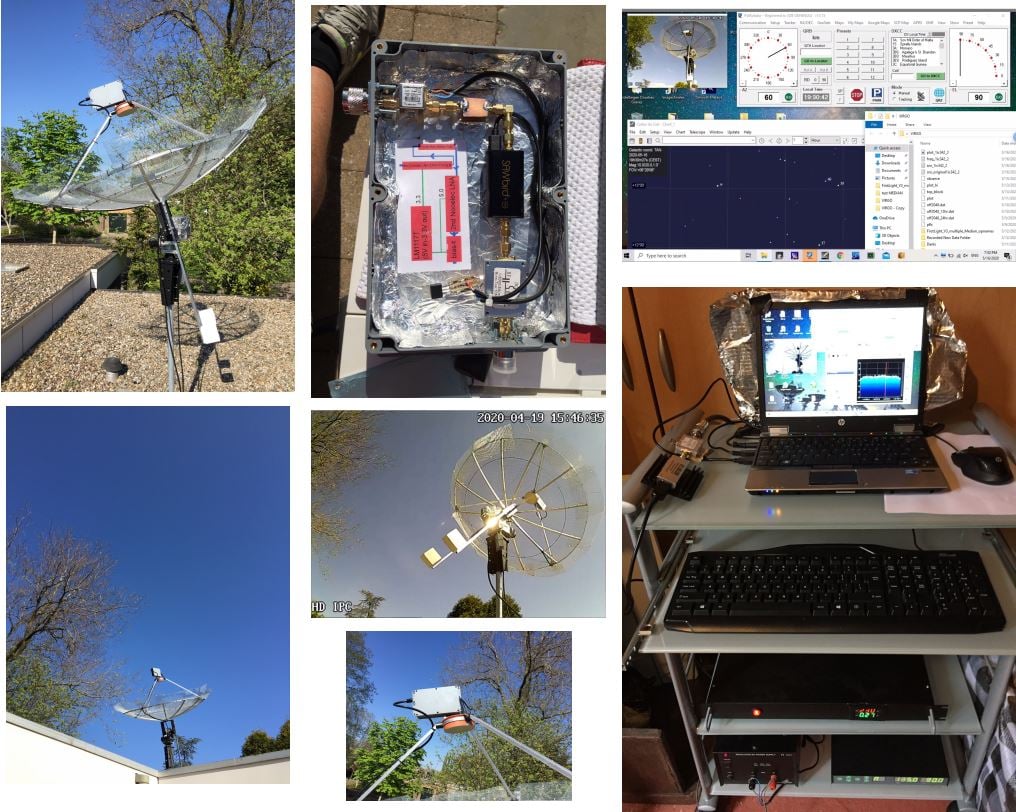
Job Geheniau's Radio Telescope Setup

In the past we've seen a very similar project performed by Marcus Leech from ccera.ca. However, his measurements use 5 months of observations resulting in much higher resolution data.

The Hydrogen Line is an observable increase in RF power at 1420.4058 MHz created by Hydrogen atoms. It is most easily detected by pointing a directional antenna towards the Milky Way as there are many more hydrogen atoms in our own galaxy. This effect can be used to measure the shape and other properties of our own galaxy.
Building a Motorized Hydrogen Line Radio Telescope with a DIY Horn Antenna, Drill Motor and RTL-SDR

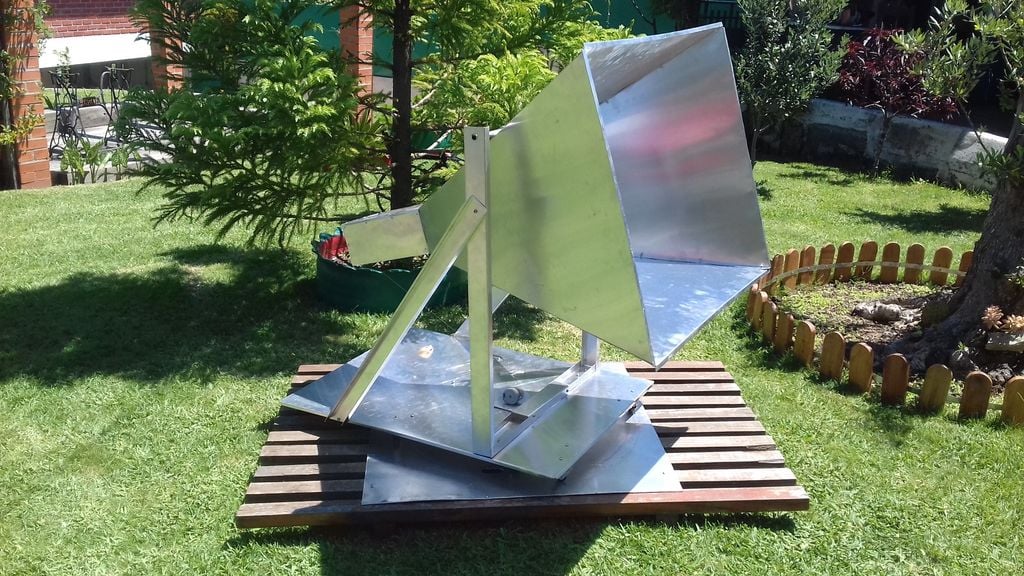
Just on the back of yesterday's post about a helical antenna Hydrogen line radio telescope, we have another submission. This telescope is a bit more advanced as it consists of a large motorized horn antenna, with a custom made LNA and filter board connected to an RTL-SDR with GNU Radio DSP processing.

Over on Instructables "diyguypt" has posted a full overview of his creation. The horn antenna is first created out of aluminum sheets, and then the waveguide is cut out of copper wire and installed into the can part of the horn. He then notes that he created two custom LNA+filter boards with the Minicircuits PMA2-43LN+ LNA and the Minicircuits BFCN-1445+ filter. This then connects to the RTL-SDR that is accessed via GNU Radio which creates a visualization spectrograph.

He then shows how he made the rotation system out of a salvaged drill motor and two relays, and how he made the Z-Axis control with a stepper motor. The motors are controlled with an Arduino and a gyroscope module.

"diyguypt"'s Hydrogen Line Horn Antenna connected to an RTL-SDR

A Hydrogen Line Radio Telescope made from a Homemade Helical Antenna and RTL-SDR

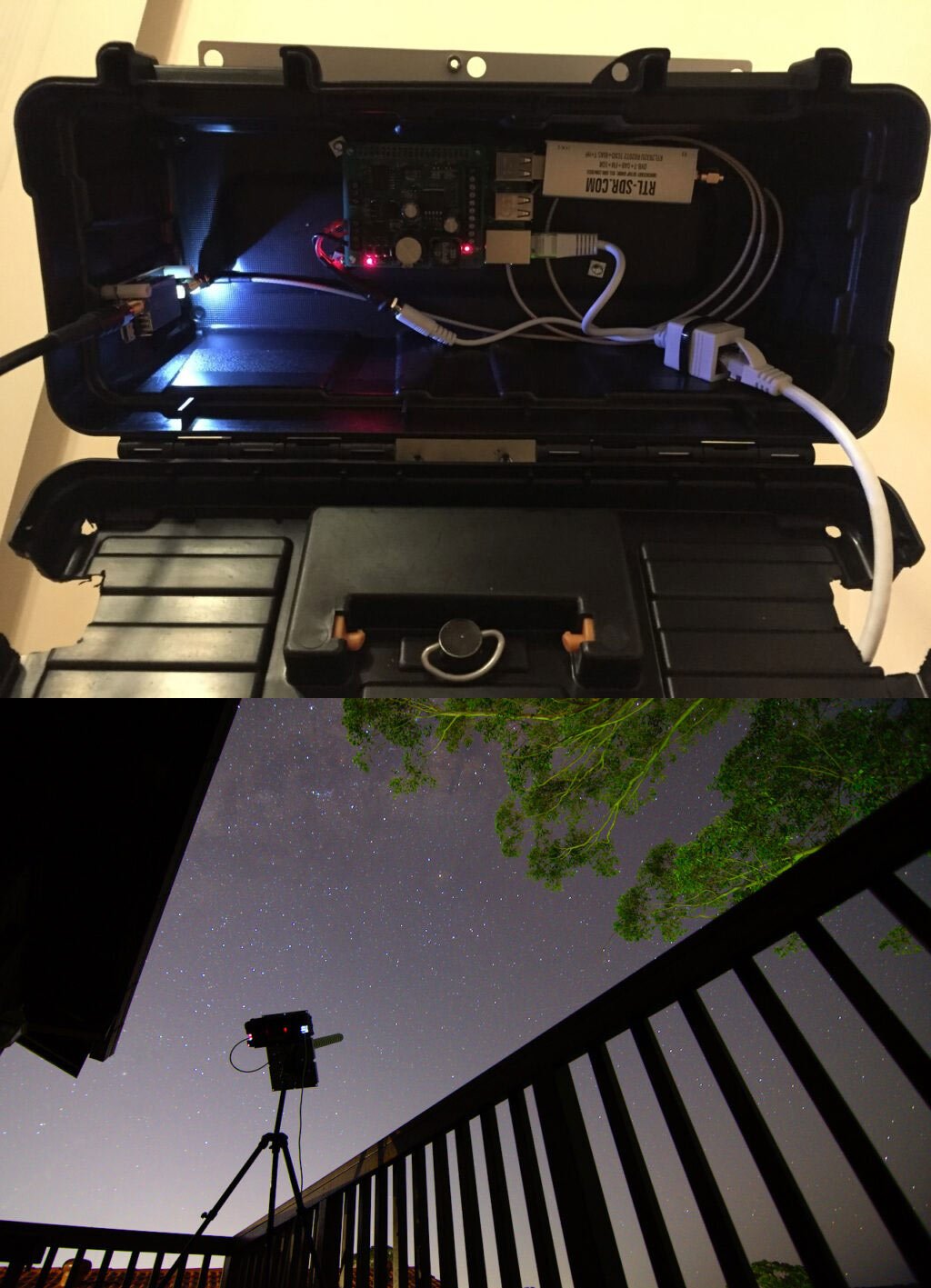
Thank you to Geoff for submitting his experience with creating a hydrogen line radio telescope out of an easy to build helical antenna, Raspberry Pi, LNA and an RTL-SDR. The Hydrogen Line is an observable increase in RF power at 1420.4058 MHz created by Hydrogen atoms. It is most easily detected by pointing a directional antenna towards the Milky Way as there are many more hydrogen atoms in our own galaxy. This effect can be used to measure the shape and other properties of our own galaxy.
Earlier in the year we uploaded a tutorial showing how to observe the Hydrogen line with a 2.4 GHz WiFi antenna. In Geoff's setup he used a home made Helical antenna instead. This antenna is basically a long tube with a spiral wire element wrapped around the tube. He also shows how he needed to impedance match the antenna with a triangular piece of copper tape. The result is a directional antenna with about 13 dBi gain. To complete his setup he used a NooElec SAWBird H1+ LNA/Filter, an RTL-SDR Blog V3 dongle and a Raspberry Pi.

The results show a clear increase in RF power at the Hydrogen line frequency when the antenna points at the Milky Way, indicating that the setup works as expected. It's good to see a Helical working for this, as it is fairly light weight and could easily be mounted on a motorized mount to scan the entire sky.

A Hydrogen Line Radio Telescope made with a Helical Antenna.

YouTube Video Replicates our Galactic Hydrogen Line Detection Tutorial

Earlier in the year we posted a tutorial showing how to detect the Galactic Hydrogen Line at home with less than $200 in components. All that is really needed is a 2.4 GHz WiFi dish, an RTL-SDR and an LNA. With this setup it's possible to do home science like determining the size, shape and rotational speed of our own galaxy. 

Over on YouTube user Nicks Tech Hobby has successfully replicated our tutorial with similar hardware, and has uploaded a time lapse video showing his results. His success confirms that this is a good way to get introduced into radio astronomy. What's also interesting is that it is possible to spot the Hydrogen line energy on the live waterfall even without averaging/integration. 

My first successful attempt to detect galactic hydrogen (Hydrogen line)

CygnusRFI: New RFI Analysis Tool for Ground Stations and Radio Telescopes

Thank you to Apostolos for submitting information about his new open source program called "CygnusRFI". CygnusRFI is a tool designed for analyzing radio frequency interference (RFI) with a focus on how it affects satellite ground stations and radio telescopes. We note that in the past we've posted several times about Apostolos' other project called PICTOR, which is an open source radio telescope platform that makes use of RTL-SDR dongles. 

Apostolos explains CygnusRFI in the following: 

CygnusRFI is an easy-to-use open-source Radio Frequency Interference (RFI) analysis tool, based on Python and GNU Radio Companion (GRC) that is conveniently applicable to any ground station/radio telescope working with a GRC-supported software-defined radio (SDR). In addition to data acquisition, CygnusRFI also carries out automated analysis of the recorded data, producing a series of averaged spectra covering a wide range of frequencies of interest. CygnusRFI is built for ground station operators, radio astronomers, amateur radio operators and anyone who wishes to get an idea of how "radio-quiet" their environment is, using inexpensive instruments like SDRs.

CygnusRFI Screenshots

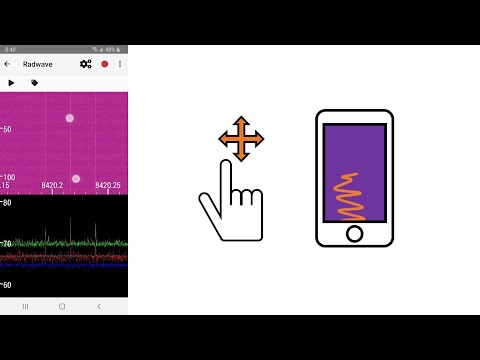
Radwave Updates: Browse SETI Spectrum Data on your Android Device

Back in February 2019 we first posted about Radwave, an Android SDR App for RTL-SDR dongles. It has some interesting features not found in other Apps like the ability to easily zoom, pause and rewind the spectrum at any time.

The author has decided to make use of these spectrum browsing enhancements by providing access to full SETI (Search for Extraterrestrial Intelligence) spectrum data sets which can be browsed via the app for a small fee. From a post on our forums the author of Radwave writes:

I've been developing Radwave, which is an RTL-SDR Android app for exploring the spectrum. I recently added some new functionality, allowing users to interactively explore full resolution SETI data hosted in the cloud - no SDR needed. You can see a preview of it here https://youtu.be/8ZJFzKcWejA and download it from https://play.google.com/store/apps/deta ... ve.android

This data comes from Breakthrough Listen. These datasets are quite large, and Radwave does all the bulk downloading, processing and hosting of the datasets, allowing you to easily navigate your way through the spectrum. If you find something cool, you can tag it and share it.

Currently there are three datasets available in the first bundle ($10 USD): Voyager 1 and two 'Oumuamua collections (surveys of the the first observed interstellar object in our solar system). The data is big, and is hosted in AWS. That gets pricey, so I'll be adding more collections to this first bundle as funding permits. If there are certain datasets you're interested in seeing, definitely let me know.


radwave intro 20200225

Starlink Doppler Reflections Caught with an RTL-SDR

Over on YouTube William IU2EFA has been uploading multiple short "meteor scatter" videos. This involves using an RTL-SDR to briefly receive distant radio stations via the RF signal reflecting off the ionized trail left by meteors entering the atmosphere. However, in a similar fashion satellites orbiting the earth can also reflect distant radio stations. 

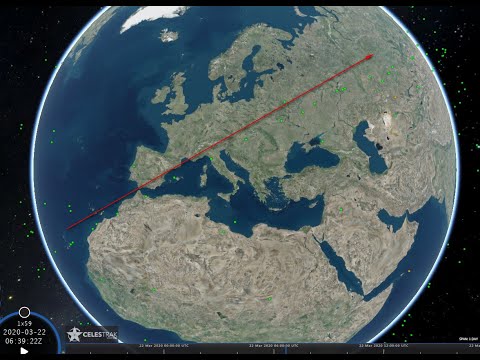
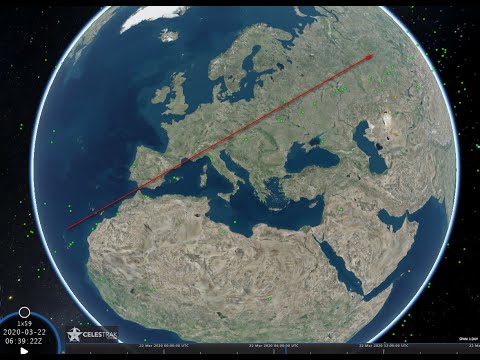
In one of his latest videos William caught a train of Starlink satellites reflecting the signal from the Graves radar in France. To do this he uses a 10 element VHF Yagi, and an RTL-SDR running with HDSDR and SpectrumLab. In the video you can see and hear the change in frequency caused by the doppler shift.

Starlink is a SpaceX project aiming to bring ubiquitous satellite internet to the entire world. Currently 358 Starlink satellites are in orbit, and the end goal is to have 12000.

Starlink Train Detected with GRAVES Passive Radar — RTL-SDR + HDSDR | IU2EFA

Cheap and Easy Hydrogen Line Radio Astronomy with an RTL-SDR, WiFi Parabolic Grid Dish, LNA and SDRSharp

We've recently been testing methods to help budding amateur radio astronomers get into the hobby cheaply and easily. We have found that a low cost 2.4 GHz 100 cm x 60 cm parabolic WiFi grid antenna, combined with an RTL-SDR and LNA is sufficient to detect the hydrogen line peak and doppler shifts of the galactic plane. This means that you can create backyard hydrogen line radio telescope for less than US$200, with no complicated construction required.

If you don't know what the hydrogen line is, we'll explain it here. Hydrogen atoms randomly emit photons at a wavelength of 21cm (1420.4058 MHz). Normally a single hydrogen atom will only very rarely emit a photon, but the galaxy and even empty space is filled with many hydrogen atoms, so the average effect is an observable RF power spike at ~1420.4058 MHz. By pointing a radio telescope at the night sky and averaging the RF power over time, a power spike indicating the hydrogen line can be observed in a frequency spectrum plot. This can be used for some interesting experiments, for example you could measure the size and shape of our galaxy. Thicker areas of the galaxy will have more hydrogen and thus a larger spike, whereas the spike will be significantly smaller when pointing at empty space. You can also measure the rotational speed of our galaxy by noting the frequency doppler shift.

The 2.4 GHz parabolic WiFi grid dishes can be found for a cheap at US$49.99 on eBay and for around US$75 on Amazon. Outside of the USA they are typically carried by local wireless communications stores or the local eBay/Amazon equivalent. If you're buying one, be sure to get the 2.4 GHz version and NOT the 5 GHz version. If you can find 1.9 GHz parabolic grid dish, then this is also a good choice. Although we haven't tested it, this larger 2.4 GHz grid dish would probably also work and give slightly better results. WiFi grid antennas have been commonly used for GOES and GK-2A geosynchronous weather satellite reception at 2.4 GHz with RTL-SDRs as well and we have a tutorial on that available on our previous post.

[2025 Update: With post-COVID inflation, the prices of these dishes are quite a bit higher now. You might also want to consider our new Discovery Dish product, which is a dish + 1.42 GHz feed + filter + LNA all in one.]

These dishes are linearly polarized but that is okay as hydrogen line emissions are randomly polarized. Ideally we would have a dual polarization (NOT circular polarized) feed, but linear appears to be enough and is much simpler. In addition, the 2.4 GHz feed is obviously not designed for 1420 MHz, but just like with GOES at 1.7 GHz the SWR is low enough that it still works.

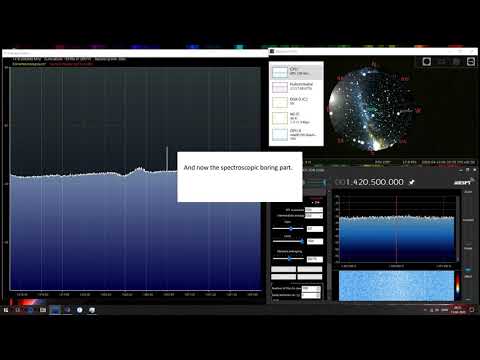
The animation below shows a hydrogen line "drift" scan performed with the 2.4 GHz WiFi dish, an RTL-SDR Blog V3 and a NooElec SAWBird H1 LNA. The scan is performed over one day, and we simply let the rotation of the earth allow the Milky Way to drift over the antenna. The Stellarium software on the left shows the movement of the Milky Way/galactic plane over the course of a day for our location. The dish antenna points straight up into the sky, and we have set Stellarium to look straight up too, so Stellarium sees exactly what our dish antenna is seeing.


You can clearly see that there is a lump in the radio spectrum at around 1420.40 MHz that grows when parts of the Milky Way pass over the antenna. This lump is the hydrogen line being detected. As our Milky Way galaxy is filled with significantly more hydrogen than empty space, we see a larger lump when the antenna points at the Milky Way, and only a very small lump when it points away.

It's important to ignore the very narrowband spikes in the spectrum. These narrowband spikes are simply radio interference from electronics from neighbors - probably TVs or monitors as we note that most of the interference occurs during the day. There is also a large constant spike which appears to be an artifact of the LNA. The LNA we used has a 1420 MHz filter built in, but LCD TVs and other electronics in today's suburban environment spew noise all across the spectrum, even at 1420 MHz.

You can also note that the hydrogen line peak is moving around in frequency as different parts of the galaxy pass overhead. This indicates the doppler shift of the part of the galaxy being observed. Because the arms of the galaxy and the hydrogen in it is rotating at significant speeds, the frequency is doppler shifted relative to us.

Using the power and doppler shift data of the hydrogen line is how astronomers first determined the properties of our galaxy like shape, size and rotational speed. If we continued to scan the sky over a few months, we could eventually build up a full map of our galaxy, like what CCERA have done as explained in this previous post.

Continue reading