PiSDR Image Gains PlutoSDR Support

[@Lugigi Cruz] has announced on twitter that his latest PiSDR image now includes full PlutoSDR support. PiSDR is a pre-built Raspberry Pi distribution that supports several SDRs including the RTL-SDR. It comes with many applications and libraries ready for you to use some of which include GQRX and GNURadio Companion. PiSDR is available on [GitHub] and just needs to be burned to an SD card to be used. The PlutoSDR is a low cost (typically priced anywhere between $99 – $149 depending on sales) RX/TX capable SDR with up to 56 MHz of bandwidth and a 70 MHz to 6 GHz frequency range.
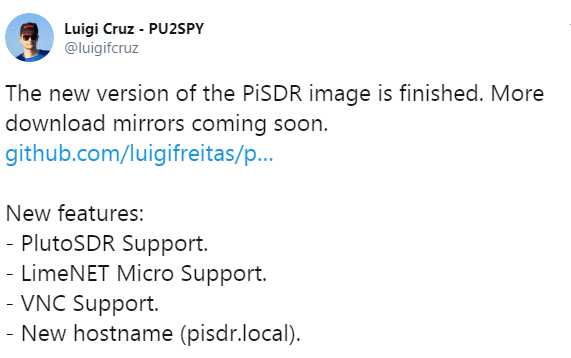
With this update support for the PlutoSDR has been added. This should allow for a host of new interesting uses for the image as it includes SDRAngel, an SDR application that works with transmit capable SDRs. While I’ve not yet tested the image myself, this should in theory mean that the PiSDR image could be used with a transmit capable SDR like a PlutoSDR or Lime/Mini SDR to both transmit and receive anything from DATV to voice and more.

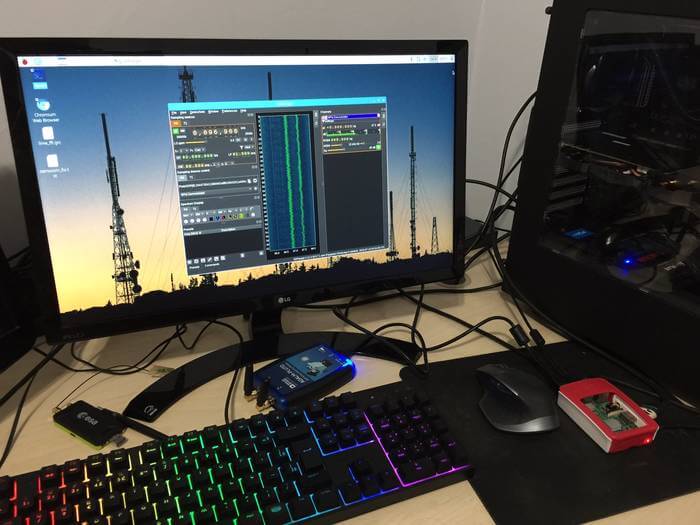
Below you can see the image running the Raspbian desktop with the SDRAngel software connected to the PlutoSDR. Those with a keen eye may also see the LimeSDR mini laying on the desk s well. The concept of SDR on a small microcomputer such as the Raspberry Pi isn’t a new one, but the existence of this distribution makes it much easier for people to jump in and start using it without having to configure and install software from scratch which can sometimes be a daunting task.
Hackaday Looks back on Seven Years of RTL-SDR

Hackaday is a very popular blog that summarizes and aggregates all sorts of content related to hardware, electronics and software projects (just like we do with SDR content). Over the years Hackaday have featured RTL-SDR related projects several times, and in their latest post Tom Nardi reminisces on the seven years since RTL-SDRs became a thing.

Tom talks about how RTL-SDR has evolved since 2012, and how they've kicked off a revolution in the SDR world. He goes on to mention how the hardware and software has improved, mentioning our RTL-SDR Blog V3 units and software like GQRX and Universal Radio Hacker.

At RTL-SDR.COM we're looking forward to where the next seven years of low cost SDR takes us!

Hackaday's Image of our RTL-SDR Blog V3 Dongle.

Tracking Multiple Amateur Radio APRS Balloons with RTL-SDRs

Last month Jeff Deaton from "Edge of Space Sciences" (EOSS) presented a talk called "SDR Multi Balloon Tracking", where he discusses how EOSS are using RTL-SDR receivers to track their APRS high altitude balloons. EOSS is a Denver, Colorado based non-profit organization that promotes science and education by exploring frontiers in amateur radio and high altitude balloons. The talk overview reads:

Review of the software defined APRS system being used to track multiple balloon flights at EOSS. Overview of primary features like the graphical user interface and landing predictions as well as a discussion of the open source software used to power the system like GnuRadio, Dire Wolf, and Aprsc.

It appears that they've created some interesting software that they run on small portable computers that they take in chase vehicles. The software uses an RTL-SDR to receive the APRS signal from the high altitude balloons that they've launched, allowing them to track and predict the flight path, and ultimately recover the balloons and attached cameras.

YouTube Review of the RS-918: A Chinese Clone of a Clone of the mcHF SDR

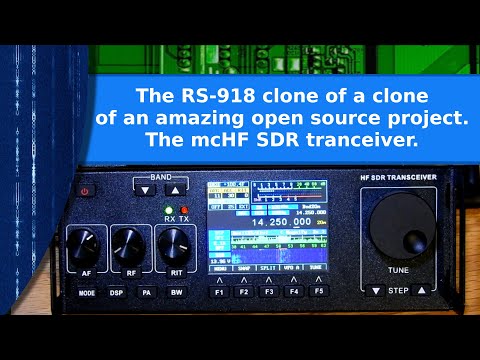
Over on YouTube Kevin Loughin has uploaded a video reviewing the "Recent RS-918" which is a Chinese clone of the popular mcHF open source SDR transceiver made by Chris (M0NKA). The mcHF is a well known small and inexpensive home brewed open source HF QRP SDR that was started back in 2013. It's sold either as a kit for 236.82 GBP (US$287), or with metal enclosure at 292.78 GBP (US$354). The kit comes with SMD components already soldered, but you still need to solder the through hole components and assemble it into the enclosure. The RS-918 clone can be found fully assembled as a ready to use product on eBay for approximately US$400.

As the "Recent RS-918" is a commercial Chinese clone of an open source project that has restrictions against commercial use, it goes against the spirit and legality of the licence imposed by the original creator. So based on that Kevin cannot recommend the RS-918 SDR. However, from his review Kevin notes that apart from some burning hot areas on the metal after transmitting, the SDR itself works and has a nice minimal design. The design appears to be based on an older version of the mcHF, so the latest upgrades are not available.

Kevin's review just overviews the RS-918 and doesn't go into depth reviewing the radio. For the rest of his video Kevin discusses the lineage of the RS-918, noting that it is actually a clone of the Ailunce HS1, which in turn is a clone of the mcHF. He then goes on to discuss the mcHF itself, noting that we should support all the hard work that Chris has put in (and continues to put in) to the original mcHF rather than these immoral clones.

Ham Radio - The RS-918 clone of a clone of an outstanding open source SDR transceiver, the mcHF.

GR-Oscilloscope: Using an Oscilloscope as a Software Defined Radio

A modern digital oscilloscope uses an analogue to digital converter (ADC) and digital signal processing (DSP), just like a software defined radio does, so it stands to reason that with some software hacks an oscilloscope could be turned into an SDR.

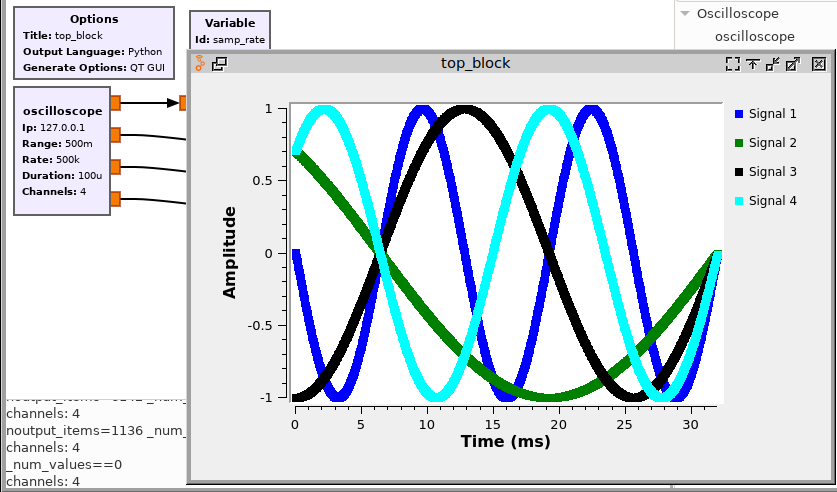
To facilitate this, jmfriedt has just released his new software called "gr-oscillioscope" over on GitHub. GR-Oscilloscope allows you to use a digital oscilloscope as a software defined radio source in the latest GNU Radio 3.8. It has been tested with a Rohde & Schwarz RTO2034 and RTE1054, and should work on any RT series oscilloscope. The software works by using the VXI11 RPC protocol which is a protocol designed for connecting instruments like oscilloscopes to computers.

GR-Oscilloscope Screenshot from GNU Radio.

Developing Your Own SDR Applications With Python

[Max-Felix Müller] wanted to develop his own SDR application with the goal of learning python and a bit about signals processing. To accomplish this goal he’s using [pyrtlsdr] a library which wraps many of the functions from the [rtlsdr-dev] library into a Pythonic set of functions that you can use to develop SDR applications for an RTL based SDR in python. Over on Hackaday.io Max-Felix has been writing about his Python RTL-SDR experiments and has been uploading sample code for anyone to take a look at and learn from. 

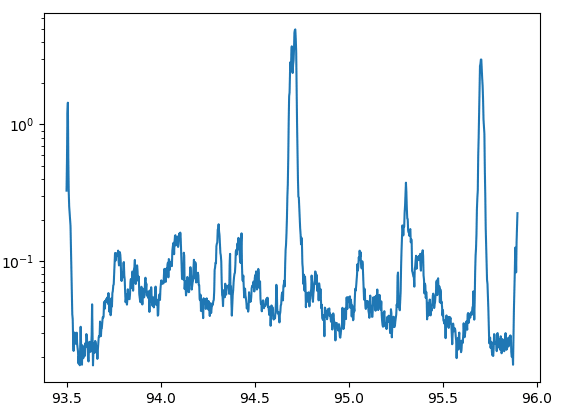
Using the library is pretty simple as it handles the basics of setting up the frequency and PPM settings as well as gain and proceeds to tunnel samples into your application. Max-Felix’s examples take us from the very first steps of setting up the dongle and gathering samples, to plotting the spectrum and creating a waterfall. This generally entails the use of another python library known as [matplotlib] and [numpy], which together you can use to create your own FFT.

It is nearly limitless what you can do with a little bit of Python and a few libraries given enough development time and you don’t need to be a software developing master to get started. You may be interested in taking a look at [PLSDR] which we covered in a previous article where [P. Lutus] developed his own SDR application completely in Python. It’s open-source so feel free to take a look and learn more about how you can implement amazing things with just a little bit of code.

POLL: What do you want in a future low cost SDR?

We've decided to ask the community what sort of radio would be more popular for a ~$30 RX-only SDR. Note that thus far this is only a hypothetical SDR that does not yet have any designs. We are just feeling for what's most interesting to people and exploring for future ideas which may not even be feasible at this time.

As always with engineering, there is always a trade off. It is likely that any low cost SDR can only be wide band, with basic RF performance, narrowband with good RF performance, or expensive.

What is most important to you in a software defined radio?

View Results

Loading ... Loading ...

Wider bandwidth: Currently the RTL-SDR allows you to see up to 3.2 MHz of spectrum live. Higher bandwidth (10 MHz or more) would mean seeing more of the spectrum at once without needing to retune, faster whole spectrum scans and the ability to receive wideband signals.

RF Performance: The RTL-SDR has an 8-bit ADC. While sufficient for many applications, in the presence of strong signals the ADC will saturate resulting in poor reception and signal overload. Higher end SDRs like the SDRplay, Airspy, LimeSDR etc use 12-bit or higher ADCs.

Frequency Range: The RTL-SDR V3 can tune from 500 kHz to 1.75 GHz. An expanded SDR could potentially tune up to 4 GHz or even higher.

If you're interested in other things, please comment on this post!

Decoding the Lucky-7 Cubesat

Lucky-7 is a Czech cubesat that carries some interesting sensors including a low power GPS receiver, a gamma ray spectrometer and dosimeter and a photo camera. The creators also claim that it is "probably the lowest-cost scientific space mission in human history". It was recently successfully launched and orbited together with the Meteor M2-2 weather satellite and several other small satellites.

"We did not build just another satellite. It is a flying laboratory. The satellite is going to test something that nobody has ever done before. Thanks to our background in electronics, materials and space effects, we implemented commonly used electrical parts from automotive and IoT industry in totally new ways. Gallium Nitride power transistors used in modern electric cars do not contain insulation layer to control its conductivity. That makes them much less vulnerable against the space radiation. We fly the world's first MOSFET-free power supply ever built for small satellites. The LED lighting industry has been used to make composite aluminum radiation shields for us. It is very cheap, lightweight and it naturally increases the mission lifetime," says Jaroslav Laifr, the CEO and founder.

If all goes well, the team will be able to measure the in-situ radiation background by miniature onboard Dosimeter and monitor the health of key subsystems, such as communication or data storage by complete satellite telemetry. The experimental Gamma Spectrometer payload informing about the energy of incident radiation will be able to detect Gamma Ray Bursts from distant galaxies. The platform also contains the VGA camera to demonstrate the data transfer capability. It may capture the first colour images ever taken by Czech satellite, possibly detecting the aurora glow. Such pictures would be greatly utilized for the outreach and inspire a new generation of scientists and engineers.

Daniel Estesvev has recently added a Lucky-7 decoder to gr-satellites, and has uploaded a post explaining some technical details on how he created the decoder. With this decoder, anyone with an SDR and appropriate antenna should be able to receive and decode the telemetry (no word on camera images yet). He writes that "Lucky-7 transmits 4k8 GFSK telemetry in the 70cm band. It uses a SiLabs Si4463 transceiver with a PN9 scrambler and a CRC-16. You must use FM mode to receive this satellite (437.525MHz)."

CubeSat companies like Sky Fox Labs are also tracking the satellite, and are tweeting results.