Over on the Saveitforparts YouTube channel, Gabe has documented how he accidentally discovered signals coming from the GPS-satellite-based US nuclear detection system.
While scanning the GPS L3 frequency around 1381 MHz with his RTL-SDR, Discovery Dish, 1420 MHz Hydrogen line Discovery Dish feed, and Discovery Drive, Gabe caught short intermittent data bursts instead of the usual navigation signals. It turns out L3 is used by the GPS constellation for nuclear detonation detection, as the satellites double as arms-control sensors. When one detects a possible event, it relays the message across the network, the only time this frequency sees activity.
Later in the video, Gabe also swaps the dish feed to compare against a regular GPS L1 signal at 1575.42 MHz, and notes that radio astronomers are reverse-engineering L3 to filter it out, since it sits close to the protected 1420 MHz hydrogen line.
Over on YouTube, Gabe from the saveitforparts channel has uploaded a video where he tests out his Discovery Drive and Discovery Dish with L-Band feed for creating sky heatmaps of L-band satellites.
If you were unaware, Discovery Drive is our sister company KrakenRF's most recent successful crowdfunding campaign, which was successfully funded a couple of weeks ago. Discovery Drive is a portable antenna rotator with low power requirements, designed for use with Discovery Dish and other antennas of similar size and weight.
In the video, Gabe writes a custom script that has the Discovery Drive sweep the sky while simultaneously taking RF power readings with the Discovery Dish and L-band feed. The result is an image showing where L-band satellites are in the sky. He goes on to conduct experiments with the hydrogen line and sun imaging, as well as with satellites at UHF frequencies.
Over on YouTube Manuel from the 'Build a Cubesat' channel has uploaded a video testing a prototype version of our Discovery Drive antenna rotator. If you are unaware, Discovery Drive is our new antenna rotator product for applications like satellite tracking and general antenna positioning that is currently being crowd-funded over on Crowd Supply. There are two days left in the campaign.
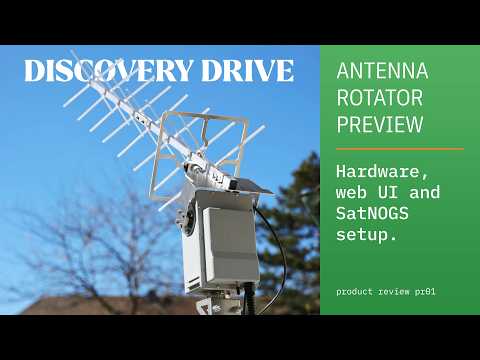
In the video, Manuel overviews the Discovery Drive, shows the internals, and walks us through the web UI. He goes on to show how it can be set up with the SatNOGS project. The SatNOGS project has volunteers set up ground-based satellite stations, and anyone can use those stations to log an observation anywhere in the world.
We note that he mentioned some trouble with getting SatNOGS to rotate the Discovery Drive over zenith. We have added a note to our Wiki showing how this can be fixed by specifying the correct rotational limits for the Discovery Drive.
Our Discovery Drive campaign is currently being crowd-funded on Crowd Supply. Please consider ordering a unit if you are interested in a high-quality, low-power, and portable antenna rotator. Below is an update from the campaign exploring a potential use-case for measuring antenna gain patterns:
In this update, we’ll examine an alternative use case: measuring antenna gain radiation patterns.
One interesting use of a capable Az/El rotator is to measure the radiation pattern of various antennas. This is normally done in an anechoic chamber, but if you have a large enough open space, it can be done cheaply with a rotator and signal source.
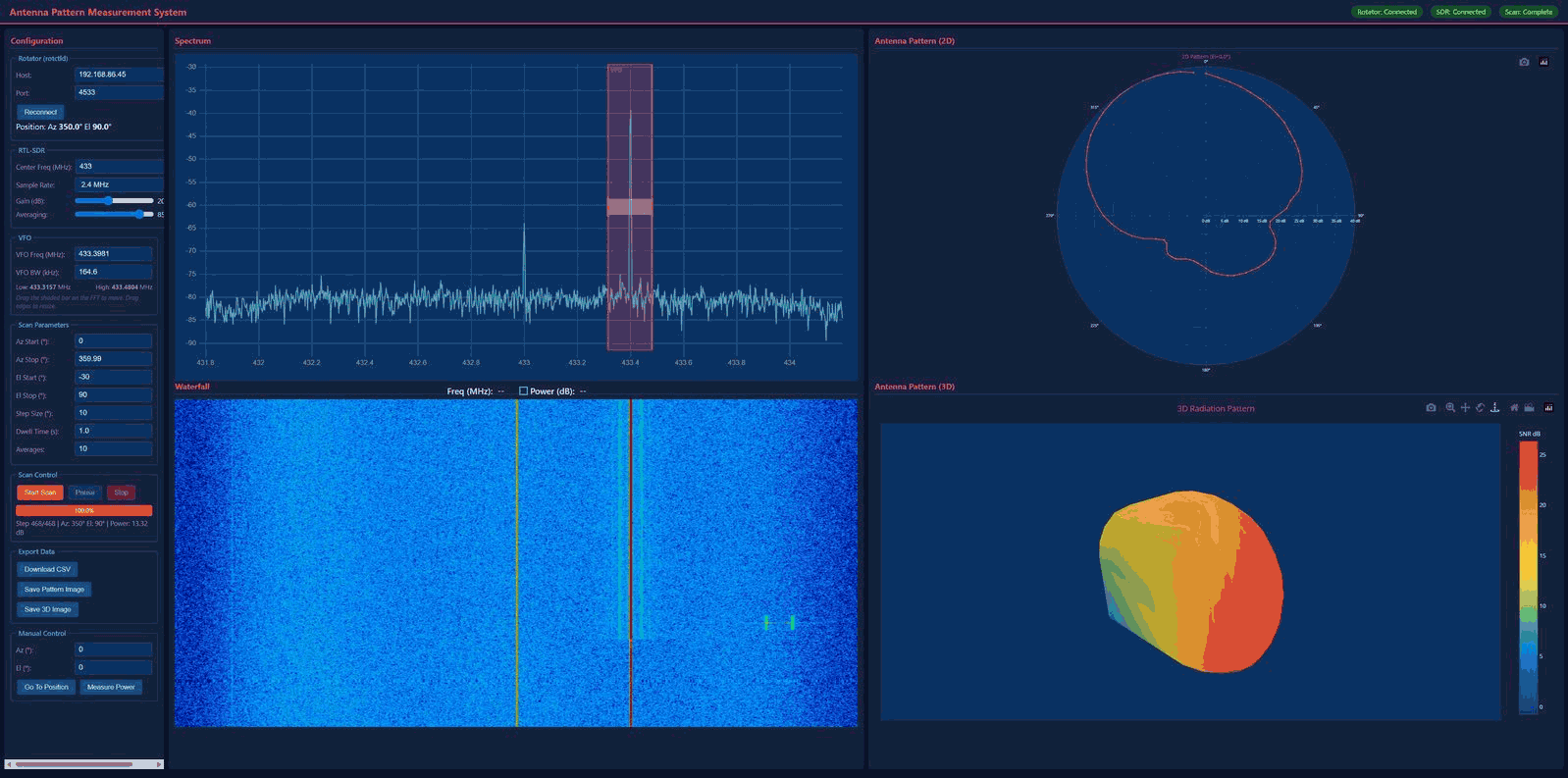
To test this as a proof of concept, we used Claude code to very quickly create a tool that could help us create an antenna pattern plot. The software tool simply rotates the antenna on the Discovery Drive one step at a time, measures the SNR using an RTL-SDR, and plots the reading on a graph. To be clear, this simple setup is not providing any sort of calibrated readings, but it will at least give you an idea of what the radiation pattern and performance of an antenna looks like.
In our test, we mounted a TV Yagi on the Discovery Drive and used our software to plot the radiation pattern at 433 MHz. As expected from a Yagi, we see higher gain at the front and lower gain at the rear.
Antenna Gain Results
Due to a lack of a suitable open area, this test was performed in a small backyard and, hence, the radiation pattern is a little lopsided due to multipath. In this test, we also used a simple omnidirectional antenna for the signal source, which exacerbated the multipath. A way to improve this test would be to use a directional antenna on the transmit side, too.
We will release this open-source tool for others to play with, but please be aware that it was only created for proof of concept. However, if there is interest, we can continue to refine it.
Below is a photo of the physical setup. A HackRF with Portapack and whip antenna are mounted on a tripod a few meters away, while the Discovery Drive carries a Yagi antenna. As the Discovery Drive rotates the Yagi through 0 to 360° in azimuth and -30 to 90° in elevation, it measures the received power at each step.
Over on YouTube, Gabe from the saveitforparts channel has uploaded a new video testing a prototype of our upcoming Discovery Drive Az/El antenna rotator, which is now live for crowdfunding on Crowd Supply.
In the video, Gabe unboxes the Discovery Drive and sets it up with a Discovery Dish. He then tests it on various weather satellites, including Meteor M2-4, Meteor M2-3, DMSP, Metop-B, and Metop-C. Later in the video, Gabe shows that you can also attach an Arrow Yagi antenna to the mount and notes that in a future video, he hopes to test CubeSat and Amateur radio satellite reception with the Yagi.
We're extremely pleased to announce that our campaign for our Discovery Drive automatic antenna rotator is now live on Crowd Supply! Pricing is reduced during the campaign period, so check it out soon!
Discovery Drive is an automatic antenna rotator designed for use with our Discovery Dish product, as well as similarly sized antennas such as Wi-Fi grid and Yagi antennas.
A motorized rotator, such as Discovery Drive, enables precise tracking of fast-moving polar orbiting satellites using a satellite dish or directional antenna. Examples of polar orbiting weather satellites include METEOR-M2, METOP, and FENGYUN. Depending on your location, you may also have access to other interesting satellites that dump data over specific regions.
In addition to public weather data, operators and enthusiasts might be interested in using Discovery Drive to track CubeSats, and amateur radio operators may wish to track amateur radio satellites.
Amateur radio astronomy hobbyists can map the galaxy in the hydrogen line spectrum using Stellarium, or custom software to aim a Discovery Dish with H-Line feed, allowing you to scan multiple parts of the sky in one night.
Discovery Drive - A Motorized Antenna Rotator Engineered for Discovery Dish
Discovery Drive is an automatic antenna rotator that is designed to be used with our Discovery Dish product, as well as similarly sized antennas such as Wi-Fi grid and Yagi antennas.
Discovery Drive with Discovery Dish Mounted
A motorized rotator allows you to use a satellite dish or directional antenna to track and receive signals from polar orbiting satellites, which quickly move across the sky. It also lets you switch swiftly between geostationary satellites without manually realigning the dish.
Examples of polar-orbiting weather satellites that you can track include NOAA POES, METEOR-M2, METOP, and FENGYUN. Depending on your location, you may also have access to other interesting satellites that dump data over specific regions. Amateur radio operators can also use Discovery Drive to track amateur radio satellites with Yagi antennas.
Discovery Drive
Discovery Dish is designed to be easy to set up and use. Unlike many other rotators on the market, no external controllers are required. Discovery Drive has a built-in ESP32 controller, and control can be commanded over WiFi or serial from rotctl-compatible software such as SatDump, GPredict, and Look4Sat on Android.
Features and Specifications
Up to 125 kgcm (12.25 Nm) of torque
ESP32 control board
± 1.5° of accuracy
-360° to +360° Azimuth range, 0° - 90° elevation range
1.5 RPM Azimuth speed, 0.25 RPM elevation speed
12 V power input (either barrel jack or USB Type-C Power Delivery)
Wi-Fi connectivity with browser-based web UI
Serial over USB data connectivity or Wi-Fi data connectivity
Low power draw (< 10 W, can be powered with PoE+ supplies and still have power left over for powering a single board computer and RTL-SDR)
Robust worm gear-locked output drives
Direct rotctl compatibility over Wi-Fi (compatible with programs that implement the rotctl protocol, such as SatDump, GPredict, and Look4Sat on Android)