Tagged: EiBi

ATS Mini Controller: A Web App for the ATS Mini Receiver with an Experimental Browser-Based RTL-SDR Mode

Thank you to Grzegorz Zajac for writing in and sharing ATS Mini Controller, a free web app for the ATS Mini. The ATS Mini is a low-cost pocket shortwave receiver based on an ESP32-S3 and the SI4732 broadcast radio receiver IC. The app connects to the radio over USB or Bluetooth LE from Chrome, Edge or Opera, with nothing to install. From the browser, you can tune the radio, manage its memory slots, tune straight from an offline copy of the EiBi shortwave schedule, run spectrum scans, and update the firmware.

Readers may also be interested in the experimental RTL-SDR mode. It connects to an RTL-SDR directly over WebUSB and demodulates inside the browser, without rtl_tcp or a server. It supports dongles with R820T, R820T2 and R828D tuners, including our RTL-SDR Blog V3 and V4. It has a spectrum and waterfall, up to six VFOs, IQ recording, and a long list of decoders such as ADS-B, AIS, ACARS, APRS, FT8, and POCSAG.

Grzegorz notes that "experimental" is meant seriously, because several of the decoders have so far only been tested on generated signals. Windows users will need to install the WinUSB driver with Zadig first, and Linux users will need to blacklist the DVB driver. We note that the app is free, but it does not appear to be open source.
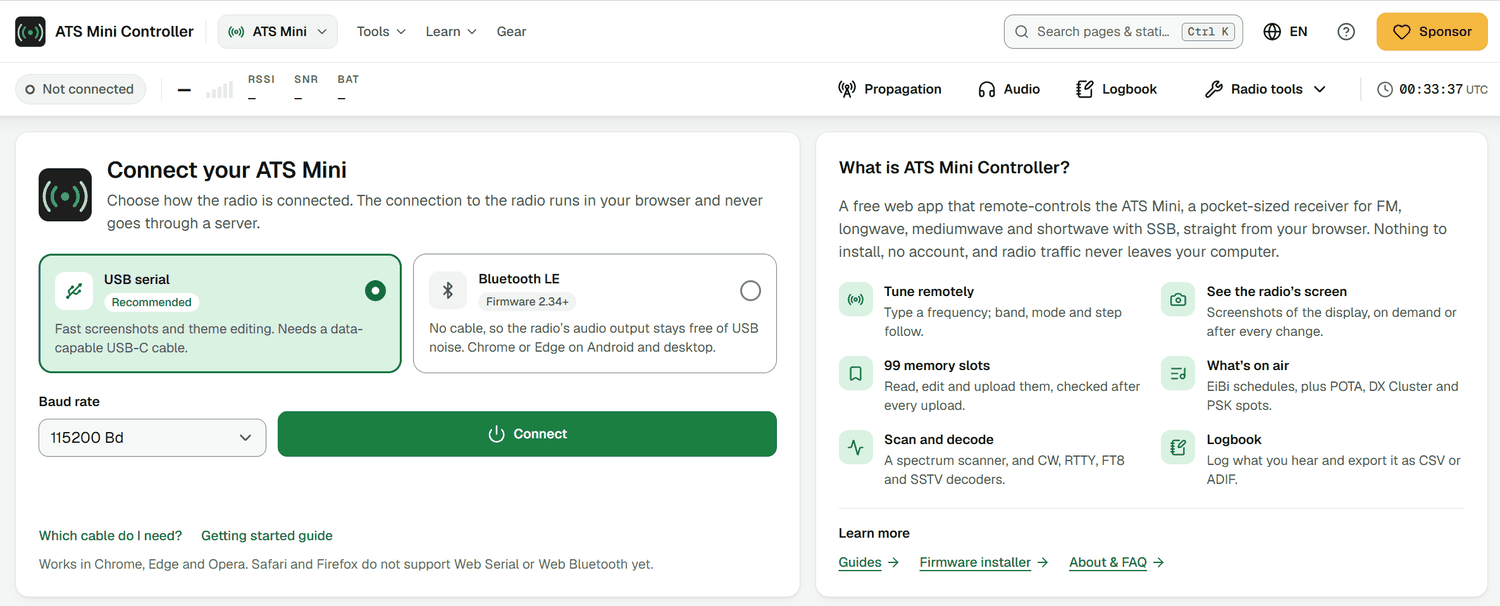
ATS Mini Controller Start Screen Screenshot

AI Disclaimer: The author has confirmed that AI was used in the development of this software, but it was not a replacement for his own experience and engineering decisions.
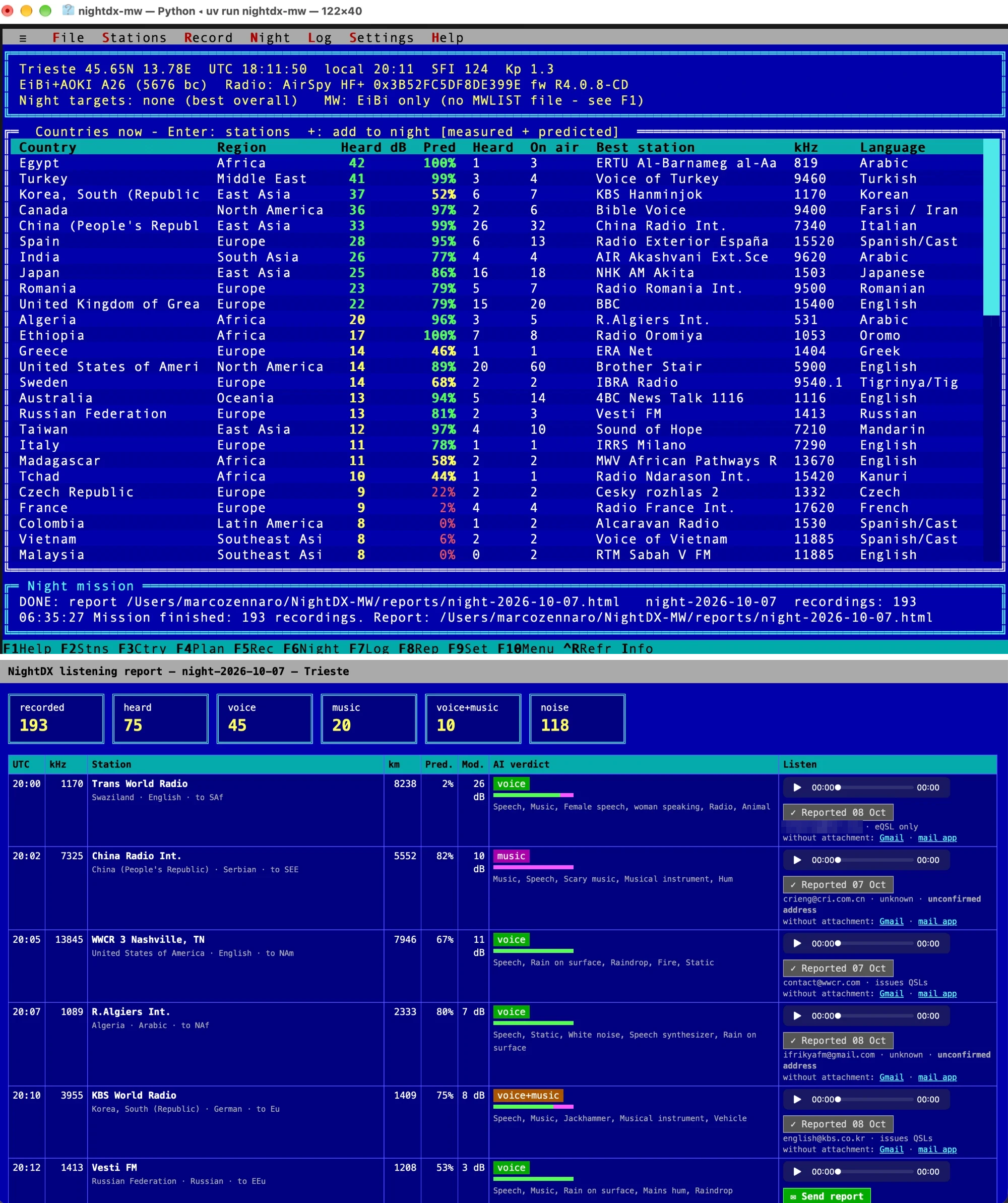
NightDX: Automated Overnight Shortwave DX Listening with an Airspy HF+

Thank you to Marco Zennaro for writing in and sharing NightDX, a free terminal app for macOS, Windows and Linux that lets an Airspy HF+ do your overnight shortwave listening for you. The menu interface is deliberately styled like early-90s DOS software.

NightDX pulls the EiBi, AOKI and HFCC broadcast schedules, plus live solar flux and Kp from NOAA. A propagation model then predicts what should reach your location and calibrates itself against what your own radio hears. The HF+ sweeps all the bands in about 10 seconds to see which carriers are really there, and overnight NightDX records the best stations, putting ones you've never logged first.

Optional AI features can then label each recording as speech, music, or noise using an AudioSet classifier, and transcribe and translate it with OpenAI's Whisper, which helps when writing reception reports. In the morning, a browser report shows the recordings with audio players, one-click reception reports drafted in Gmail, and a QSL card log.

We note that NightDX doesn't claim to identify stations. It shows schedule names as candidates and flags recordings where the evidence doesn't fit, such as the wrong language or a signal far too strong for the predicted path. Only the Airspy HF+ (Discovery or Dual Port) is supported for now, so there is no RTL-SDR support. Marco notes that other SDRs such as the Perseus and Elad are being looked into. The code is open-source under the MIT license and available on GitHub.

NightDX Screenshots
NightDX Screenshots

AI Disclaimer: Marco notes that NightDX was built with the help of Claude.