Thank you to Reid Crowe for submitting his project, "voacap-skill." This skill for Claude Code AI (a frontier LLM) lets Claude access and use the latest VOACAP ionospheric propagation data in conversations.
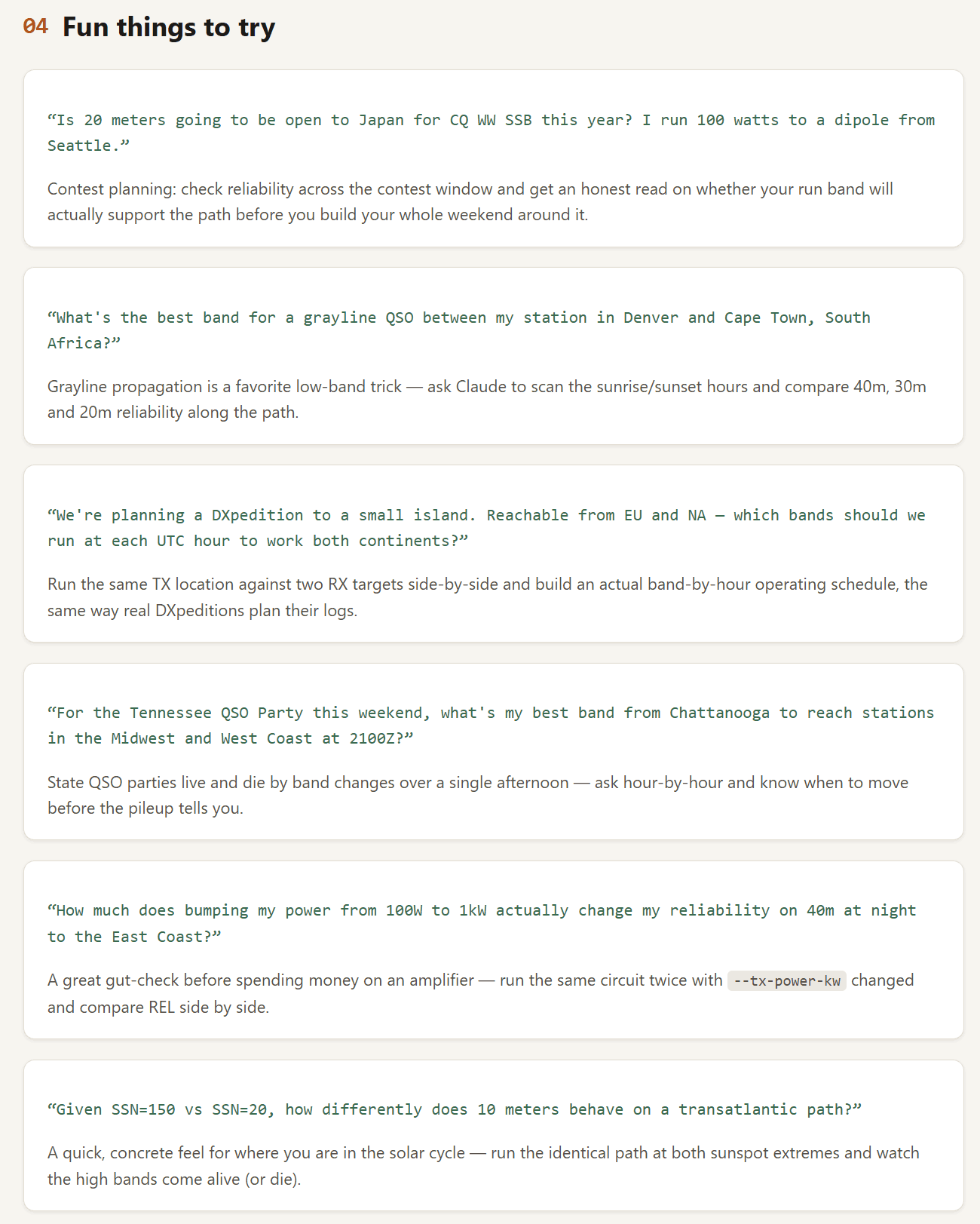
Instead of manually filling out a form for each prediction and analyzing the results yourself, with the voacap-skill, users can ask Claude questions like, "What's the best band to reach Tokyo from Columbus, Ohio around 0300Z in October?" and Claude will run a VOACAP prediction in the background and return an answer. Reid explains:
If you've ever used VOACAP, VOACAP Online, or watched a contest DXpedition plan its band schedule, you already know the engine underneath this: it's the same NTIA/ITS point-to-point HF prediction model that's been the industry standard for propagation forecasting since the 1980s. It takes a transmitter location, a receiver location, a month, and a sunspot number, and tells you — for every hour of the day and every frequency you care about — how reliable that circuit is likely to be.
voacap-skill takes that engine (via voacapl, the modern Linux/GFortran port, on macOS/Linux, or the native NTIA/ITS Windows engine on Windows) and wires it into Claude Code as a "skill" — a capability Claude can reach for on its own.
The skill is free and open-source, with the code available on GitHub. Below, Reid provides some more examples of what you can ask Claude once it has access to VOACAP data.
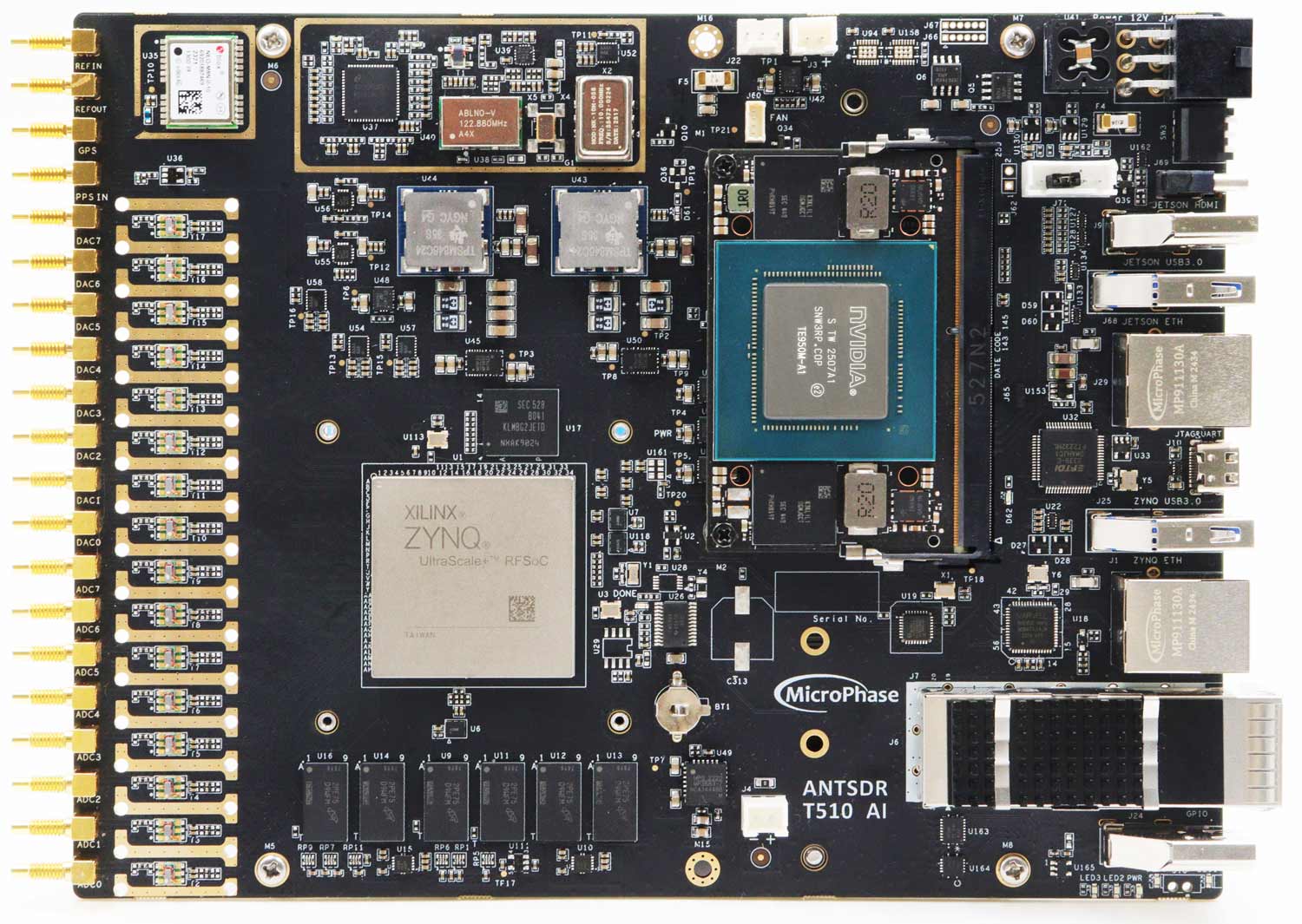
MicroPhase has just announced the pre-launch of its AntSDR T510 AI software-defined radio platform. This high-end device combines the AMD Zynq UltraScale+ RFSoC ZU47DR with an NVIDIA Jetson Orin Nano. The AMD ZU47DR RFSoC alone is already a beast, covering 1 MHz to 6 GHz, with 14-bit ADCs and 8 RX and 8 TX channels. This is a direct-sampling SDR, meaning no tuners are used, and the ADC simply samples at an extreme 5 GSPS. After the DDCs, each channel has a maximum bandwidth of up to 2 GHz, but smaller channelization can easily be achieved within the large FPGA embedded in the RFSoC.
Obviously, processing a large amount of data requires powerful computing, so the AMD ZU47DR RFSoC is combined with an NVIDIA Jetson Orin NX for real-time AI signal processing and intelligent spectrum analysis.
MicroPhase also notes that the AntSDR T510 AI will be open source, allowing developers to easily work with the hardware. It will ship with an Ubuntu 22.04 system preconfigured with CUDA, include GNURadio and SoapySDR compatibility, and include GPU-accelerated demos for real-time Wi-Fi, Bluetooth, and modulation classification using RF data captured by the platform.
This is a high-end SDR comparable to Ettus products that cost US$30k+ like the USRP X410, but Chinese manufacturers like MicroPhase may be able to bring the pricing down. The ANTSDR-T510 non-AI version without the Jetson is already available on Chinese marketplace sites for about US$5000, so with the additional $500 Jetson Orin Nano added, this version should only be a little more expensive.
Recently, we posted about DeepSDR, which is a program that automatically transcribes voice data from public safety radio communications and uses an LLM to categorize and plot incidents on a map as they happen.
In that post, we noted that we expect to see more projects like this soon, and sure enough, another program called "Scanner Command" with a similar angle has been submitted to the blog by author Benjamin Blood. Like DeepSDR the software listens to public safety and then uses voice transcription and an LLM to automatically understand, categorize and map incidents on the map. One additional feature that Scanner Command has is a fun tool that correlates ADS-B data with airband voice. Benjamin explains it best:
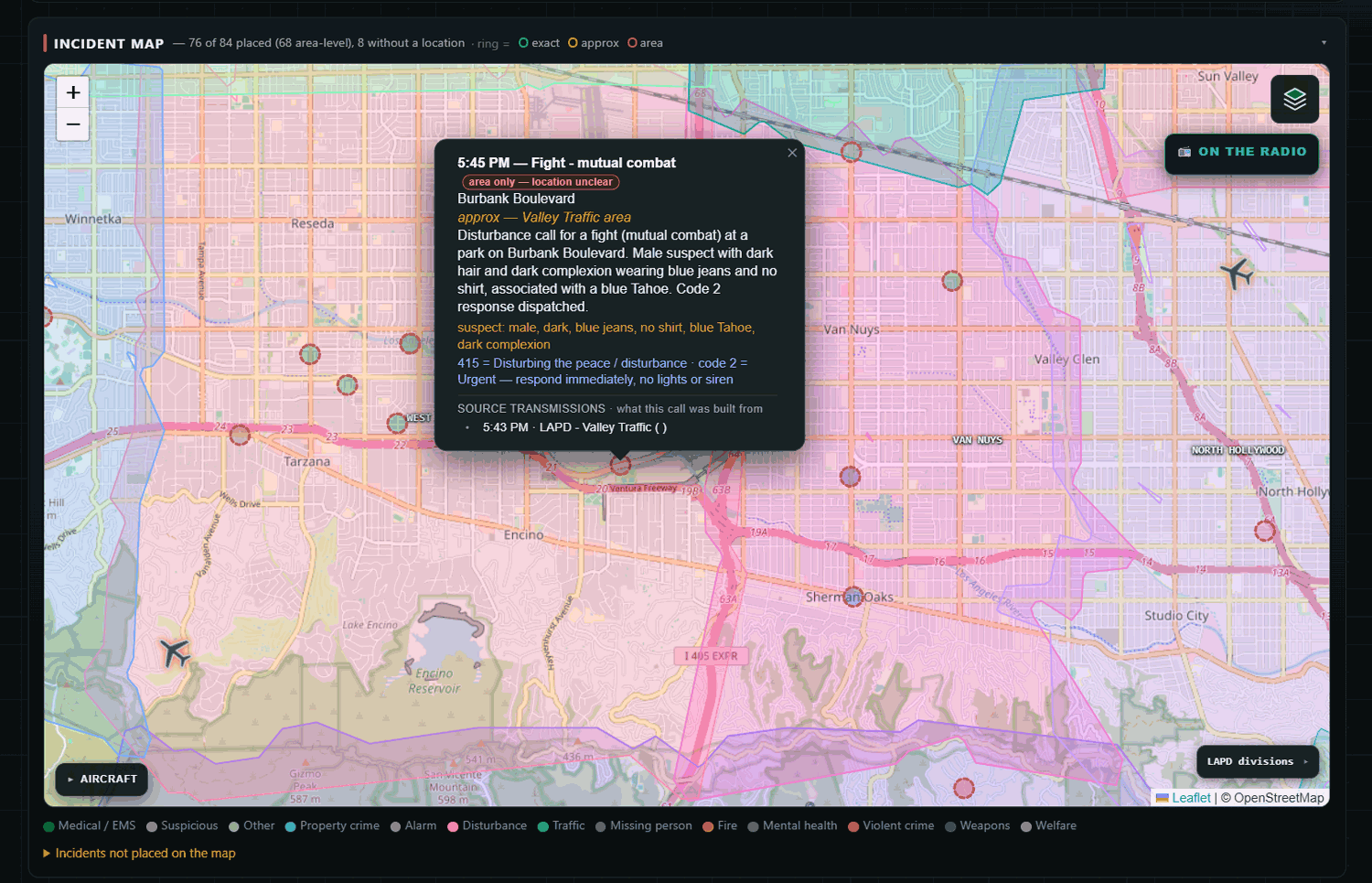
Scanner Command turns a radio scanner into a live AI incident map. A Uniden SDS200 covers the trunked digital public safety side (the LA area's P25 Phase II system, with ProScan driving the scanner and handing off every recording), and two $45 RTL-SDR dongles handle the rest, one decoding ADS-B with readsb, one capturing VHF airband transmission by transmission. Everything gets transcribed locally with Whisper, an AI extraction pass works out what happened and where, and about 30 seconds after a call ends it's a color-coded pin on the map with the audio one click away. Location matching is honest on purpose: an exact intersection match gets a solid pin, an area-only match gets a dotted one, and it tells you which.
Here's the design idea underneath it, and what I think separates it from the other transcribe-and-map projects out there: this is built for tactical situational awareness when the grid's down. The system does its learning while it's online, building its own gazetteer of local streets and places, learning unit callsigns and talkgroup names, priming the transcriber's vocabulary from real local traffic, precisely so it's more capable when it's cut off. Map tiles, geocoding, and hazard data are all cached locally with that scenario in mind.
The picture in my head has always been: grid's down, the box is running on backup power serving wifi, and my neighbors connect with their phones and everyone can see what's happening around us, instead of one guy hunched over a scanner relaying it. It's not shelf gear you dust off when something happens; the whole point is that running it every day is what trains it for the day you need it. Transcription is already fully local, the LLM extraction step currently uses a hosted model when online (it runs me about a dollar a day at 24/7), and the next build phase is a GPU box that closes that last gap with a local model.
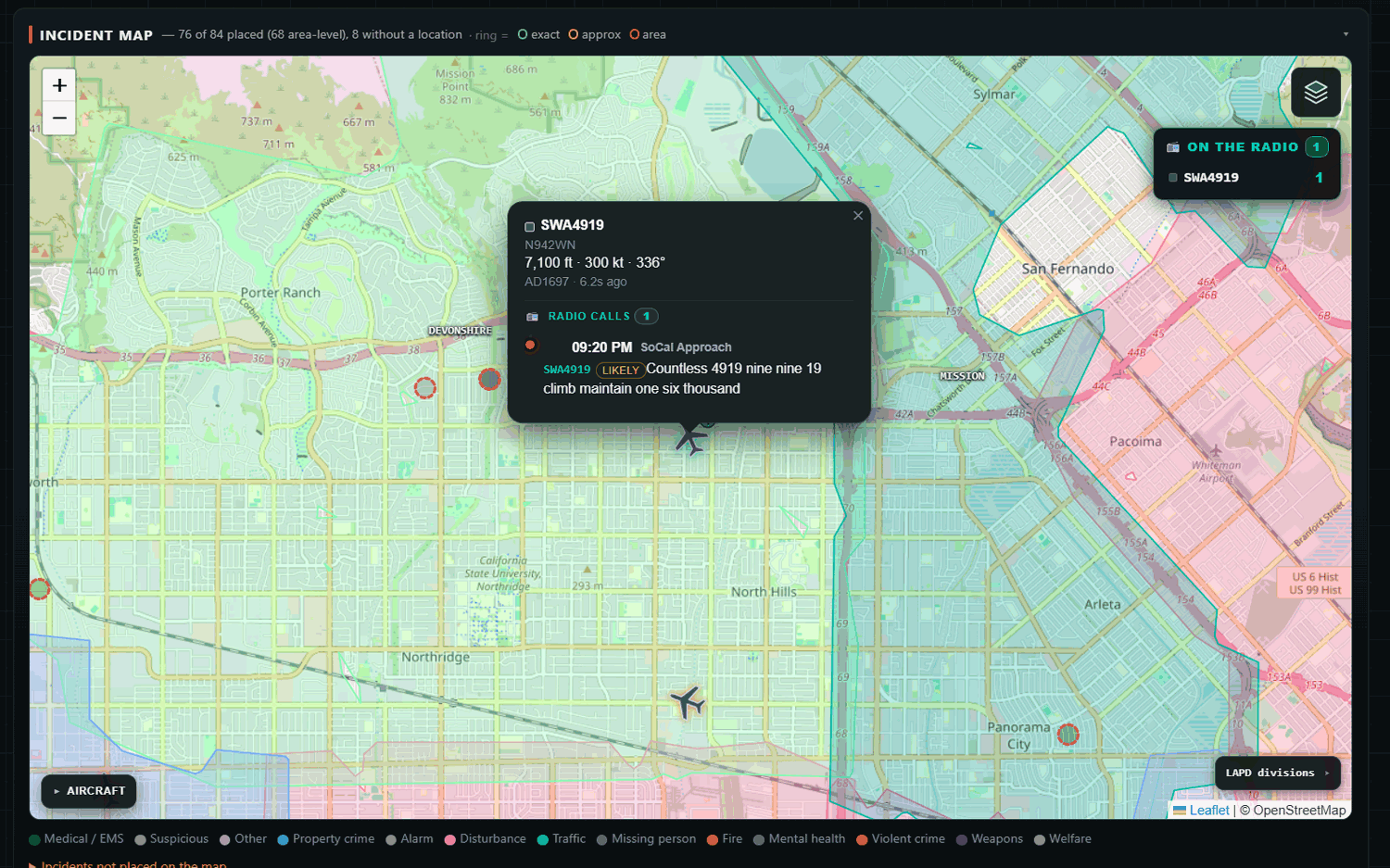
The feature people are having the most fun with is the airband/ADS-B correlation. The system pulls spoken callsigns out of airband transcripts and matches them to ADS-B tracks by time and geometry, with match windows scaled by altitude and speed, plus hex-to-tail-number derivation. Click a plane on the map and hear what its pilot actually said, with a confidence badge when the match came from a partial readback. Beyond that: an ATAK feed (CoT/KML/GeoJSON), twice-daily AI briefs, a BOLO board, incident threading with a unit activity board, and helicopter orbit detection.
ADS-B aircraft position data automatically linked to airband voice transcripts
Benjamin adds that a public demo is available at https://demo.scannercommand.com. But he notes that "the public demo is a replay of two real days of traffic from my setup".
The software has not yet been released, and it does not appear to be free or open-source. There is a signup waitlist available on the scannercommand.com website.
This is an exciting time with AI not only helping to rapidly develop new software, but now being used to summarize and condense the vast amount of information about the state of the surrounding world available in the RF spectrum.
Scammer Command example mapped incident report
I Turned My Police Scanner Into a Live AI Incident Map (24/7)
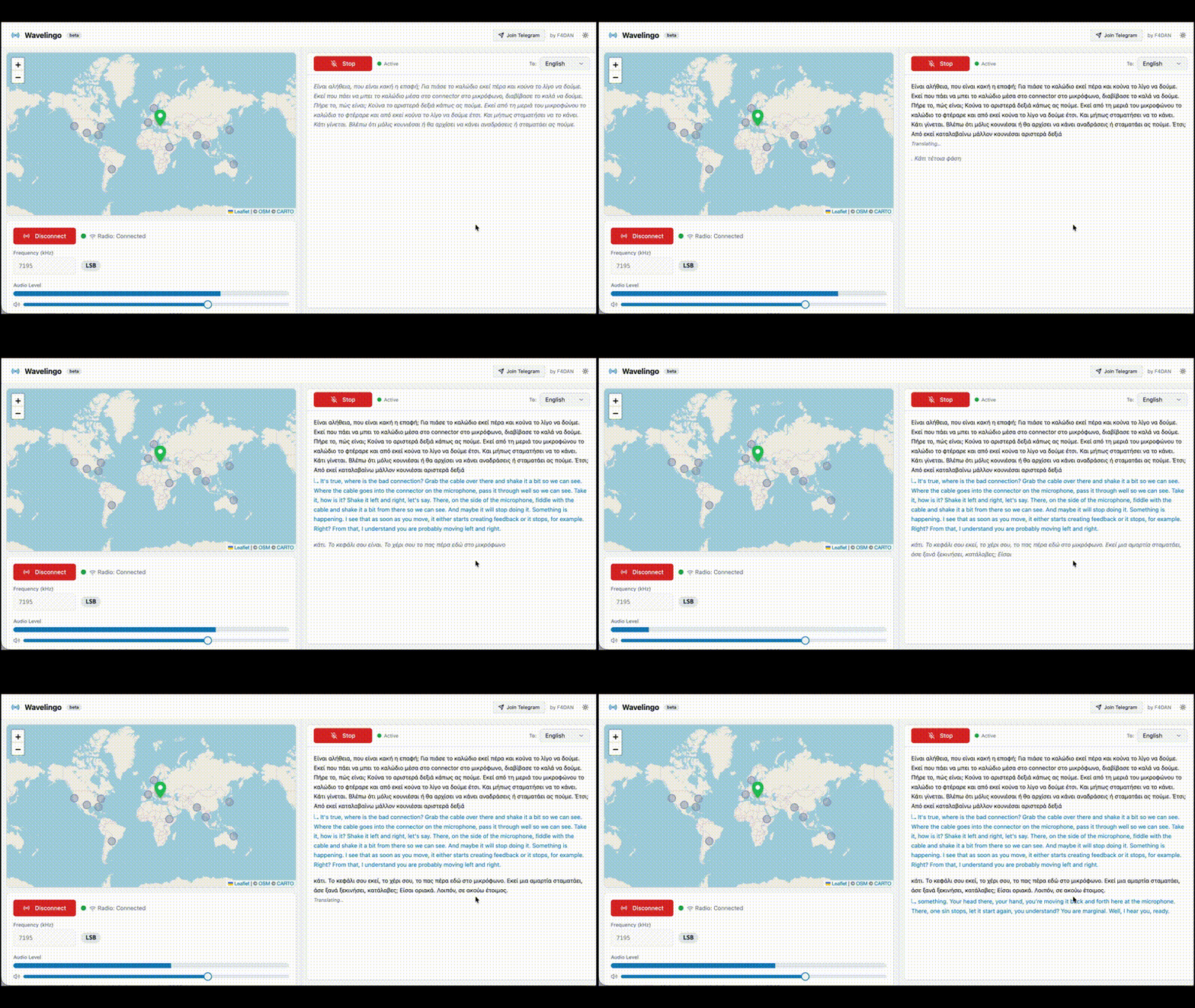
Thank you to Christophe (F4DAN) for writing in about his new project called Wavelingo, an AI real-time shortwave radio translator. The software currently works with the KiwiSDR web SDR network. Christophe has a live public example running at wavelingo.app, however, with a 60-second timeout due to hosting cost constraints. Christophe writes:
Are you listening to a QSO in a foreign language on your transceiver? Click on the closest SDR (KiwiSDR fleet for now, more SDR to come in the future), and get real-time translations.
I opened a telegram channel to share updates and feedbacks on this projects - and provide support.
Thank you to Trevor Unland for submitting his AI machine learning project called "RTL-ML" which automatically recognizes and classifies eight different signal types on low-power ARM processors running an RTL-SDR.
Trevor's blog post explains the machine learning architecture in detail, the accuracy he obtained, and how to try it yourself. If you try it for yourself, you can either run the pre-trained model or train your own model if you have sufficient training data.
RTL-ML is an open-source Python toolkit for automatic radio signal classification using machine learning. It runs on ARM single-board computers like the Raspberry Pi 5 or Indiedroid Nova paired with an RTL-SDR Blog V4, achieving 87.5% accuracy across 8 real-world signal types including ADS-B aircraft transponders, NOAA weather satellites, ISM sensors, FM broadcast, NOAA weather radio, pagers, and APRS.
The project provides a complete pipeline from signal capture to trained classifier. Unlike academic approaches that rely on synthetic data or expensive GPU hardware, RTL-ML uses real signals captured from actual antennas and runs entirely on edge hardware with no cloud dependency. The Random Forest model is 186KB and processes signals in around 120ms on a Pi 5.
The GitHub repository includes the full capture and training scripts, a pre-trained model, 8 validated spectrograms, and documentation for adding new signal types. It works out of the box on both Raspberry Pi 5 and Indiedroid Nova with identical code and accuracy.
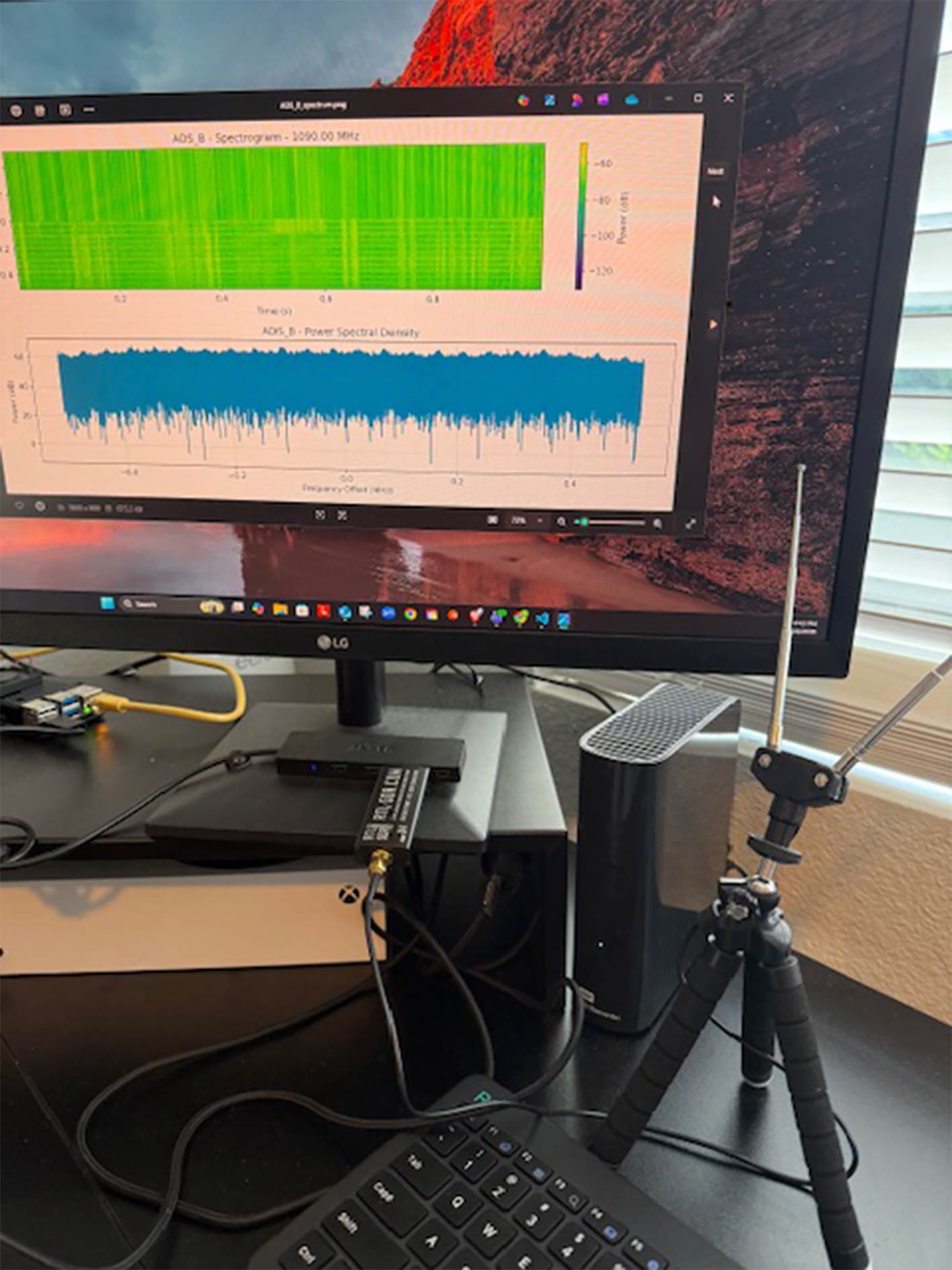
RTL-ML Setup: RTL-SDR Blog V4, Dipole Antenna and Indiedroid Nova ARM Computer.
Thank you to Edwin Temporal for writing in and showing how his proprietary neuromorphic engine, GhostHunter (Anti-LIF), is being used to recover satellite data buried in the noise floor, which typical DSP methods would fail to do.
To recover the signals, Edwin uses trained Spiking Neural Networks (SNN). SNNs are artificial neural networks that draw further inspiration from nature by incorporating the 'spiking' on/off behavior of real neurons. Edwin writes:
My engine has successfully extracted and decoded structured data from high-complexity targets by mimicking biological signal processing:
Technosat: Successful decoding of GFSK modulations under extreme frequency drift and low SNR conditions.
MIT RF-Challenge: Advanced recovery of QPSK signals where traditional digital signal processing (DSP) often fails to maintain synchronization.
These missions are fully documented in the https://temporaledwin58-creator.github.io/ghosthunter-database/, which serves as a public ledger for my signal recovery operations. Furthermore, the underlying Anti-LIF architecture is academically backed by my publication on TechRxiv, proving its efficiency in processing signals buried deep within the noise floor.
Although the engine remains proprietary, I provide comprehensive statistical reports and validation metrics for each mission. I believe your audience would be thrilled to see how Neuromorphic AI (SNN) is solving real-world SIGINT challenges.
In the database, Edwin shows how his Anti-LIF system has recovered CW Morse code telemetry and QPSK data from noisy satellite signals.
While Edwin's Anti-LIF is proprietary, he is offering proof of concept decoding. If you have a 250MB or less IQ/SigMF/Wav recording of a signal that is buried in the noise floor, you can submit it to him via his website, and he will run Anti-LIF on it for analysis.
Advanced readers interested in AI/neural network techniques for signal recovery can also check out his white paper on TechRxiv, where he shows signal recovery from signals buried in WiFi noise, as well as results from use in ECG and Healthcare applications.
An Example Signal Recovery with the Anti-LIF Spiking Neural Network
Over in our new forums, user Nite has shared a new open-source project that he's created called RadioTranscriber, a real-time speech-to-text tool for public safety radio feeds using OpenAI’s Whisper large-v3 model. The idea is to take live scanner audio, such as authenticated streams from Broadcastify, and continuously turn it into readable text with minimal babysitting. The project grew out of earlier experiments with Radio Transcriptor, which we posted about back in June, but quickly evolved into a more robust, long-running setup with better audio conditioning and fewer of Whisper’s common hallucinations.
Under the hood, RadioTranscriber is a Python script that pulls in a live stream, cleans it up with filtering, normalization, and WebRTC VAD, then runs Whisper large-v3 with beam search for transcription. A set of custom “hallucination guards” strips out common junk text and replaces alert tones with simple markers, while daily log rotation and basic memory management let it run unattended for long periods, even on a modest CPU-only machine. Although it’s tuned to the author’s local dispatch style, the config and prompt are easy to adapt, and the full code is available on GitHub for anyone who wants to experiment or build on it.
Lutz's blog post first describes and shows his RTL-SDR GOES reception setup. Then, it explains how he used Edge Impulse on his Raspberry Pi 4 to create an AI model that automatically detects the clouds in the image.
The process begins by importing 100 images into Edge Impulse, manually labelling the clouds in each image, training the model, and testing it. The result was an average detection accuracy of 90%.