Tagged: propagation

NightDX: Automated Overnight Shortwave DX Listening with an Airspy HF+

Thank you to Marco Zennaro for writing in and sharing NightDX, a free terminal app for macOS, Windows and Linux that lets an Airspy HF+ do your overnight shortwave listening for you. The menu interface is deliberately styled like early-90s DOS software.

NightDX pulls the EiBi, AOKI and HFCC broadcast schedules, plus live solar flux and Kp from NOAA. A propagation model then predicts what should reach your location and calibrates itself against what your own radio hears. The HF+ sweeps all the bands in about 10 seconds to see which carriers are really there, and overnight NightDX records the best stations, putting ones you've never logged first.

Optional AI features can then label each recording as speech, music, or noise using an AudioSet classifier, and transcribe and translate it with OpenAI's Whisper, which helps when writing reception reports. In the morning, a browser report shows the recordings with audio players, one-click reception reports drafted in Gmail, and a QSL card log.

We note that NightDX doesn't claim to identify stations. It shows schedule names as candidates and flags recordings where the evidence doesn't fit, such as the wrong language or a signal far too strong for the predicted path. Only the Airspy HF+ (Discovery or Dual Port) is supported for now, so there is no RTL-SDR support. Marco notes that other SDRs such as the Perseus and Elad are being looked into. The code is open-source under the MIT license and available on GitHub.
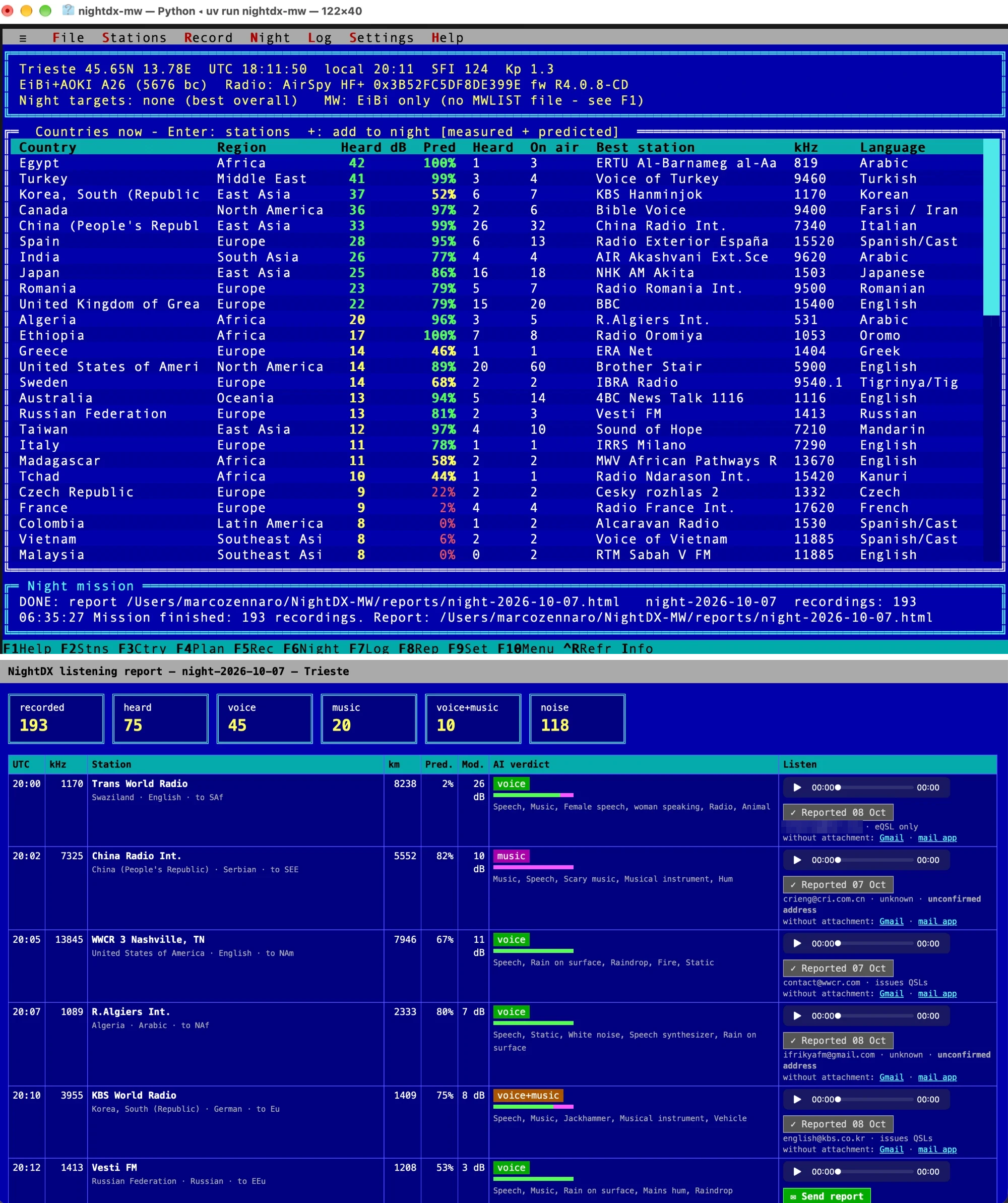
NightDX Screenshots
NightDX Screenshots

AI Disclaimer: Marco notes that NightDX was built with the help of Claude.

SimTX: A Multiplayer Shortwave Radio Simulator with Realistic Propagation and rtl_tcp Support

Recently, we came across SimTX, an open-beta multiplayer shortwave radio simulator. Everyone shares the same simulated band, so whatever one user transmits from their virtual station can be picked up by anyone else, simulated propagation permitting. The website suggests running a pirate station, making your own numbers station, or just tuning around and listening.

For realism, the ionosphere is based on IRI-2020 climatology with live ionosonde data assimilated on top, groundwave and noise follow ITU-R models, and every link passes through a Watterson fading channel with Doppler, multipath and storms. Users can transmit from a mic, an audio file or raw IQ from GNU Radio in modes including AM, SSB, CW, NFM, WFM, WSPR and FT8, and can even launch and track their own satellites.

To receive, the SimTX app runs a local rtl_tcp bridge, so SDR++ or any other rtl_tcp-capable SDR program can tune the simulated band as if it were an RTL-SDR, without any real radio hardware. The app runs on Windows, macOS, and Linux, and accounts are created via Discord. The software does not appear to be open source. The demo video below shows a song broadcast from a simulated Amsterdam and received 1145 km away in Budapest.

This may be useful for playing around with and seeing what different TX/RX variables and propagation effects do to signal reception.

We broadcast a song through a simulated ionosphere

Claude VOACAP Skill: Ask Claude About Live Ionospheric Propagation Predictions to Optimize DX

Thank you to Reid Crowe for submitting his project, "voacap-skill." This skill for Claude Code AI (a frontier LLM) lets Claude access and use the latest VOACAP ionospheric propagation data in conversations.

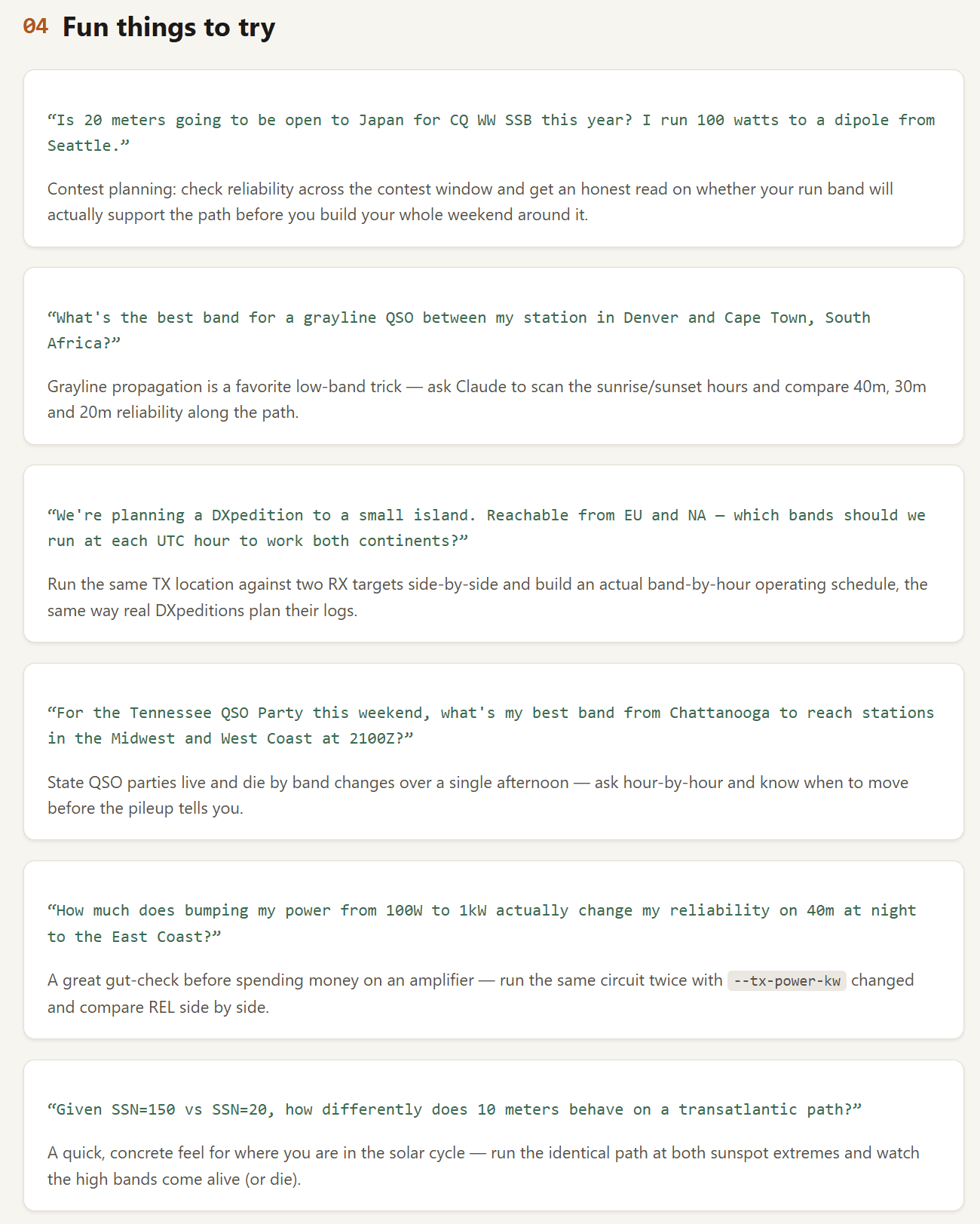
Instead of manually filling out a form for each prediction and analyzing the results yourself, with the voacap-skill, users can ask Claude questions like, "What's the best band to reach Tokyo from Columbus, Ohio around 0300Z in October?" and Claude will run a VOACAP prediction in the background and return an answer. Reid explains:

If you've ever used VOACAP, VOACAP Online, or watched a contest DXpedition plan its band schedule, you already know the engine underneath this: it's the same NTIA/ITS point-to-point HF prediction model that's been the industry standard for propagation forecasting since the 1980s. It takes a transmitter location, a receiver location, a month, and a sunspot number, and tells you — for every hour of the day and every frequency you care about — how reliable that circuit is likely to be.

voacap-skill takes that engine (via voacapl, the modern Linux/GFortran port, on macOS/Linux, or the native NTIA/ITS Windows engine on Windows) and wires it into Claude Code as a "skill" — a capability Claude can reach for on its own.

The skill is free and open-source, with the code available on GitHub. Below, Reid provides some more examples of what you can ask Claude once it has access to VOACAP data.