Tagged: ESP32-S3

WaveSentry: Detecting Drone Signals with a HackRF, a Neural Network and an ESP32 Handheld

Thank you to Minsu (Gabriel) Kim for writing in and sharing WaveSentry, a drone RF detection prototype built with teammates Hyeongjun Kim and Junghwan Kim for D4D, a defense hackathon in South Korea. Their project uses a HackRF to feed I/Q samples to a Windows app, which converts them into spectrograms and uses a YOLO model to spot drone signal patterns. YOLO ("You Only Look Once") is a popular family of fast neural network models for detecting objects in images, and here it treats drone transmissions in the spectrogram as objects to find and draw boxes around. An "RF Observatory" view shows the spectrum, waterfall, and detections, and alerts can be sent to "Halo", an ESP32-S3 handheld with a circular LVGL display.

In their write-up on LinkedIn, the team explains that their first model, trained on synthetic backgrounds, raised alerts on recordings made with the drone switched off. They fixed this by recording real background I/Q with the HackRF and inserting segments of recorded drone signals into it to generate labeled training data. Minsu also notes that on November 14 they recorded the drone link on the platform and aboard a crowded train at Suwon Station, a busy rail station full of Wi-Fi and Bluetooth traffic, and they are now preparing a paper on the work.

We note that WaveSentry is still a prototype. The RF detection and the handheld alerts were tested separately, and alert latency and false alarm rates over the full path from receiver to handheld have yet to be measured.
The Wavesentry UI detecting an RF drone signature

esp32-sdr-trx: Use an ESP32-S3 as a Receiver for SDR++ and as an FM/SSB Voice Transmitter on 13cm

Thank you to Jochen (DA2JH) for writing in and sharing with us his project, esp32-sdr-trx,  a software-defined transceiver built from a single ESP32-S3 dev board and two USB cables.

esp32-sdr-trx uses the same undocumented I/Q dump that we posted about previously, which was first discovered by h0m3us3r. To be able to get the data off the ESP32 and into the PC via the ESP32's limited USB streaming bandwidth, it is necessary to decimate the IQ data oln the chip down to 250 or 333 ksps. Then to keep things simple, the espdr-rx tool presents itself as an rtl_tcp server, allowing any RTL-SDR compatible software like SDR++ and GNU Radio to receive data within 1.84 to 2.79 GHz.

On the transmit side, the espdr-tx tool is used to transmit narrowband FM or SSB voice in the 13cm amateur band via a WAV file, audio pipe or sound card. Jochen notes that the ESP32 has no I/Q input so the PHY's test-tone carrier is steered in frequency and amplitude 40,000 times a second (polar modulation).

Jochem notes that there are several limitations to be aware of with this software and hardware "one board and one Linux host tested; the transmitter's power is not calibrated and its harmonics were not measured; transmitting needs an amateur radio licence (the tool asks for confirmation, and the firmware only sends in 2320 to 2450 MHz)".

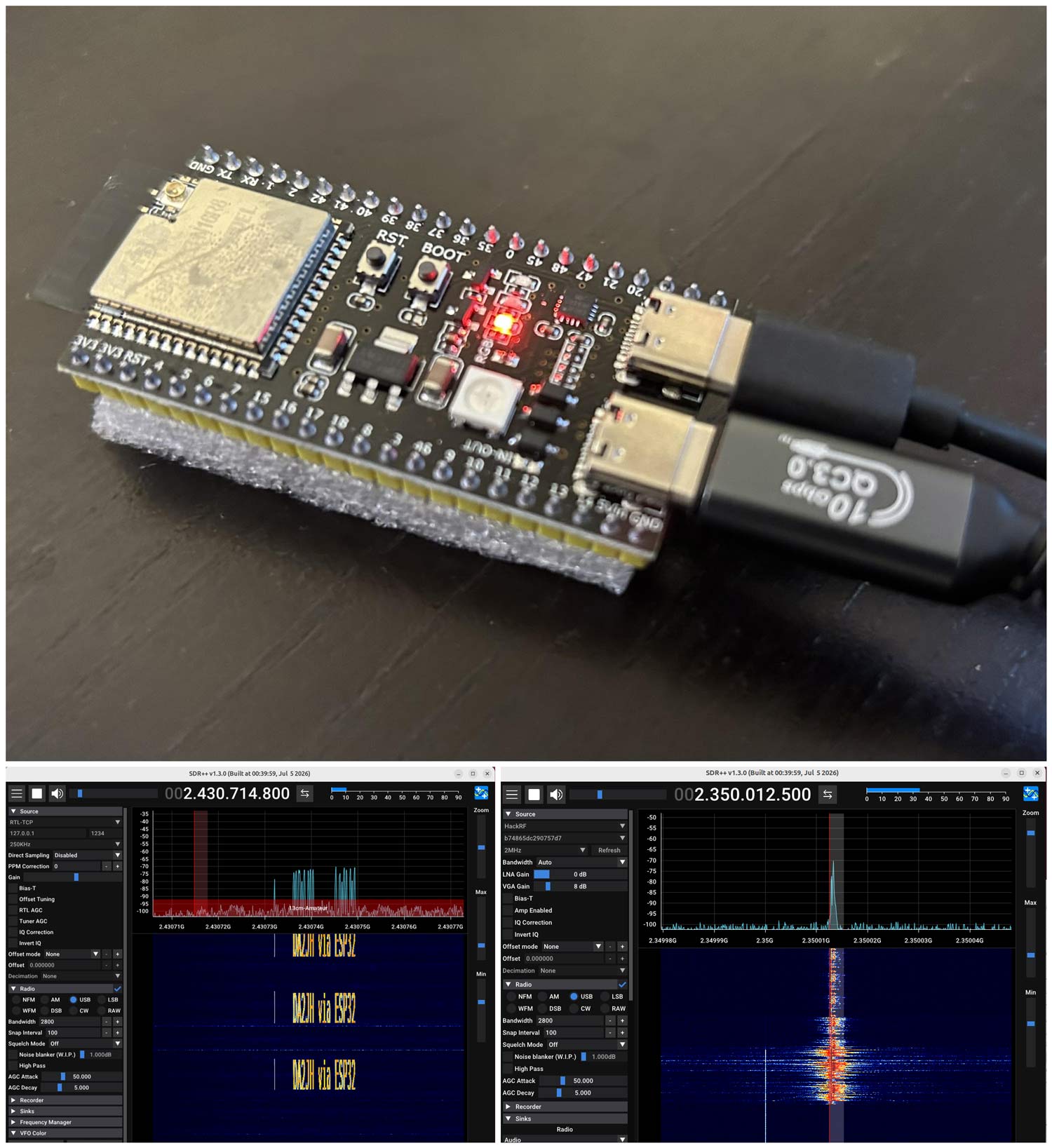
The ESP32-S3 (Top) |  SDR++ receiving a PlutoSDR through the ESP32 (Left) | SDR++ receiving SSB voice transmitted by the ESP32 with a HackRF. (Right)
The ESP32-S3 (Top) | SDR++ receiving a PlutoSDR through the ESP32 (Left) | SDR++ receiving SSB voice transmitted by the ESP32 with a HackRF (Right)

AI Disclaimer: Jochen notes that much of the code and documentation for this project was written with Claude.

GridDown Secure Messenger: Using an SX1262 LoRa Radio as a Drone Scanner and Secure Messenger

Back in March, we posted about GridDown, an open-source Android tablet-based situational awareness system designed to operate without an internet connection, which uses sensors such as an RTL-SDR, a SARSAT receiver and an ESP32-S3/SX1262 LoRa radio.

Recently, GridDown developer Cameron wrote in again and shared with us that the LoRa firmware for GridDown has now been released as an open-source project called "GridDown Secure Messenger" (main website).

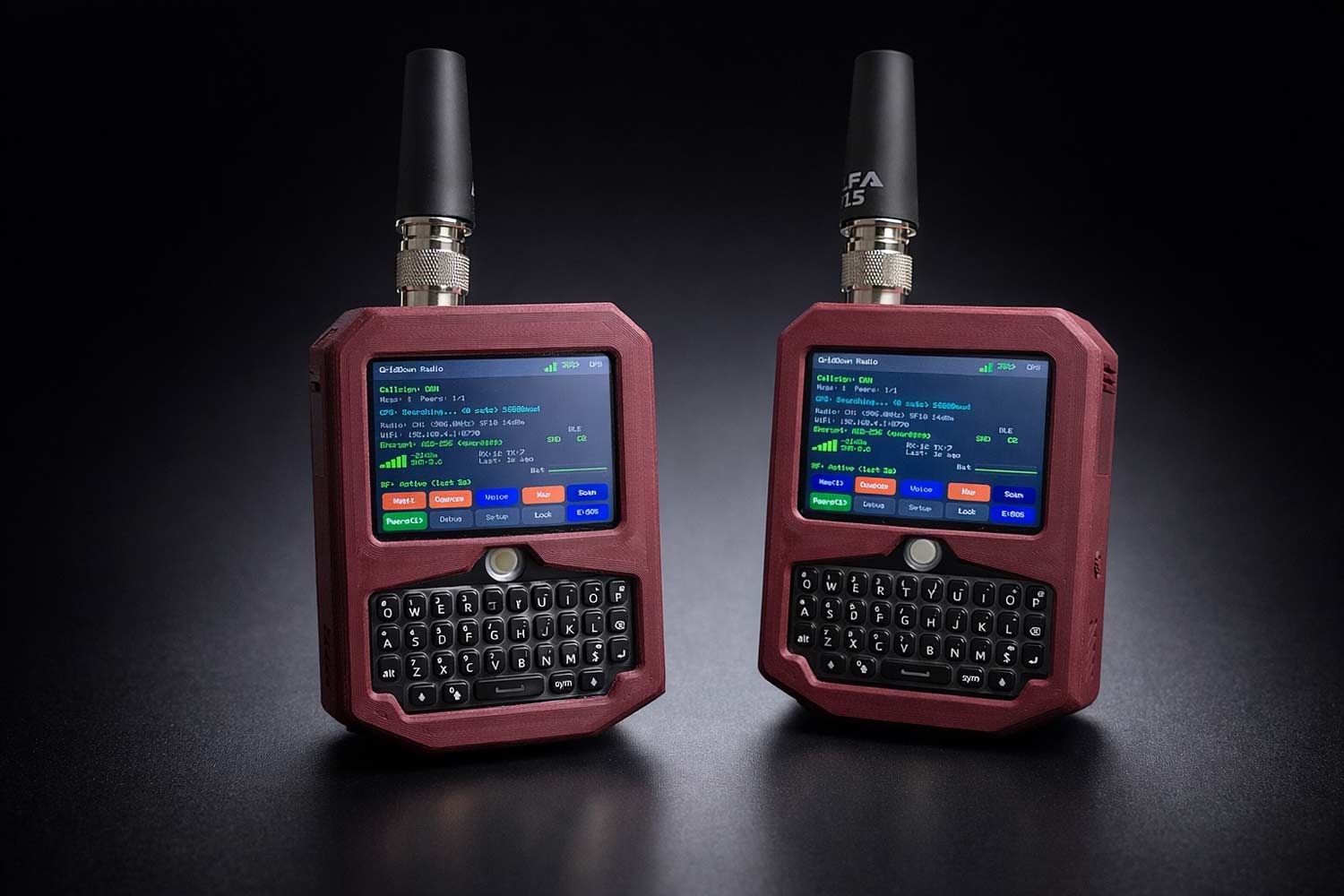
The project uses a LILYGO T-Deck CYPHER-M8K (an ESP32-S3 with SX1262, 2.8" display, keyboard, and GPS) to implement secure, encrypted off-grid text messaging, and it also doubles as a 900 MHz drone scanner, with the ability to decode drone Remote ID.

Cameron has also provided two YouTube shorts [1] [2], showing the firmware in action.

Example Renders of the GridDown Secure Messenger Running on a LILYGO T-Deck CYPHER-M8K.

AI Disclaimer: The renders appear to have been AI-generated.