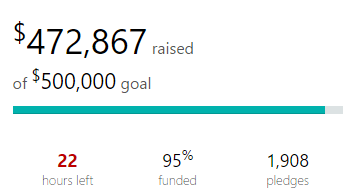
The LimeSDR crowdfunding campaign is now in it’s final few hours (22 hours left at the time of this post), and funding is up to 95% or 473k out of its 500k goal. After a few unsure days it looks like the goal will be reached just in time. The LimeSDR is a RX/TX capable SDR with a 100 kHz – 3.8 GHz frequency range, 12-bit ADC and 61.44 MHz bandwidth. We’re not affiliated with LimeSDR in any way, but we think it is shaping up to be a much better version of the RX/TX experimenter radios that are on the market now, such as the HackRF and bladeRF. For a price lower than the HackRF you get a much better ADC, a larger bandwidth and full duplex TX/RX capabilities. The LimeSDR capabilities appear to be close to the Ettus Research B210, which usually sells for over $1000 USD. Also, one of the drawbacks of radios like the HackRF and bladeRF was the lack of decent ready to go software apps. LimeSDR have made promises to focus hard on developing a software “app” store for the device meaning that application software will be able to be downloaded very easily, not to mention that all their software and hardware is fully open source.
During the crowdfunding campaign the LimeSDR is available for an early bird price of $249 USD. After the campaign the price will be raised to $289 USD for preorders, and $299 USD once the device actually begins shipping.
In a recent update they show the LimeSDR being used to receive GPS satellites and decode the data in GNU Octave and also mention that the app store development will begin once crowdfunding is successful.
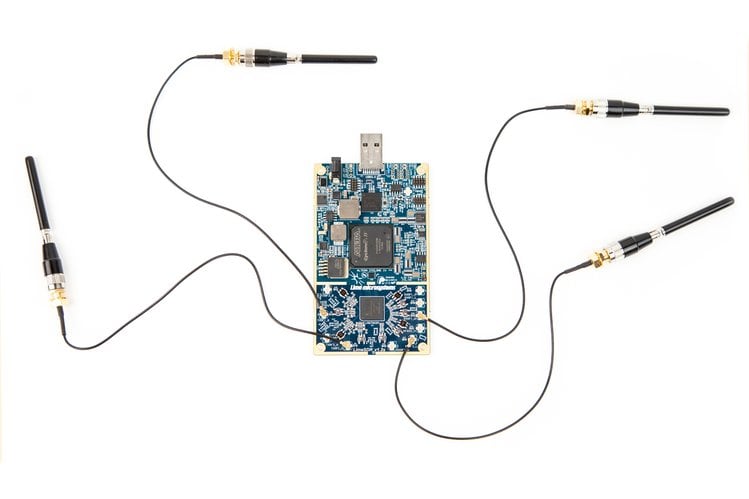
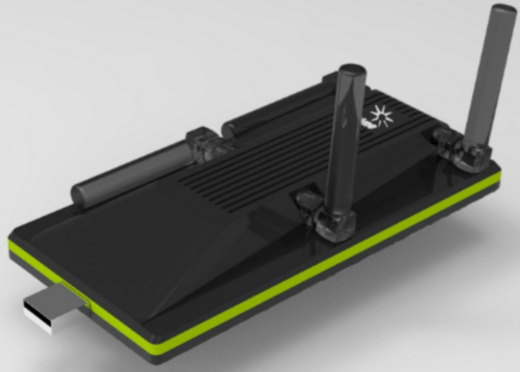
The LimeSDR with four antennas attached.LimeSDR Goal Almost Reached.
The LimeSDR is a new transmit capable software defined radio with a 100 kHz – 3.8 GHz frequency range, 12-bit ADC and 61.44 MHz bandwidth which is currently seeking crowdfunding. At the time of this post there is about four days left to reach the $500k goal, and it is only 80% funded. To try and reach their funding goal they have released another batch of discounted units which cost only $249 USD. After the crowd funding campaign the price will rise to $289/$299 USD. If the LimeSDR is not funded in time, they write that the project will unfortunately be put on hold and it’s future may be uncertain. We believe that this product is shaping up to be a very good TX/RX capable SDR, like the HackRF and bladeRF, but much better overall and for the same or even lower price.
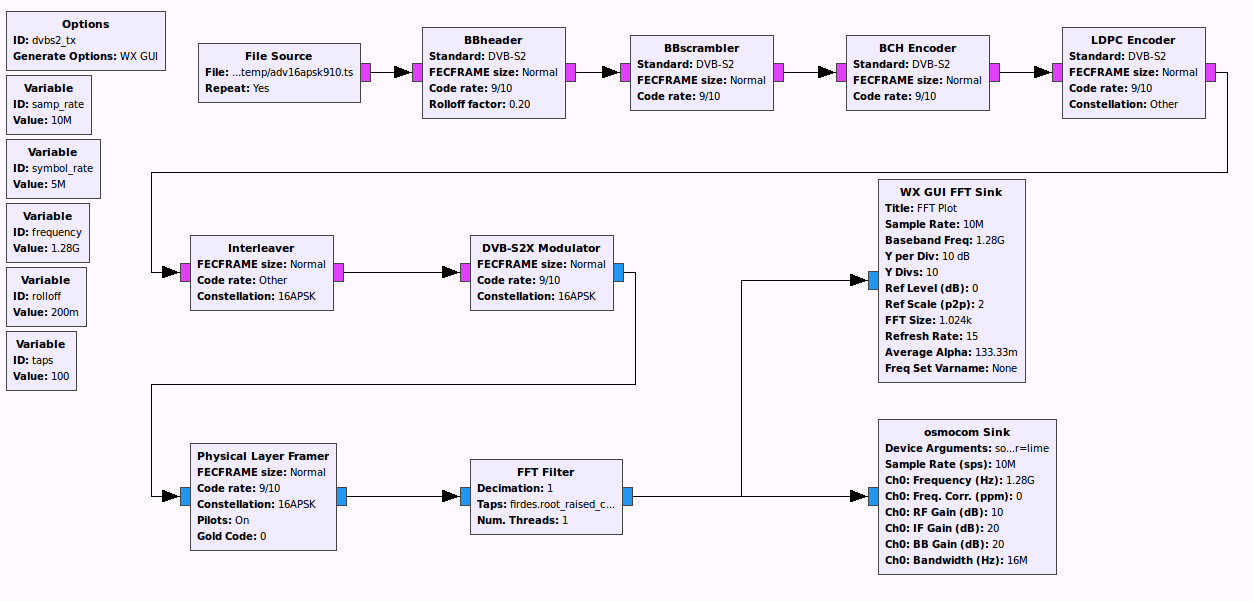
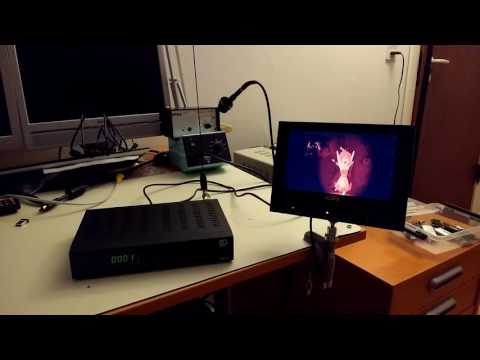
Recently they also released some new updates that show off some LimeSDR features. In a post previously featured on our blog beta tester Alexandru showed how he was able to get the LimeSDR to transmit DVB-S2 HDTV. In later updates they showed how the LimeSDR can be used to:
Control LoRa based IoT devices. In this post they used the LimeSDR to demonstrate how it can be used to transmit to, receive and simulate IoT devices running the popular LoRa wireless protocol
Create a 10 MHz LTE cellular site. In this post they also show a mobile phone connecting to the cell site and using LTE mobile internet at 20MSPS.
Create a Vector Network Analyzer. With the help of a directional coupler the LimeSDR can also be turned into a Vector Network Analyzer to measure parameters such as gain, insertion loss, return loss and VSWR.
Build a remote radio head. By mounting the LimeSDR near the antenna and streaming the data back over an IP link, coax feed losses can be eliminated.
The LimeSDR is a $299 USD software defined radio that has RX and TX capabilities, a tuning range of 100 kHz – 3.8 GHz, a 12 bit ADC and up to 61.44 MHz worth of bandwidth. It is currently seeking crowdfunding over at CrowdSupply.com, and there are still 170 early bird units available at a lower price of $249 USD. The funding campaign ends in 14 days at the time of this post.
In the HF region between about 0 – 30 MHz it is common to see and hear “chripers” – signals which quickly sweep through the HF frequency band and produce an audible chirp. These chirps are actually signals from Ionosondes which is a type of radar system used to monitor the Ionosphere. The Ionosphere exists about 50km above the surface of the earth and is the atmospheric layer responsible for a large part of long range HF communications. In a previous post by Mario Filippi we also discussed Ionosondes.
Usually it is scientists who transmit and monitor these Ionosondes, however if you have wide band radio that can cover a majority of the HF spectrum then you can also monitor these chirpers yourself. Over on his blog Fabrizio Francione has created a post showing how to use a USRP, together with a GNU Radio Program called GNU Chirp Sounder to create his own amateur Ionogram monitoring station. The USRP is a fairly expensive SDR with a bandwidth of 25 MHz, but we add that we think that next generation of low cost wide band SDRs like the up and coming LimeSDR should also be able to do the same job.
The Ionograms show at what frequencies HF propagation is currently optimal for a specific distance (or number of signal bounces from the Ionosphere). Below is an example Ionogram animation showing the reception of Ionosondes taken over time. Video from the GNU Chirp Sounder page.
The LimeSDR is a new SDR $299 USD currently seeking crowdfunding over on CrowdSupply. At the time of this post the LimeSDR is currently 60% funded, with 29 days left to go. The LimeSDR is a RX/TX capable device, with a 100 kHz – 3.8 GHz frequency range, 12-bit ADC and 61.44 MHz bandwidth. From the price and specs, we consider it to be a potential next generation HackRF type device which will have vastly improved RX performance.
Over on the MyriadRF blog, Alexandru Csete has received a demonstration unit, and has written about his first thoughts on the LimeSDR. Alexandru was able to easily set the device up by using SoapySDR and GQRX on Linux. He first did the “hello world” of SDR and was able to successfully receive broadcast FM signals. Next he tried to receive Amateur Satellite signals and was successful in receiving the FO-29 satellite. Finally he was also successful in receiving NOAA weather satellite images.
From a quick judge of the waterfall images it looks as though the LimeSDR has a very clean spectrum with a low noise floor, which looks good for RX. In future posts Alexandru hopes to test out the transmit capabilties of the LimeSDR, as well as its shortwave RX performance.
The LimeSDR is a new transmit capable software defined radio with a 100 kHz – 3.8 GHz frequency range, 12-bit ADC and 61.44 MHz bandwidth which is currently seeking crowdfunding.
A few days ago the LimeSDR crowdfunding campaign went live, and within the first 32 hours all 500 of the $199 USD discounted early bird LimeSDR’s were grabbed up. Since then the crowfunding momentum has unfortunately slowed considerably. However, in an attempt to possibly revitalise the campaign LimeSDR has released a second batch of early bird units which are selling for the $50 discounted price $249 USD. They also write that people who already backed at the higher regular price of $299 USD have automatically been converted to the $249 USD price. At the time of this post there are still 427 early bird units remaining.
We think the LimeSDR has the potential to be a significantly better version of the HackRF and bladeRF which would sell for the same price or even less in the future, so please consider backing the project if an SDR like this interests you.
Their press release reads:
First, a big thank you to all our backers. With your support, we hit 20% of our campaign target in just over 24 hours and all 500 of the first flock of early bird boards were pledged within 32 hours. This is phenomenal! We have been blown away by the support and excitement from you, our community. Thank you!
Our mission is to democratise wireless innovation. Anybody should have access to this technology and be able to create innovative, game changing solutions. The level of support we have received from all of you has gone a long way to reassure us that we have made a great start in achieving our mission.
We are now confident that the LimeSDR campaign can jump start this democratisation. When we successfully reach our target and have delivered on our commitment, the work doesn’t stop there either. We will continue to work on the LimeSDR platform to improve it, together with the help of the community.
We are also working with the key players in the wireless industry and have been partnering with innovators and organizations, including EE/British Telecom, who share our vision to bring the power of open source innovation to wireless communications in a way that has never been done before.
As a result of the early success of our campaign, we are gathering further support from our manufacturers and suppliers and are now able to offer new pledge levels, including an additional flock of 500 early bird LimeSDR boards boards at a reduced price of $249. This is a significant reduction from the retail price of $299. Those who have already signed up for the $299 LimeSDR will instead pay the reduced price – your order will be amended and an updated order confirmation email will be sent to you within the next 24 hours.
We have big announcements in the pipeline, and our plan is to send you regular updates throughout the campaign. These will include exciting partnerships and new pledge levels as we see the growth of our supporters. Stay tuned!
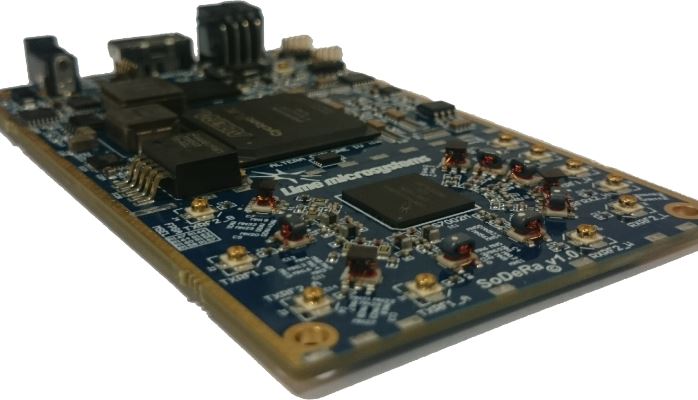
Previously we posted news about the upcoming release of SoDeRa/LimeSDR, a low cost 100 kHz – 3.8 GHz range RX/TX capable software defined radio. Due to copyright reasons SoDeRa have renamed the product to LimeSDR.
LimeSDR is a low cost, open source, apps-enabled (more on that later) software defined radio (SDR) platform that can be used to support just about any type of wireless communication standard. LimeSDR can send and receive UMTS, LTE, GSM, LoRa, Bluetooth, Zigbee, RFID, and Digital Broadcasting, to name but a few.
While most SDRs have remained in the domain of RF and protocol experts, LimeSDR is usable by anyone familiar with the idea of an app store – it’s the first SDR to integrate with Snappy Ubuntu Core. This means you can easily download new LimeSDR apps from developers around the world. If you’re a developer yourself, you can share and/or sell your LimeSDR apps through Snappy Ubuntu Core as well.
The LimeSDR platform gives students, inventors, and developers an intelligent and flexible device for manipulating wireless signals, so they can learn, experiment, and develop with freedom from limited functionality and expensive proprietary devices.
The price for a single board is $299 USD for regular backers, but there is an early bird price of $199 USD. At the time of this post there are still over 200 boards left to go at the lower price. There are also higher end options such that add turn-key support and acrylic and aluminium enclosures as well as a PCIe interface option.
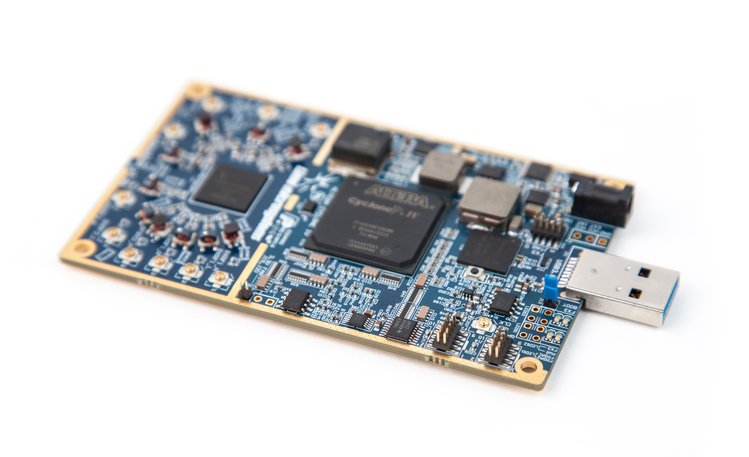
The LimeSDR can tune from 100 kHz – 3.8 GHz, can have a bandwidth of up to 61.44 MHz, uses a 12-bit ADC, has two transmit channels, two receive channels, is full duplex and comes with a 4 PPM stable oscillator. To achieve such a high bandwidth the board requires a USB 3.0 connection, and will likely require a modern PC to reach a high bandwidth. From its pricing and specs it looks like it can be thought of a next generation HackRF, or lower cost version of the high end Ettus SDR’s.
The people behind this SDR are currently marketing SoDeRa as “the Arduino of the Telecom and Radio Engineer”. It appears to be designed mainly to implement IoT and other radio communications protocols, but it also sounds like it could find excellent use in the hobby and amateur market as well as have benefits for the average person. Interestingly, the developers also plan to implement an app store which would allow you to essentially download a radio and instantly configure the SoDeRa SDR for any desired protocol or application. They write:
This is the first time that a revolutionary device for which we are organising a joint crowd-funding campaign with Lime Microsystems is made public. The #SoDeRa is the cheapest software defined radio you can buy. The #SoDeRa will have an app store and will be able to provide any type of (bi-directional) radio communication going from LTE, Lora, WiFi, GPS, Bluetooth, radar, radio-controlled toys/robots/drone, digital radio, digital TV to even MRI scanners, satellite and air traffic communications by just installing an app. The #SoDeRa is the Arduino of the Telecom and Radio Engineer.
The SoDeRa is powerful enough to be a full MiMo LTE base station with long range coverage, provided you add the right antenna. You can via apps put other wireless communication protocols like LoRaWAN, Bluetooth, Zigbee, Z-Wave, GPS, Galileo, Airspace protocols, radar, MRI scanning RF, TV/Radio, any toy/robot/drone control, White Space, etc. But most importantly because of its price and ease of adding more protocols, the SoDeRa will enable anybody to define competing wireless communication protocols and put them into Github. Developers don’t like closed standards like LTE or complex standards like Bluetooth & Zigbee. The future will allow developers to compete against corporations and standardization bodies if they think current standards can be improved upon. The Internet has shown that this dynamic brought us easier standards through adoption like JSON and Yaml vs XML and EDI. Wireless, RF and telecom engineers never had an Arduino like the electronics engineers. The SoDeRa will plug this hole.
Development on SoDeRa is working towards a trend in radio systems where all radio devices are software defined, allowing for futuristic features like advanced spectrum control and the ability to change protocols on the fly. They write:
Including #SoDeRa in any type of smart device will greatly reduce the cost of deploying a mobile base station network because by open sourcing the hardware design it will become commodity. By including software defined radio in lots of devices, often with a completely different purpose, will allow these devices to become a smart cell via installing an extra app. In the future, support for software defined radio will likely be embedded directly in Intel and ARM chips. The foundational steps are already happening. This will likely reshape the telecom industry. Not only from a cost perspective but also from a perspective of who runs the network. Telecom operators that don’t deliver value will see their monopoly positions being put in danger. As soon as spectrum can be licensed on a per hour basis, just like any other resource in the cloud, any type of ad-hoc network can be setup. The question is not if but when. Open sourcing and crowdfunding will make that “when” be sooner than later. Smart operators that align with the innovators will win because they will get the app revenue, enormous cost reductions, sell surplus spectrum by the hour and lots of innovation. Other operators that don’t move or try to stop it will be disrupted. What do you want to be?
At first glance SoDeRa sounds like it will be an expensive device, but on their official website they are currently running a survey asking people what they would be willing to pay, and the lowest price given is $50 – $99. This makes it seem likely that in the future with enough volume SoDeRa could be sold at very low cost and become very popular.
I am willing to pay for 1 unit
$50 – $99 (lead time 9 months)
$100 – $199 (lead time 6 months)
$200 – $299 (lead time 3 months)
$300 – $399 (lead time 2 months)
$400 – $500 (lead time 1 month)
It sounds like the team behind SoDeRa are gearing up for a crowd funding campaign so we will be keeping an eye on this SDR.
Thanks to RTL-SDR.com reader Serdar (TA3AS) for submitting news about SoDeRa to us.