Tagged: radio direction finding

Creating a Signal Strength Heatmap with an RTL-SDR

Over on Reddit, user tautology2 has linked to his project which is software that can create a heatmap of signal strengths. His software uses the data that is output from RTLSDR Scanner which is a program that will collect signal strength data over any desired bandwidth and at the same time also record GPS coordinates using an external GPS receiver. RTLSDR Scanner can also create a heatmap by itself, but tautology2’s heatmap is much clearer and has good web controls for choosing the heatmap signal frequency.

Tautology2 writes about his program:

Eartoearoak’s rtl-sdr scanner can save GPS location data along with spectrum samples, I had put USB GPS unit and SDR’s antenna on the top of my car, put my notebook with running scanner on the front seat and driven it around.

Then I saved results both as an image sequence (which you can see at the bottom of the map) and as the raw data in json format. My script (scan2web.rb[3] ) parses raw data, filters out redundant samples (which were captured standing at the traffic lights etc) and computes normalized spectrum power for eight 300-KHz bands for each spatial sample. Results are saved in heatmap.json[4] , which is rendered using Google maps v.3 heatmap API.

The Reddit thread discussing his project can be found here.

Tools used for making the heatmap: Laptop, RTL-SDR with stock antenna and a GPS.
Heatmap of GSM Signal Strengths

RTLSDR Scanner Now Supports GPS for Signal Strength Mapping

The RTLSDR scanner software has been updated and now supports connection to an external GPS receiver. With a GPS receiver attached to a laptop, the RTL-SDR can be used to make signal strength maps by driving around in a car and monitoring the radio spectrum with RTLSDR Scanner running. The signal strength map can then be viewed in Google Earth, a GIS program or any image viewer.

RTLSDR Scanner GPS Signal Strength Heatmap

Locating an Interfering Signal with Radio Direction Finding and the RTL-SDR

The people at the MIT Haystack Observatory discovered recently that someone was transmitting an interfering signal on their licensed radar band. The interferer was effectively jamming the radar, preventing them from carrying out any experiments.

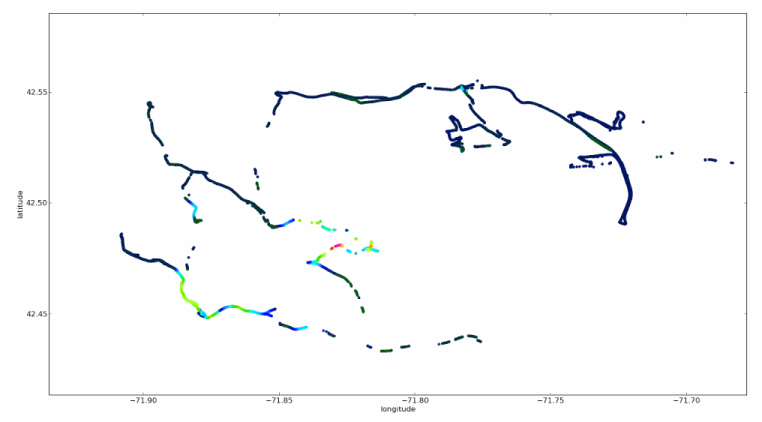
After checking for local causes of interference and finding nothing, they decided that the interferer must be coming from further away. To find the location of the jamming signal they did some radio direction finding. This involved driving around with Yagi and magnetic loop antennas and RTL-SDR and USRP N200 SDRs and then measuring the signal strength at various points.

For the software they used a custom GNURadio block which calculated the power spectra using the FFTW C library, and averaged the results to disk. They then post processed the data to calculated the RFI power, and correlated the data with GPS coordinates recorded on his phone.

After all the data was processed, they discovered that the interference originated from an FM radio tower which had a faulty FSK telemetry link. They notified the engineer responsible who then replaced the link and the interference disappeared.

RFI strength at various geographic locations