Tagged: Radiosonde

Turning an old Radiosonde into an Active L-Band Antenna

VK5QI's Radiosonde Collection

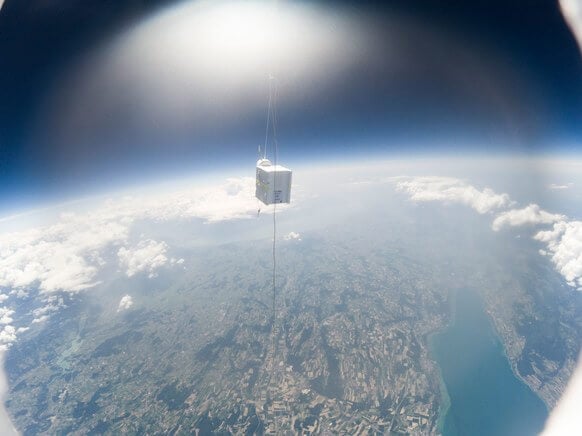
Over on his blog VK5QI has shown how he has was able to re-purpose an old radiosonde into a wideband active L-band antenna. Radiosondes are small packages sent up with weather balloons. They contains weather sensors, GPS and altitude meters and use an antenna and radio transmitter to transmit the telemetry data back down to a ground station. With a simple radio such as an RTL-SDR and the right software, these radiosondes can be tracked and the weather data downloaded in real time. Some hobbyists such as VK5QI go further and actually chase down the weather balloons and radiosondes as they return to earth, collecting the radiosonde as a prize.

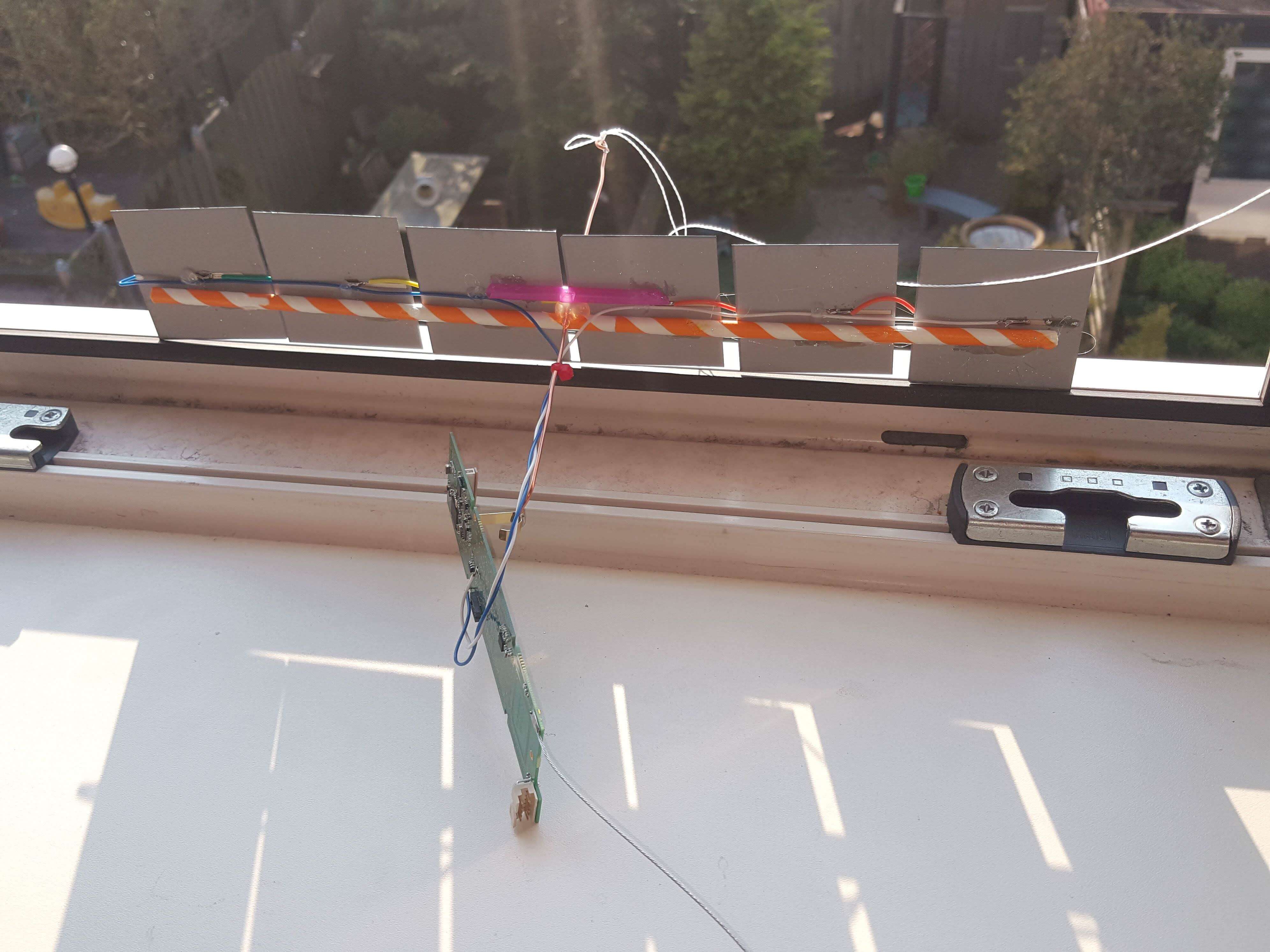
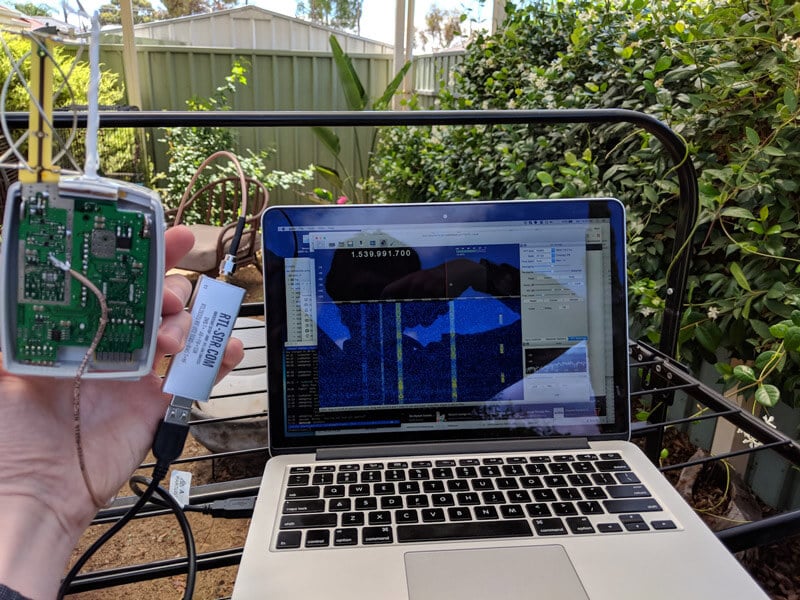
VK5QI and his friend Will decided to put some of his radiosonde collection to good use by modifying one of his RS92 radiosondes into a cheap active L-band antenna. They did this by first opening and removing unnecessary components that may interfere such as the main CPU, GPS receiver, 16 MHz oscillator, SAW filters and balun. They left the battery, LDO's, LNA's and Quadrifilar Helix GPS antenna which is tuned to the GPS L-band frequency. Finally they soldered on a coax connector to a tap point on the PCB and it was ready to use.

They then connected the new antenna to a RTL-SDR V3 and fired up GQRX. They write that their results were quite promising with several Inmarsat and Iridium signals being visible in the spectrum. VK5QI also used gr-iridium with the antenna as was able to decode some Iridium signals.

Modified Radiosonde L-Band Antenna connected to a RTL-SDR V3.

NOAA using the SDRplay RSP2 and RTL-SDR for Receiving Weather Balloon Data

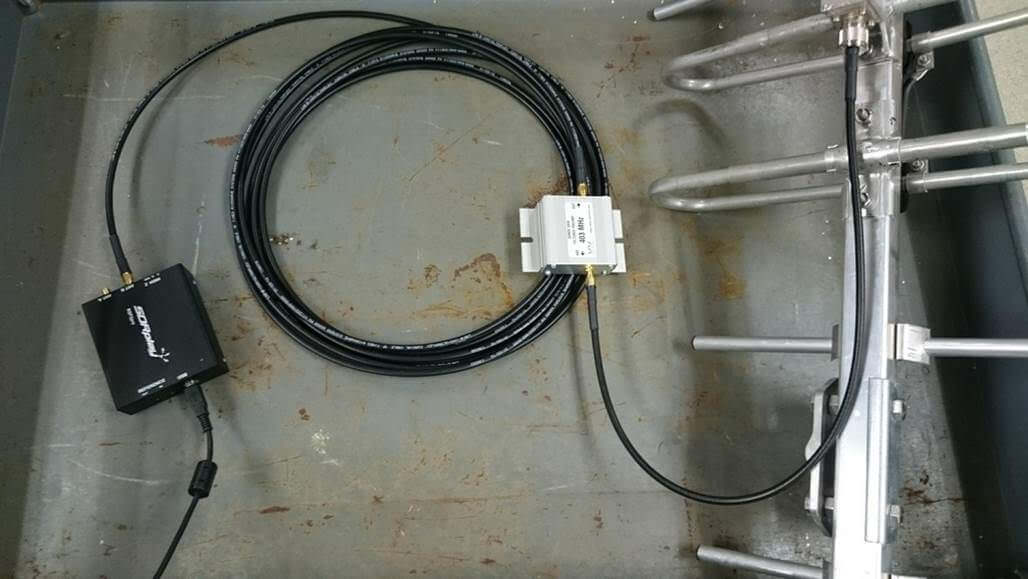
NOAA RSP2 setup for Receiving Radiosonde Data

Over on the SDRplay forums there has been a post by a NOAA engineer showing how they are using SDRplay RSP2 units in the field for tracking their radiosonde weather balloons. A radiosonde is a small sensor package and transmitter that is carried high into the atmosphere by a weather balloon. It gathers weather data whilst transmitting the data live back down to a base stations. You can get data such as temperature, pressure, humidity, altitude and GPS location.

Bobasaurus' coworker launching a weather balloon.

The NOAA engineer on the forum (handle 'bobasaurus') wrote SkySonde, which is the software used by NOAA to decode and plot data from the radiosondes. SkySonde is freely available for public download on the NOAA website. A PDF file showing how to use the SkySonde software with an RSP2 or RTL-SDR can be found here, and the full SkySonde manual is available here. The software consists of a client and server, with the server connecting to the RSP2 or RTL-SDR, and then sending data to the client. Both server and client can run on the same PC.

The hardware setup consists of an RSP2 (can be interchanged with an RTL-SDR), an Uputronics Radiosonde Filtered preamp and a Yagi antenna. Presumably a Yagi and LNA is not completely required, although the receivable range will be less. The RSP2 bias tee is used to power the preamp, and on a V3 RTL-SDR the bias tee should also work.

NOAA appears to use the iMet brand of radiosondes which transmit a Bell 202 signal. Bobasaurus writes that they transmit in the 401-405 MHz range. This video shows an example of such a signal. If you are in the US near an area that launches these iMet weather balloons you should be able to receive them. An alternative piece of software that supports iMet radiosondes is RS. For other radiosondes we have a tutorial that uses SondeMonitor available here.

SkySonde Radiosonde Software

Radiosonde Decoding

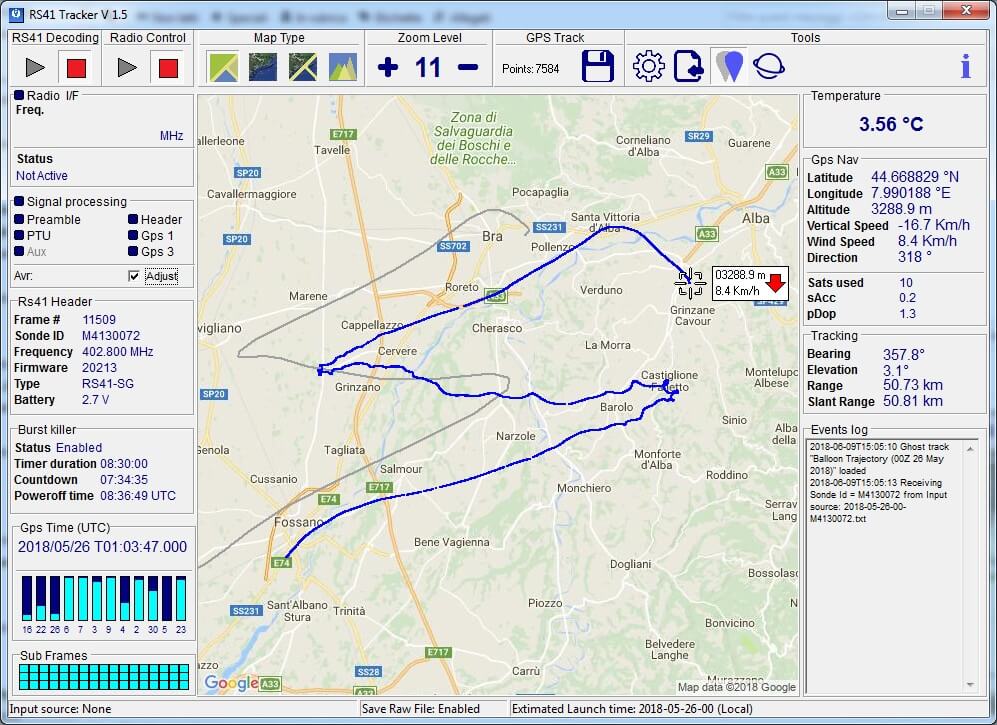
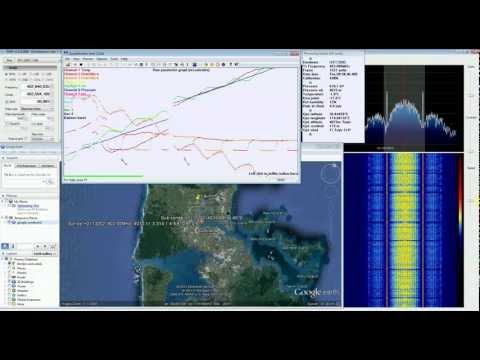
Over on his blog, nerdsville has posted about his experiences with decoding Radiosondes, a.k.a Meteorological Weather Balloons using his Funcube Dongle, which is an SDR with similar capabilities to the RTL-SDR. Using a program called SondeMonitor he was able to produce graphs balloon sensor data such as temperature, pressure, humidity and altitude.

If you are interested in decoding this type of thing we also have a tutorial on this topic available on our site.

SondeMonitor Graphs
SondeMonitor Graphs

RTL-SDR Tutorial: Receiving Weather Balloon (Radiosonde) Data with RTL-SDR

Around the world meteorological weather balloons are launched twice daily, and continuously transit weather telemetry to a ground station using something called a radiosonde. The RTL-SDR software defined radio combined with a decoding program can be used to intercept this telemetry, and display it on your own computer. You will be able to see real time graphs and data of air temperature, humidity, pressure as well as the location and height of the balloon as it makes it's ascent.

Note that if you are in the USA, then this tutorial may not be applicable for you as different radiosondes are used. Instead have a look at this post which shows how to use the SkySonde software from NOAA. You can also try an alternative command line based decoder called RS available on GitHub.

This tutorial is also applicable to other software defined radios such as the Funcube dongle, Airspy, HackRF, BladeRF or even hardware radios with discriminator taps, but the RTL-SDR is the cheapest option that will work.

Examples

In this example YouTube user Superphish shows a radiosonde being received and decoded using a RTL-SDR, SDRSharp and SondeMonitor.

Weather Balloon (Radiosonde) tracking with RTL SDR (RTL2832), Sondemonitor and SDR Sharp

Continue reading