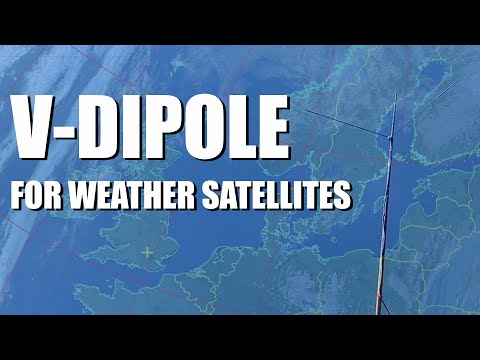
A new video showing how to build a V-dipole for weather satellite reception has been uploaded over on the Tech Minds YouTube channel. A V-dipole isa dipole antenna arranged in a 120 degrees "vee" shape, and mounted horizontally. It was first popularized by Adam 9A4QV who realized that such a simple antenna would work well for low earth orbit satellites like the NOAA and Meteor weather sats.
The video shows how to use some steel rods, a plastic pipe and terminal block to build the v-dipole. After building and mounting the antenna in the required North-South orientation he shows how he's using Gpredict with SDR# and WxToImg to decode the NOAA satellite image.
How To Build A V Dipole For Receiving Weather Satellites
Over on YouTube the "Ham Radio Crash Course" channel has uploaded a new video showing how to receive APT images from NOAA weather satellites. There are many tutorials (such as ours here) and videos on this topic already, but more cannot hurt, and this one makes specific reference to how to download the WXtoIMG software now that the official website has been abandoned.
In the tutorial he uses an SDRplay with SDRuno as the receiver software, VBCable as the audio piping software, and WXtoIMG as the decoding software.
How To Receive Images Directly From NOAA Satellites
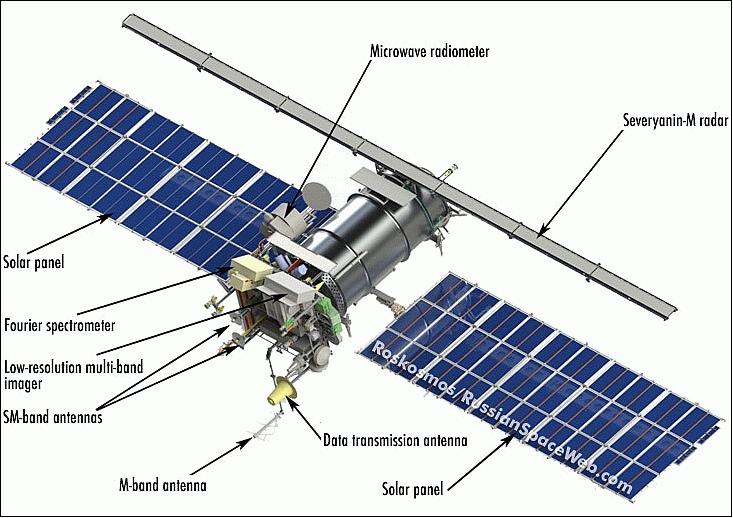
In late December 2019 we posted about Russian weather satellite Meteor M N2-2 which had unfortunately been struck by a micro-meteorite on Dec 18, causing it to lose control and go offline. Meteor M N2 and N2-2 satellites are often monitored with RTL-SDR dongles as it is relatively simple to receive their LRPT signal at 137 MHz which contains a high resolution weather satellite image.
Recently Happysat updated his Meteor M status page, noting that Meteor M N2-2 has been partially recovered, but due to low power it can no longer transmit a 137 MHz LRPT signal ever again. However, the L and X-bands are transmitting while the satellite is in daylight. Happysat writes:
January 2020 There will be only short-term power-ups in the radio visibility zone, and the battery life will be reduced tenfold.
Of particular concern are the batteries they are very quickly overheated and switching from regular to backup.
Unfortunately the power supply features do not allow the 137 MHz transmitter to be used in abnormal power, mode (from solar panels) which is used now although technically it is working fine.
There will be no LRPT Transmission's anymore.
The older Meteor M N2 satellite remains operational transmitting at 137.100 MHz.
UPDATE: It has now been confirmed by Roscosmos that the satellite was struck by what is presumed to be a micrometeorite which caused a leak of thermal transfer gas, and hence a sudden orbit change. It seems unlikely that the satellite will begin operations again as the satellite cannot operate it's camera sensors without thermal cooling. Data is being transmit currently on the X-Band, however, it appears to be a stored image only, rather than live images.
On December 18, 2019, an abnormal situation was recorded on the Meteor-M spacecraft No. 2-2 associated with an external impact (presumably a micrometeorite) on its structure.As a result, he changed the parameters of the orbit and switched to a non-oriented flight mode with high angular velocities.
In accordance with the inherent logic of operation, the device stopped fulfilling the target task and automatically switched to energy-saving mode when the on-board systems that were not involved in ensuring its functioning (including all on-board target equipment) are turned off.
After entering into the zone of Russian ground-based controls with the Meteor-M spacecraft No. 2-2, communication was established and work began to restore its operability: damping angular velocities, transferring to the standard orientation, receiving telemetric and target information.
Currently, work is underway with the satellite under the program of the chief designer.Meteor-M No. 2-2 is in an oriented flight; regular control sessions are conducted with it to receive telemetric information and information from target equipment.
Meteor M N2-2 is a Russian weather satellite that was successfully launched into orbit on July 5 2019. Like with the NOAA and Meteor M N2 satellites, it is possible to receive weather satellite images from this satellite with an RTL-SDR (when it is operational).
The older but still operational Meteor M2 satellite has failed several times in it's history too, each time with the satellite entering an unstable tumble. However, each time the satellite was recovered back into full operation after a few days.
Message from Happysat Meteor M-N 2-2.Around 17/18 Dec lost orientation. Spent two days getting him back unther control again. Succeeded today. Now analysis is stil being carrieout before it becomes operational again. Why it came is still unknown. Thanks Alex.
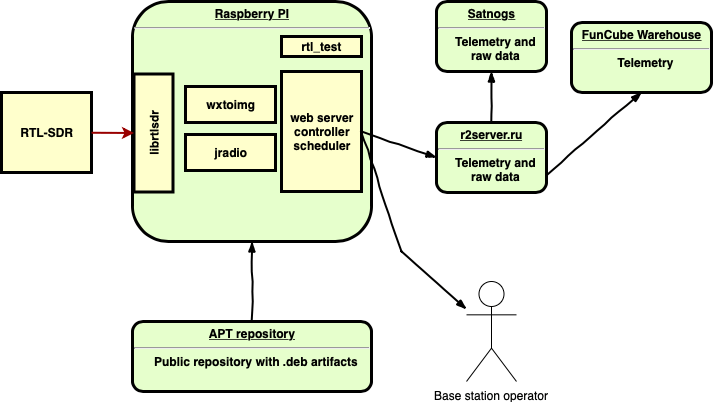
Thanks to a tweet by @rf_hacking we recently came across an interesting project called "r2cloud". This is an open source program provided on a ready to use image for the Raspberry Pi that can be used to set up an automated satellite recording station for NOAA APT and Meteor LRPT signals, as well as for CubeSats.
The software presents a web based user interface that is easy to setup and view decoded images on. It appears that the software also communicates with a public server that can aggregate and log your data, and also provide it to SatNOGS and provide FunCube satellite telemetry to FunCube Warehouse.
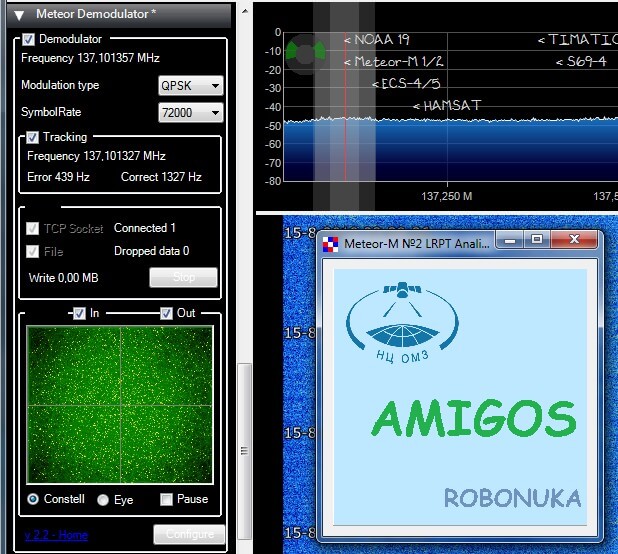
Thanks to Happysat for providing info on updates to these programs again. Meteor Demodulator V2.2 is a plugin for SDR# that connects to the M2 LRPT Decoder software. Together with an RTL-SDR and 137 MHz satellite antenna, these programs are used to receive, track, demodulate and decode Meteor M satellite signals into live weather satellite images. Happysat has a tutorial available here, however we note that at the time of this post it hasn't been updated to use the latest software versions.
The biggest change appears that you can now affect the decoder settings from within the SDR# plugin. This is useful because the METEOR M2-2 satellite appears to be changing it's operating mode often (number of infrared vs visible channels, data rate etc).
We also note news from Happysat that the Meteor M-N2-2 satellite has now changed frequency to 137.100 MHz mode 72K on 16 Aug. 9:30 Moscow time (6:30 UTC). Other users have also indicated that M2-2 is currently transmitting two IR channels, and one visible now. Meteor M2 appears to still be transmitting visible channels.
M2 LRPT Decoder V47:
- Added Meteor Demodulator V2.2 socket support
- only mode, sat, rgb are supported so far.
- Fix manual s-file processing
By design, the plug-in will manage the settings of the decoder and this should reduce the number of settings that must be done when changing the Meteor operating modes.
Example scheduler options:
M2_decoder_init_Line <rgb=123.jpg> or (rgb=125,444,555 ect)
In order for the decoder to work with Meteor Demodulator V2.2 http://happysat.nl/meteor_2.2.zip , the ini-file mode and sat entries must be assigned to auto!
Added interaction with Meteor LRPT-Decoder via socket.
At the beginning of the data transmission, the configuration of the modulation speed and modulation type (satellite name) is transmitted to the decoder.
That is, there is no need to change the decoder settings when changing 72K / 80K and M2 / M2.2.
It will receive signal information from the plugin.
It is enough to change the speed in the scheduler.
A new scheduler command "M2_decoder_init_Line <>" has been added to the plugin.
Using it, you can transfer any commands that are in the ini file of the decoder (for example, the command to select channels to save a color picture:
M2_decoder_init_Line <rgb = 123.jpg>)
In general, this allows you to change the settings when changing the reception conditions only in the scheduler and not in the entire chain of programs for processing the signal from the satellite.
M2 decoder compatible with these functions is >V47
If you've been following our blog, or have your own RTL-SDR based weather satellite station, then you'll know that the NOAA-15 APT satellite has been experiencing issues lately. There appear to be problems with it's camera scan motor resulting from it running low on lubrication. This is fully understandable as the satellite is 21 years old and well past it's expected life span. The satellite appears to be working some days, and producing garbage image other days.
When NOAA-15 fails for good, don't feel too bad as we still have NOAA-18 and NOAA-19, the Russian Meteor M2, and Meteor M2-2 satellites, and the GOES satellites, all of which can be received by an RTL-SDR. Several new weather satellites are also planned for 2020 and onwards.
Thank you to Happysat for submitting the following information about the updated LRPT decoder for Meteor M-N2-2. He has also provided a link to his very useful Meteor Satellite reception tutorial.
Today the official LRPT-Decoder V42 ready for release :)
Before we did use a older internal debug version from 2014, because this one was still in development.
This version 42 of LRPTDecoder will work with both Meteor M-N2 and Meteor M-N2-2.
Example ini configuration files for other modes are attached in the archive.