Category: Amateur Radio

RTL-SDR Live Discussion Net at 8pm EDT Tonight

Over on Reddit amateur radio hobbyist K2RWF has posted about a live discussion and QA session that he and some others will be having on a amateur radio net about RTL-SDR dongles. The discussion begins at 8PM EDT (about 2 hours from time this is posted) and will run for about an hour. For non-hams the discussion can be streamed live from http://rfissel.no-ip.biz:8080/stream.m3u. On the post K2RWF writes:

We had a pretty successful net last week regarding the RTLSDR sticks that are now widely available. We’ve decided to make the net a weekly occurrence for the time being, every Wednesday at 8 pm.

Tonight, we will be covering basic setup and configuration of the sticks from a software and hardware perspective, answering any questions you may have about getting up and running.

The net originates on W2LI, and tonight, we will be linked to the W2NJR repeater network, covering NJ and parts of NYC. This includes Echolink (21005) and IRLP (4935) capabilities for those wishing to participate from outside the area. The net beings at 8 pm EDT, and is expected to run for about one hour.

All are welcome, from newbies through advanced users. For non hams wishing to participate, you may stream the net using the link provided below. We will also be monitoring this thread to yield and answer questions from the r/rtlsdr community.

http://rfissel.no-ip.biz:8080/stream.m3u

Update: Recording of the net can be downloaded here (mp3)

Teensy SDR Updates and User Interface Demo

Last year in April we posted about the Teensy SDR, which is a SDR project that involves running a SoftRock SDR on a Teensy 3.1 Microcontroller. The Teensy is a tiny microcontroller board that uses a 32-bit ARM processor and the SoftRock SDR is a HF only software defined radio kit that is capable of RX and TX. Back then the Teensy SDR has no enclosure and the user interface hadn’t been finished.

In his latest YouTube videos, creator of the Teensy SDR rheslip20 (aka VE3MKC) shows his latest improvements to the project and in the second video shows off the user interface. In the future he hopes to implement TX capability too.


Teensy SDR User Interface Demo - Tuning around the bands

Low Pass Filter for RTL-SDR Direct Sampling Mode

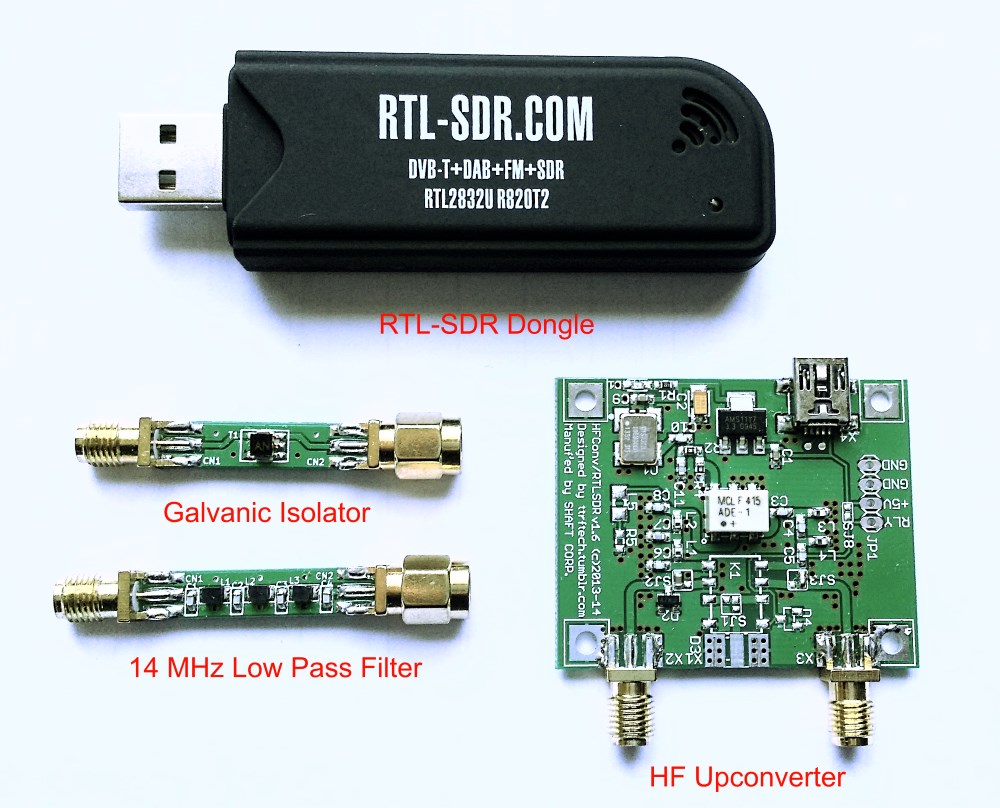
Over on his blog (in Japanese) Nobu has been working on prototyping a 14 MHz low pass filter (LPF) product for direct sampling modified RTL-SDR dongles (in Japanese, use Google Translate). Direct sampling mode is a hardware modification that allows the tuner chip in RTL-SDR dongles to be bypassed, allowing reception of signals between 0 – 14 MHz. However, after performing this mod there is no filtering and images from higher frequencies such as broadcast FM can be problematic. To fix these problems a low pass filter is required.

Another product Nobu is working on is an isolation transformer (aka Galvanic Isolator) which can be used together with an upconverter to help reduce noise generated from common ground sources such as the PC. The isolation transformer is inserted between an upconverter and antenna.

Low Pass Filter (Top), Isolation Transformer (Bottom)

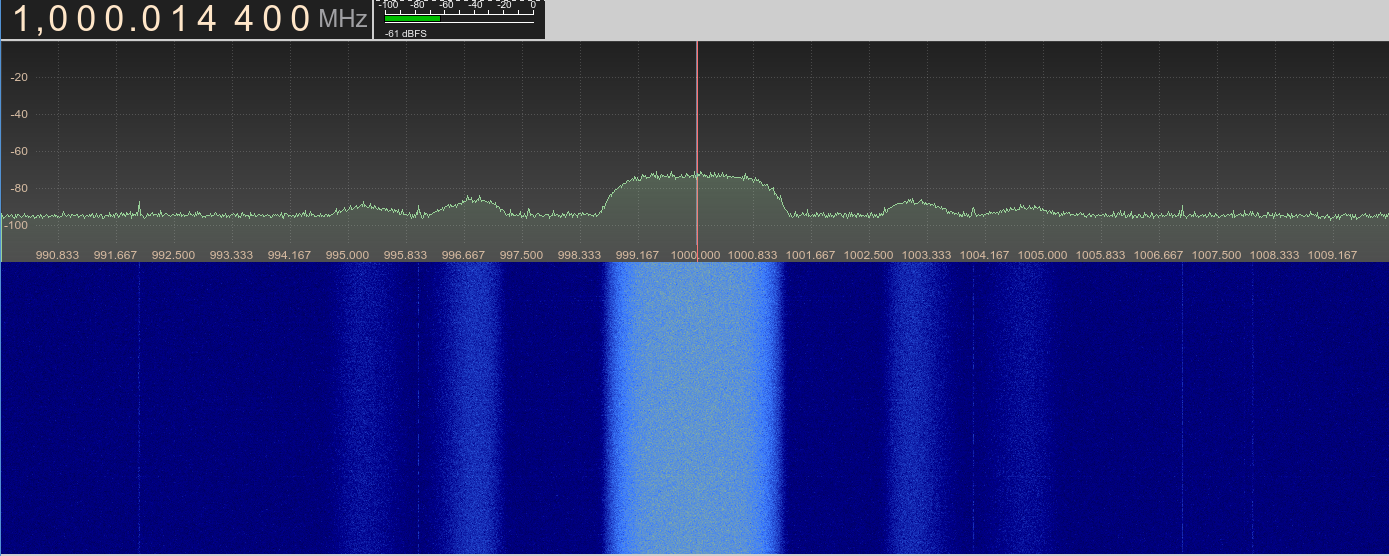
In the image below Nobu shows the effect of inserting the LPF . An interfering FM broadcast band signal is removed after inserting the LPF.

Effect of inserting the Low Pass Filter

The image below shows the effect of the isolation transformer showing a clear decrease in noise floor and increase in signal strength.

Effect of an Isolation Transformer when used with an Upconverter

Using a Quantum Phaser to Null Out Interfering Signals

Over on YouTube user kugellagers has uploaded several videos showing how he used two vertical antennas together with an RTL-SDR and ham-it-up upconverter to demonstrate the effect of using a Quantum Phaser to null out strong interfering signals that can cause trouble when DXing.

A Quantum Phaser is a device that combines signals from two antennas in order to create a steerable null. Essentially this means that a strong nearby station coming from one direction that is overlapping a weak remote station coming from another direction can be heavily attenuated, allowing the weak station to come through.

In his videos kugellagers demonstrates the Quantum Phasers nulling effect with splatter from an AM station, an overlapping IBOC hash signal (AM HD Radio) and Non-Directional Beacons (NDBs).

Phasing Out Splatter From a 50 kW Local On Adjacent Channel

Phasing Out IBOC Hash From A Strong Local On Adjacent Channel

Phasing out LF/NDBs With Closely Spaced Vertical Antennas

Linux Command Line based Doppler Correction and Demodulation Tools

Programmer Andres has recently been working on creating a toolset for receiving AX.25 packets (FSK 9600) from satellites with an RTL-SDR or other software defined radio. The AX.25 protocol is commonly used for APRS packet radio or telemetry in amateur radio satellites. Andres’ programs focus on using a true UNIX philosophy of piping data between different programs. The toolset consists of doppler correction and demodulation tools and the piping philosophy is demonstrated in the following example:

rtl_sdr | doppler | demod | multimon-ng

Andres writes…

rtl_sdr receives raw IQ data from satellites which is then piped to “doppler” which corrects doppler offset. Zero centered baseband signal is piped to “demod” which outputs demodulated audio suitable for multimon-ng to do actual AX.25 packet decoding.

Such pipeline is intended for resource constrained embedded platforms like RaspberryPi or BeagleBoneBlack where running full blown SDR software would be too much.

The doppler corrector tool works by using the same libraries for calculating satellite positions as those used in Gpredict and the demod tool uses the liquid-dsp library to demodulate the IQ stream.

More information about Andres’ project can be found in these three blog posts that he has written.

Andres also writes that he would be interested in hearing any feedback or pull requests on GitHub for these tools.

How to Receive the Funcube Satellite with an RTL-SDR

Over on the Hamspirit.de blog author Jan as written a post explaining how to receive the FUNcube satellite with an RTL-SDR dongle (note in German, use Google translate). The FUNcube is a CubeSat (a low cost miniature 10 cm cube sized satellite) which is intended mainly for educating young people about radio, space, physics and electronics, but has also piqued the interest of amateur radio hobbyists.

Jan first writes how the Funcube Dongle was originally invented as a low cost means of receiving the FUNcube satellite, but now there are the even lower cost RTL-SDR dongles. Jan’s post then goes over how to receive the FUNcube at a frequency of 145.935 MHz using software such as SDR-Radio or SDR# and how to decode the telemetry data using the FUNcube dashboard. He also explains a bit about the FUNcubes operating modes which change the satellites transmission strength depending whether or not its solar panels are in sunlight or not.

Funcube Telemetry Dashboard

The International Space Station is Transmitting SSTV Images

Happysat, a reader of RTL-SDR.com has written in to remind us that the International Space Station (ISS) is currently transmitting slow scan television (SSTV) images out of respect of the 80th birthday of Russian cosmonaut and first man to go to space Yuri Gagarin. The images will be transmitted continuously until 24 February 21.30 UTC.

SSTV is a type of radio protocol that is used to transmit low resolution images over radio. A RTL-SDR dongle and satellite antenna (QFH, turnstile, even terrestrial antennas like random wire antennas and monopoles have been reported to work) can be used to receive and decode these images. Happysat writes that it is expected that the ISS will continuously transmit 12 images at a frequency of 145.800 MHz FM using the SSTV mode PD180, with 3 minute off periods between each image.

To decode the images it is recommended to use SDR# and pipe the audio into MMSSTV, a freeware SSTV decoding software program. To get the best results out of MMSSTV happysat recommends enabling “Auto slant” and “Auto resync” under Options->Setup MMSTV->RX.

To know when the ISS is overhead you can track it online using http://spotthestation.nasa.gov/sightings/http://www.isstracker.com/ or http://www.mcc.rsa.ru/English/trassa.htm.

Received SSTV images can be submitted to the ARISS Gallery, and Happysat has also uploaded a collection of his own personal received images here.

Happysat also shows us some images from the ISS showing the Kenwood D710 transceiver located in the Russian service module, the computers used to generate the SSTV signal and the antennas used for amateur radio transmission.

One of the broadcast SSTV images from the ISS
One of the SSTV images broadcast from the ISS
Computers on the ISS used to transmit SSTV images
Antennas on the ISS used to transmit SSTV images

PortableSDR now on Kickstarter

Back in November, 2014 we posted about the PortableSDR, a 0 – 35 MHz portable software defined radio transceiver that was the third place winner in the Hackaday Prize competition. The PortableSDR project is gaining traction and now has a Kickstarter campaign. They write:

The Portable Software Defined Radio, or PSDR, is an Open Source, Fully stand-alone HF/Shortwave Software Defined Transceiver. It includes a Vector Network Analyzer and Antenna Analyzer as well as GPS. It’s built for rugged portable use. It is designed to be a flexible platform for development, a learning aid, and and a useful instrument for electronics enthusiasts.

Features:

  • Coverage from 0 to 35MHz
  • Waterfall display that lets you see radio signals
  • Receives AM, USB (Upper Side Band), LSB (Lower Side Band), and Morse code (CW)
  • Modulates USB and LSB signals
  • Variable bandpass filter

The campaign hopes to raise $60,000 USD to aid in the development of the hardware and software and with the manufacturing process. The kickstarter is offering kits at various stages of completion from $250 to $475 and a fully assembled kit at $499. They note that the current PSDR2 that you will receive from the Kickstarter is still a development version, not the final product. The PSDR2 is missing some key features that will be in the final version like filters and output amplifiers.

The PSDR v.1
The PSDR v.1
PortableSDR - 2014 Hackaday Prize Judge Recap